Introduction
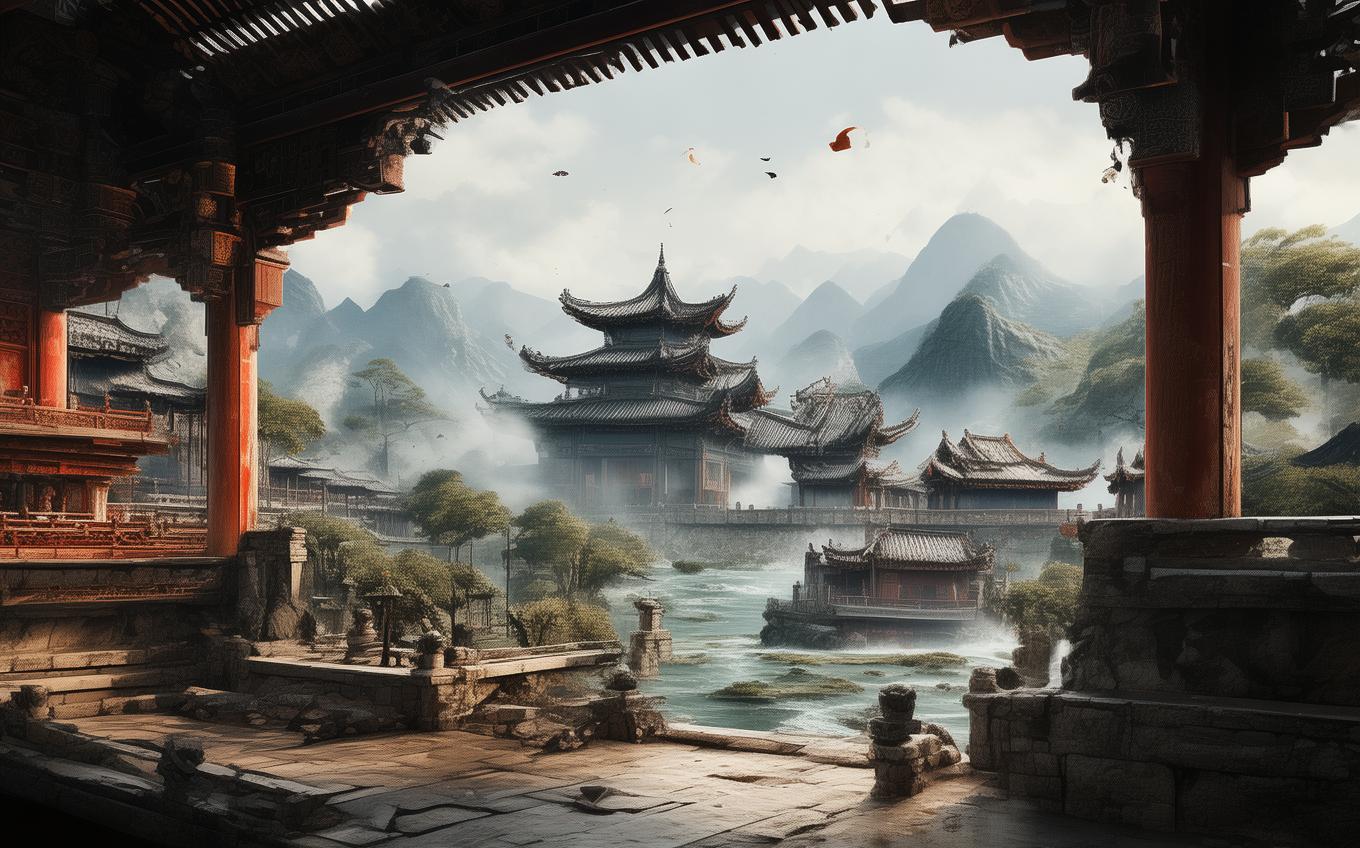
Li Bai (701–762), also known as Li Po, is one of the most celebrated poets in Chinese literary history. A wanderer at heart, he combined a Daoist love of nature with a profound sensitivity to the spiritual and the sublime. His poem “谒大慈恩寺” (Visiting the Temple of Great Mercy and Kindness) was written during a visit to the famous Big Wild Goose Pagoda in Chang’an (modern Xi’an), the glorious capital of the Tang Dynasty. The pagoda stood within the temple complex of Ci’en, a center of Buddhist learning. This poem is a masterful blend of landscape description, religious reflection, and cosmic grandeur, showcasing Li Bai’s unique ability to fuse physical elevation with spiritual aspiration. It remains one of the finest poetic depictions of a Buddhist monument in classical Chinese verse.
The Poem: Full Text and Translation
塔势如涌出,孤高耸天宫。
Tǎ shì rú yǒng chū, gū gāo sǒng tiān gōng.
The pagoda’s force is like a sudden surging forth; solitary and lofty, it soars to the Celestial Palace.
登临出世界,磴道盘虚空。
Dēng lín chū shì jiè, dèng dào pán xū kōng.
Climbing up, I leave the world behind; the stone steps twist and coil through the void.
突兀压神州,峥嵘如鬼工。
Tū wù yā shén zhōu, zhēng róng rú guǐ gōng.
Towering sharply, it bears down upon the Divine Land; precipitous, as if shaped by ghostly hands.
四角碍白日,七层摩苍穹。
Sì jiǎo ài bái rì, qī céng mó cāng qióng.
Its four corners block the bright sun; its seven storeys brush the blue firmament.
下窥指高鸟,俯听闻惊风。
Xià kuī zhǐ gāo niǎo, fǔ tīng wén jīng fēng.
Looking down, I point at the high-flying birds; bending my ear, I hear the startled wind.
连山若波涛,奔凑似朝东。
Lián shān ruò bō tāo, bēn còu sì cháo dōng.
The mountain ranges roll like billows, rushing together as if surging toward the east.
青槐夹驰道,宫观何玲珑。
Qīng huái jiā chí dào, gōng guàn hé líng lóng.
Green locust trees line the imperial avenue; palaces and temples, how exquisitely wrought!
秋色从西来,苍然满关中。
Qiū sè cóng xī lái, cāng rán mǎn guān zhōng.
Autumn’s glow arrives from the west, a vast azure overwhelming the Pass’s heartland.
五陵北原上,万古青濛濛。
Wǔ líng běi yuán shàng, wàn gǔ qīng méng méng.
On the northern plain, the Five Tombs lie; for endless ages, a misty, eternal green.
净理了可悟,胜因夙所宗。
Jìng lǐ liǎo kě wù, shèng yīn sù suǒ zōng.
The pure truth now becomes clear and comprehensible; the noble cause I have long held in my heart.
誓将挂冠去,觉道资无穷。
Shì jiāng guà guān qù, jué dào zī wú qióng.
I vow to hang up my official cap and depart; the path of enlightenment offers inexhaustible reward.
Line-by-Line Analysis
Li Bai opens with a dramatic, almost cinematic image: the pagoda seems to burst upward like a geyser (“如涌出”). The verb “涌” (surge, gush) suggests an irresistible natural force, not a static building. The adjective “孤高” (solitary and lofty) immediately sets it apart from mundane surroundings, connecting it to heaven. The reference to “天宫” (Celestial Palace) introduces a Daoist-tinged cosmology, blending Buddhist and native Chinese imagery.
Climbing the pagoda becomes a metaphysical journey. “出世界” literally means “going beyond the world,” implying a detachment from earthly concerns. The twisting “磴道” (stone steps) “盘虚空” (coil through the void) adds a sense of precarious suspension, as if the ascent were through pure space.
The next couplet uses strong, towering language: “突兀” (towering) and “压神州” (bears down upon the Divine Land, a poetic name for China). The structure is so immense it seems to dominate the entire country. “峥嵘如鬼工” calls the craftsmanship superhuman, perhaps even demonic, echoing a Chinese trope that truly awe-inspiring works must be of non-human origin.
Sunlight and sky are physically obstructed: “四角碍白日” (corners block the sun) and “七层摩苍穹” (seven storeys scrape the heavens). The pagoda’s seven levels correspond to Buddhist symbolism (seven steps of the Buddha, etc.), but here Li Bai emphasizes sheer height. From the top, birds that normally fly high are now below; the wind becomes a startling sound, accentuating the isolation and extreme altitude.
The panoramic view sweeps from the mountain ranges like ocean waves rushing eastward to the imperial capital below. The imagery of mountains as waves (“若波涛”) is a classic Li Bai hyperbole, compressing vast distances into a single dynamic vision. “青槐夹驰道” (green locust trees lining the avenue) grounds the scene back in Chang’an’s orderly grandeur, while “宫观何玲珑” (how exquisitely wrought) admires man-made splendor.
Autumn’s arrival from the west carries philosophical weight. In Chinese thought, west is associated with metal, autumn, and the fading of life, yet Li Bai describes it as “苍然满关中” – an intense blue-green fullness spreading across the Guanzhong region. This leads his gaze to the “五陵” (Five Tombs), burial mounds of Han emperors on the northern plain, now covered in timeless, misty green. History and nature intermingle; human glory becomes a vague, enduring haze.
The final four lines shift to direct spiritual reflection. “净理” (pure truth or pure principle) is a Buddhist-inspired concept of the underlying reality. The poet claims he can now grasp it clearly, and “胜因夙所宗” – the noble cause (enlightenment, renunciation) he has always honored – comes to the fore. The concluding vow to “挂冠” (hang up the official cap) is a conventional gesture of resigning from worldly office, but here it carries genuine weight because the vision from the pagoda has shown him the transience of earthly power. “觉道资无穷” promises that the path of enlightenment offers endless spiritual nourishment.
Themes and Symbolism
The central theme is spiritual ascent, both literal and metaphorical. The climb up the pagoda mirrors the journey toward enlightenment: leaving the ordinary world, passing through voids, and finally gaining a transcendent perspective. Nature’s grandeur is another key theme; Li Bai turns mountains into waves and autumn light into a cosmic presence, dwarfing human affairs. Impermanence appears in the image of the ancient tombs, now only a misty green – all emperors return to dust, but nature and spiritual truth endure.
The pagoda itself is a symbol of Buddhist aspiration, stretching between earth and heaven. The number seven (storeys) alludes to Buddhist cosmology. The “五陵” (Five Tombs) symbolize worldly power and its ultimate fading. Autumn, though a season of decline, is depicted as a vast, pervading color – symbolizing the all-encompassing nature of Daoist/Buddhist emptiness that transcends simple decay. The act of “挂冠” (hanging up the cap) becomes the symbol of liberation from political life.
Cultural Context
The Great Ci’en Temple and its Big Wild Goose Pagoda were built in the mid-7th century under Emperor Gaozong to honor his mother. The pagoda housed sutras brought from India by the monk Xuanzang, a symbol of cultural and religious exchange along the Silk Road. By Li Bai’s time (mid-8th century), Chang’an was the world’s largest city and a cosmopolitan hub where Buddhism, Daoism, and Confucianism coexisted. Poets often visited the pagoda to compose verses, and the climb became a trope for elevated vision.
Li Bai’s poem reflects a syncretic worldview: Buddhist temple, Daoist vocabulary (“天宫”, “虚空”), and Confucian resignation from office. The Tang dynasty was at its peak, but the poet’s withdrawal hints at the political instability that would later erupt in the An Lushan Rebellion. Thus, the poem captures both the splendor of the age and a personal yearning for transcendence beyond its troubled glory.
Conclusion
“谒大慈恩寺” is a brilliant fusion of scenic description, philosophical meditation, and subtle political disengagement. Li Bai’s language soars as high as the pagoda he climbs, sweeping from the solid stone steps to the boundless autumn sky. For English-speaking readers, the poem offers a window into the Tang Dynasty’s spiritual landscape – a world where a tower could be a bridge to enlightenment, and a view could change a life. Its enduring beauty lies in that moment of luminous clarity when the poet looks down upon a glorious empire and recognizes, in the misty tombs, the quiet call of a path beyond power. More than a travelogue, this poem is an invitation: climb, see, and perhaps let go.
Comments (0)
No comments yet. Be the first to comment!