Analysis of “温汤对雪” – Classical Chinese Poetry
Introduction
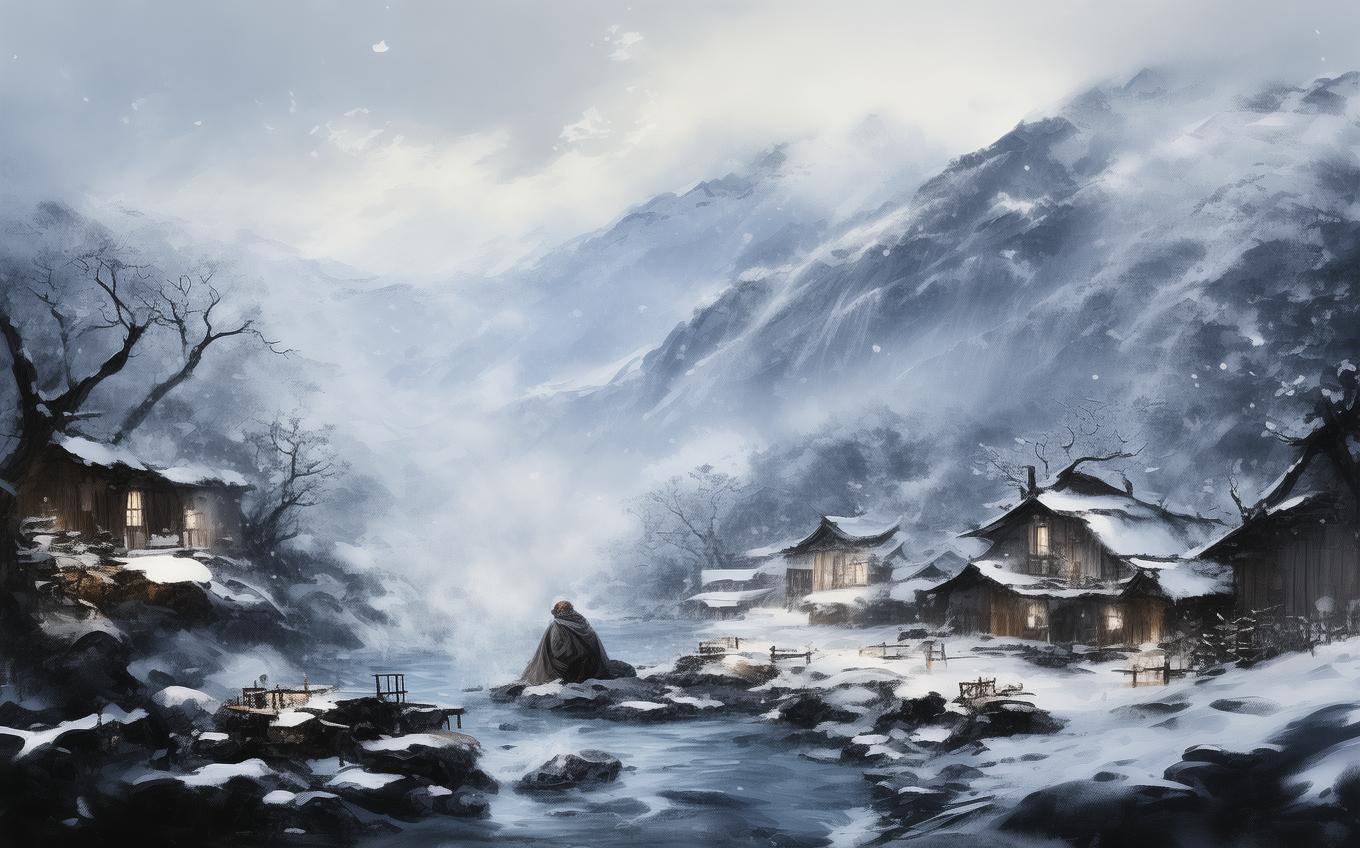
Emperor Xuanzong of Tang (唐玄宗, personal name Li Longji, reigned 712–756 CE) was not only one of the most celebrated rulers of China’s golden age, but also a cultivated poet, calligrapher, and patron of the arts. His long reign witnessed the pinnacle of Tang cultural brilliance, yet it ended in the tragedy of the An Lushan Rebellion. The poem “温汤对雪” (Wēn Tāng Duì Xuě – Facing Snow at the Hot Springs) belongs to the earlier, prosperous decades of his rule, when the imperial court often retreated to the hot springs of Huaqing Palace (华清宫) near Chang’an to escape winter’s bite. Written during such a snow-dusted sojourn, this short lyric captures an emperor’s private moment with nature – at once a meditation on the forces of cold and heat, and a quiet reflection on cosmic harmony. Though less famous than works by Li Bai or Du Fu, the poem offers a rare glimpse into the mind of an imperial poet and the elegant simplicity of occasional verse at the Tang court.
The Poem: Full Text and Translation
北风吹同云,
Běi fēng chuī tóng yún,
The north wind blows the thick, uniform clouds;
同云飞白雪。
Tóng yún fēi bái xuě.
The thick clouds release a flight of white snow.
白雪乍回散,
Bái xuě zhà huí sàn,
The white snow suddenly whirls and scatters;
同云何惨烈。
Tóng yún hé cǎn liè.
How bleak and fierce those uniform clouds are!
未见温泉冰,
Wèi jiàn wēn quán bīng,
Never have I seen the hot springs freeze;
宁知火井灭。
Nìng zhī huǒ jǐng miè.
How then could one know if fire wells went out?
表瑞良在兹,
Biǎo ruì liáng zài zī,
The auspicious omen truly lies right here;
庶几可怡悦。
Shù jī kě yí yuè.
Perhaps this may bring us some delight.
Line-by-Line Analysis
“北风吹同云,同云飞白雪。”
The poem opens with a stark, kinetic image: the north wind driving a solid, leaden mass of cloud (同云, literally “same cloud” or “uniform cloud,” often a classical expression for a sky evenly covered with snow clouds). The repetition of 同云 (tóng yún) from the first line to the second creates a drumbeat effect – the clouds are at first passive, then become active agents that “fly” the snow. The verb 飞 (fēi) suggests that the snowflakes are not drifting but bursting forth, almost as if the clouds themselves are tearing apart into flecks of white. Here, the Emperor observes nature not as a distant painter but as a witness to raw elemental motion.
“白雪乍回散,同云何惨烈。”
The snow’s sudden whirling and scattering (乍回散) introduces instability: beauty is fleeting, order can dissolve in an instant. The question “何惨烈” (how bleak and fierce) is partly rhetorical wonder, partly existential shiver. The clouds that only moments ago were simply “uniform” now strike the viewer as merciless. This shift from neutral description to emotional judgment is deeply characteristic of classical Chinese poetry – landscape becomes mood. The emperor, wrapped in the warmth of the hot spring palace, gazes outward and feels the violent chill as a stark contrast, perhaps a reminder of forces beyond imperial control.
“未见温泉冰,宁知火井灭。”
A philosophical turn. The hot spring (温泉) is naturally immune to freezing; by analogy, one can only know an underground fire (火井, literally “fire well,” referring to natural gas vents or volcanic phenomena) has gone out if its heat ceases. The couplet poses an epistemological riddle: without contrast, how can we perceive permanence? The hot spring, symbolic of the emperor’s enduring virtue or the vitality of the state, never freezes – so how would one know if the cosmic fire were extinguished? This suggests both comfort and hidden anxiety. The ruler, sitting at the warm center, acknowledges that his knowledge of the world’s extremes is limited.
“表瑞良在兹,庶几可怡悦。”
Snow was traditionally seen as an auspicious sign (瑞, ruì) in agrarian China, promising a good harvest. By calling it a 表瑞 (manifested omen), the emperor places the scene in a cosmological frame: the snow is a blessing from Heaven. The final line is tentative – 庶几 (shù jī, “perhaps, hopefully”) betrays that even an imperial observer finds joy not as a certainty but as an aspiration. The poem closes on a note of gentle optimism, the sovereign choosing to read the bleak snowstorm as a gift, and turning his gaze from the harsh clouds to the promise of renewal.
Themes and Symbolism
Nature’s Duality
The poem pivots on the interplay of cold and heat, movement and stillness, violence and grace. The north wind and fierce clouds embody nature’s harsh majesty, while the hot spring and the auspicious snow represent warmth, stability, and cosmic beneficence. Together they mirror the Daoist concept of yin and yang in constant, productive tension.
Imperial Perception
Written from the viewpoint of an emperor in his retreat, the poem subtly reflects the distance between the throne and the raw world. The ruler sees the storm from inside warmth, contemplates the unseen fire well, and deliberately reframes the snow as a blessing. This is both a personal aesthetic act and a political gesture – transforming potential threat into state-supporting omen.
Hot Spring and Fire Well
The hot spring is a central symbol of constancy and life-force. Not freezing, it suggests an eternal, geothermal vitality. The “fire well” extends this geothermal imagery, hinting at the hidden energies that sustain the realm. In Tang poetry, imperial hot springs often carried overtones of Daoist paradises and alchemical immortality; here they serve as a quiet anchor against the transient storm.
Auspicious Snow
In Chinese tradition, snow is a portent of good harvest and divine approval. By explicitly labeling it 表瑞, the emperor invokes the long-standing belief that Heaven communicates with the ruler through natural signs. The poem thus enacts a ritual reading of the landscape – the right interpretation brings joy and legitimizes the sovereign.
Cultural Context
Emperor Xuanzong’s court was a universe of refined sensibility, where poetry was both an elegant pastime and a mark of cultivated rulership. The Huaqing Palace hot springs, nestled at the foot of Mount Li, had been an imperial spa since the Zhou dynasty, but reached legendary status during Xuanzong’s reign, not least because of his romance with Yang Guifei. While this poem predates that affair’s tragic unraveling, it belongs to the same world of courtly leisure, art, and the aestheticization of nature.
The Tang dynasty embraced a syncretic worldview blending Confucian statecraft, Daoist nature philosophy, and Buddhist impermanence. An emperor composing a snow-gazing poem was participating in a cultural ideal: the sage-king who harmonizes with the cosmos, reads Heaven’s signs, and expresses his understanding through graceful verse. The tentative joy at the end – 庶几可怡悦 – also reflects a Confucian caution against excess, even in delight. The ruler must remain humble before Heaven.
Conclusion
“温汤对雪” is a deceptively slight poem that ripples with subtle meaning. In just eight lines, Emperor Xuanzong moves from meteorological observation to philosophical question to a quiet affirmation of cosmic order. The imagery – wind-lashed clouds, swirling snow, steadfast hot spring, hidden fire – becomes a mirror for the human condition and the ruler’s particular burden of seeking auspiciousness amid ambiguity. For a modern reader, its appeal lies in this blend of immediate sensory power and timeless reflection. We may not preside over hot springs or read omens for an empire, but we still stand at windows, watching storms, hoping that what seems bleak might actually be a gift. In that shared moment of facing snow with open eyes, the emperor’s voice reaches across twelve centuries, inviting us to find joy, 庶几可怡悦.

Comments (0)
No comments yet. Be the first to comment!