Introduction
The phrase “过王濬暮” almost certainly refers to “过王濬墓” (Guò Wáng Jùn Mù), meaning “Passing by Wang Jun’s Tomb.” Wang Jun (王濬, 206–286 CE) was a celebrated Jin dynasty general who engineered the naval conquest of Eastern Wu in 280, ending the Three Kingdoms period. His tomb, located near present-day Lingbao in Henan, became a natural place for poets to reflect on the rise and fall of empires. Although several Tang poets wrote verses titled “Passing by Wang Jun’s Tomb,” the most famous poem woven around Wang Jun’s legacy – and repeatedly anthologized in Chinese literature courses – is Liu Yuxi’s (刘禹锡, 772–842) masterpiece “西塞山怀古” (Xīsài Shān Huái Gǔ, “Thoughts of the Past at Xisai Mountain”). While not literally titled “过王濬墓,” the poem uses Wang Jun’s military miracle as its entrance into a meditation on history, drawing the reader to the very ground where the general’s memory haunts the landscape. This article will take you through Liu Yuxi’s poem as a perfect lens for understanding how a single warrior’s tomb became a doorway to the Chinese historical imagination.
The Poem: Full Text and Translation
Liu Yuxi’s regulated verse in seven-character lines is a model of evocative economy. Here is the full poem, followed by its pronunciation and a faithful English rendering.
王濬楼船下益州
Wáng Jùn lóu chuán xià Yìzhōu
Wang Jun’s towered warships sailed down from Yizhou,金陵王气黯然收
Jīnlíng wáng qì ànrán shōu
The royal aura over Jinling faded dimly away.千寻铁锁沉江底
Qiān xún tiě suǒ chén jiāng dǐ
Thousand-fathom iron chains sank to the riverbed,一片降幡出石头
Yī piàn xiáng fān chū Shítóu
A single flag of surrender emerged from Stone Fortress.人世几回伤往事
Rénshì jǐ huí shāng wǎngshì
In human affairs, how many times have we grieved over bygones?山形依旧枕寒流
Shān xíng yījiù zhěn hán liú
The mountain’s shape still rests its head upon the cold current.今逢四海为家日
Jīn féng sì hǎi wéi jiā rì
Now we meet the day when all within the four seas are one family,故垒萧萧芦荻秋
Gù lěi xiāoxiāo lúdí qiū
But old ramparts rustle with reeds and rushes in the autumn.
Line-by-Line Analysis
Lines 1–2: The Conquest Set in Motion
“Wang Jun’s towered warships sailed down from Yizhou, / The royal aura over Jinling faded dimly away.”
Liu Yuxi opens not with a tomb but with the thunderous beginning of the end. Wang Jun, stationed in Yizhou (modern Sichuan), built massive multi-decked vessels – “楼船” (lóu chuán) – to float down the Yangtze and attack the Wu capital at Jinling (Nanjing). In just fourteen syllables, the poet compresses a whole military campaign: the phrase “下益州” conveys both geographical descent and the inexorable momentum of fate. The “royal aura” (王气, wáng qì) was believed to be a visible emanation of divine legitimacy. By saying it “faded dimly” (黯然收), Liu suggests that Wu’s mandate died the moment Wang Jun’s ships appeared – a stark, cinematic contrast between human action and cosmic will.
Lines 3–4: The Broken Defense and Surrender
“Thousand-fathom iron chains sank to the riverbed, / A single flag of surrender emerged from Stone Fortress.”
Wu had stretched enormous iron chains across the Yangtze to block warships, but Wang Jun’s men melted them with fire or broke them with rafts. The “千寻铁锁” (qiān xún tiě suǒ, a notably hyperbolic length – 1 xún ≈ 8 Chinese feet) represents not just physical barriers but the desperate, futile efforts to stop the turning of history. The sinking chains vanish into the river’s silence; immediately, “a single flag of surrender” (一片降幡) emerges from Stone Fortress (石头城, Shítóu Chéng), the symbolic heart of Wu’s defense. The balance of overwhelming force against a lone, pale banner accentuates the pathos of a state’s end.
Lines 5–6: The Mountain and the Sorrow of Human Time
“In human affairs, how many times have we grieved over bygones? / The mountain’s shape still rests its head upon the cold current.”
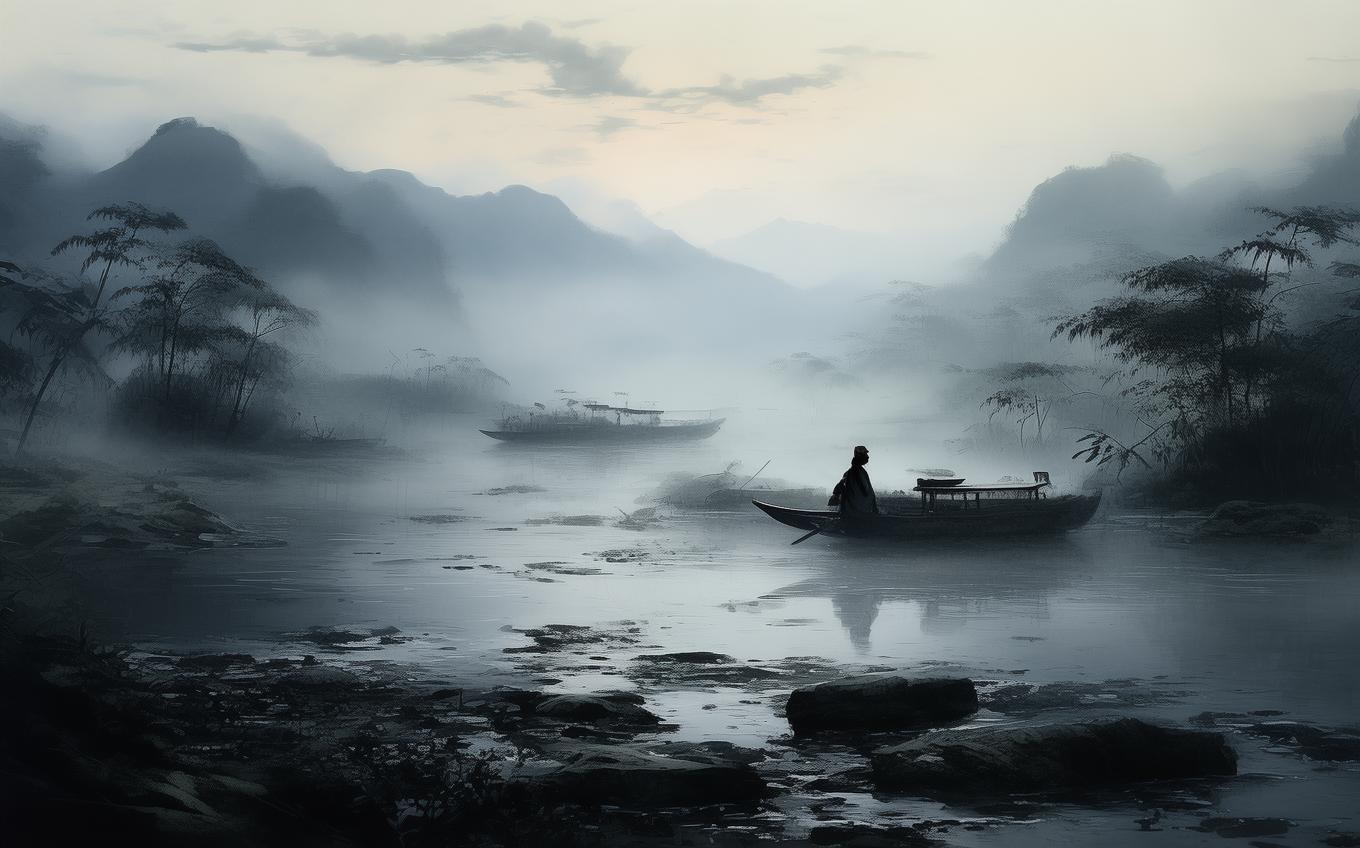
Now the poem pulls back. The poet stands at Xisai Mountain, a strategic spot on the Yangtze where Wang Jun once passed, and sees the landscape unchanged. “人世几回伤往事” is a rhetorical sigh: countless poets, soldiers, and passers-by have mourned the same vanished kingdoms. Yet the mountain – sleepless, indifferent – “rests its head upon the cold current” (枕寒流). The verb “枕” (zhěn, to pillow the head) anthropomorphizes the mountain, giving it a gentle, eternal composure that mocks human grief. The juxtaposition of warm sorrow and cold water is a signature Tang technique to evoke wúqíng (无情), the feeling that nature has no sentiments for our stories.
Lines 7–8: Present Unity and the Weeds of Time
“Now we meet the day when all within the four seas are one family, / But old ramparts rustle with reeds and rushes in the autumn.”
Liu Yuxi lived in a reunified Tang empire when “all within the four seas are one family” (四海为家). The phrase echoes the Confucian ideal of universal peace. Yet the poet does not cheer; he turns his gaze to the “故垒” (gù lěi), the ancient ramparts built during the Three Kingdoms wars. These earthworks, now overgrown with “萧萧芦荻” (rustling reeds and rushes), speak of the futility of man’s military glories. Autumn, the season of decline, colors the scene with a soft melancholy. Even in unity, the landscape remembers fragmentation. The tomb of Wang Jun is not named, but it is everywhere in the reeds that whisper over ruined fortifications.
Themes and Symbolism
The Impermanence of Power is the poem’s core subject. Wang Jun’s victory, so absolute in the first couplet, fades into archaeological litter by the final line. The “royal aura,” once so potent, is entirely a thing of the past. This is not just a political statement; it is a Buddhist-inflected meditation common in Tang poetry: all phenomena – even empires – rise and vanish.
Nature as the Eternal Witness is embodied in the mountain and the river. “山形依旧” (the mountain’s shape remains as before) is a quiet, terrifying phrase. While kings and ministers build navies and chains, the mountain does nothing and yet outlasts them all. This recalls the Daoist reverence for the uncarved block, the natural order that flows underneath human striving.
Xisai Mountain as a Memory Site functions as a huáigǔ (怀古, “meditating on antiquity”) landscape. Chinese poets routinely returned to places dense with historical ghosts, and Xisai Mountain – where chains were broken and ships passed – becomes a text written in topography. The reeds, the autumn air, the cold current: every element is a character in a story larger than one dynasty.
Symbols include:
- 楼船 (towered warships): human ambition and technical might, eventually as silent as the riverbed.
- 铁锁 (iron chains): futile resistance, the arrogance of thinking one can lock the flow of time.
- 降幡 (flag of surrender): the moment imperial dignity becomes a piece of silk, delicate and final.
- 芦苇 (reeds): the disenchanted present, nature reclaiming human borders.
Cultural Context
Wang Jun was instrumental in achieving the Jin reunification, but in the broader literary imagination, he often appears as a tool of larger forces. The Three Kingdoms era (220–280) was a period of legendary heroes and betrayals, immortalized in the 14th-century novel Romance of the Three Kingdoms. By Liu Yuxi’s time, the story of Wang Jun’s naval attack was already historical romance – the chains, the fires, the surrender at Stone Fortress – all part of a cultural memory that Tang poets loved to invoke.
Liu Yuxi himself was a politically active scholar-official, frequently banished for his reformist ideals. His huáigǔ poems are never purely academic; they are coded commentaries on his own era. The Tang dynasty, after the An Lushan Rebellion (755–763), struggled to maintain its grip. By noting that “now the four seas are one family,” Liu may be gently warning: unity is fragile, and the rustling ramparts of former divisions are never far away. The poem thereby weaves together personal melancholy, historical consciousness, and political caution.
The “tomb” dimension, though implicit, enriches the poem’s atmosphere. Wang Jun died with high honors, but his grave, like the old ramparts, would have been subject to time’s erosion. In the Chinese poetic tradition, visiting the tomb of a famous figure (a sub-genre called diào gǔ, “mourning the ancient”) is a standard occasion for reflecting on fame and mortality. Although Liu Yuxi does not explicitly stand at the burial mound, the feeling of passing by a place “where Wang Jun once was” performs the same elegiac work.
Conclusion
“西塞山怀古” may begin with warships and chains, but it ends in a whisper of autumn reeds. Liu Yuxi’s genius lies in transforming a local historical event into a universal sigh. For readers today, the poem remains a powerful reminder that even the mightiest victories decay into scenery. The grave of Wang Jun – whether literal or evoked – becomes a silent teacher: history is not over there, written in books; it is the very ground we walk on, the breeze that stirs the grass across old battlefields. By letting the mountain “rest its head upon the cold current” while we grieve, Liu Yuxi offers a gentle, stoic comfort – a view of time in which all of us are, in our own way, ships sailing down from Yizhou, soon to be reeds on an autumn bank.
Comments (0)
No comments yet. Be the first to comment!