
Introduction
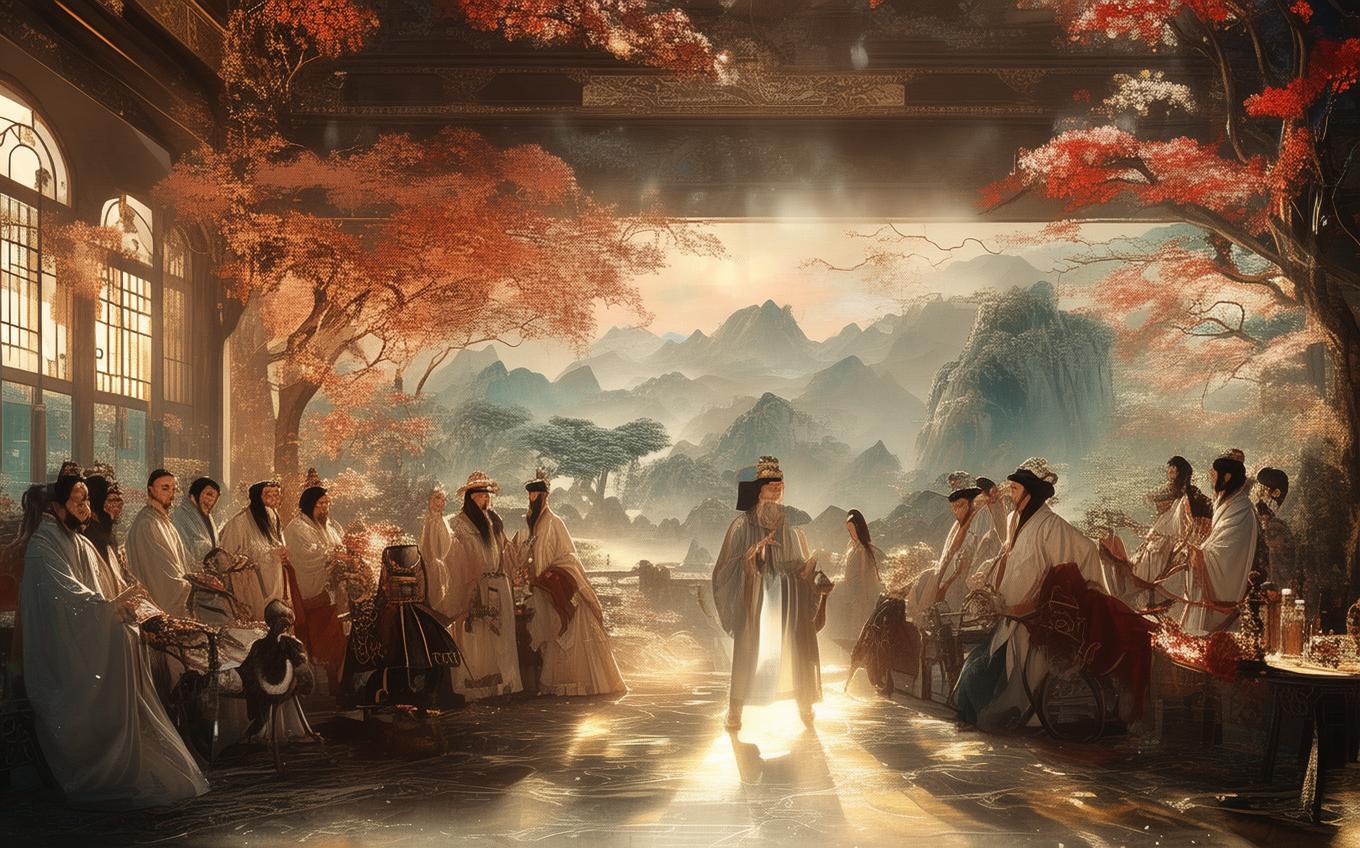
This poem, whose full title reads 《过大哥宅探得歌字韵》 (Guò Dà Gē Zhái Tàn Dé Gē Zì Yùn – “Passing by Elder Brother’s Residence, I Drew the Rhyme-Word ‘Ge’ ”), comes from the brush of Tang Xuanzong (唐玄宗, Emperor Xuanzong of Tang, also known as Li Longji 李隆基, r. 712–756). A ruler who presided over one of China’s most brilliant cultural eras, Xuanzong was himself an accomplished poet, musician, and patron of the arts. The poem was composed during a visit to his elder brother, Li Chengqi (Prince of Ning), the man who had renounced his own claim to the throne in Xuanzong’s favor. At such imperial family gatherings, it was a Tang custom to fēn yùn fù shī (分韵赋诗) – each participant would randomly receive a rhyme character and compose a regulated verse on the spot. Xuanzong drew the word 歌 (gē – “song”), and out of that playful constraint arose a poem that weaves together fraternal love, the joys of music, and a subtle meditation on virtuous rule. For English readers, this piece offers a rare window into how personal sentiment and political philosophy merged seamlessly in the heart of a Tang emperor.
The Poem: Full Text and Translation
The poem is a five-character regulated verse (五律, wǔ lǜ) of eight lines, each line containing five syllables. Below is the complete text with pinyin and a faithful English rendering.
鲁卫情先重
Lǔ Wèi qíng xiān zhòng
The bond like that of Lu and Wey was already weighty in our hearts,
亲贤爱转多
qīn xián ài zhuǎn duō
And love for my dear, worthy kin has only grown deeper.
冕旒丰暇日
miǎn liú fēng xiá rì
With the beaded crown’s leisure on this abundant free day,
乘景暂经过
chéng jǐng zàn jīng guò
I avail myself of the fine scene to pass briefly by.
戚里申高宴
qī lǐ shēn gāo yàn
In the noble relatives’ ward a grand feast is spread out;
平台奏雅歌
píng tái zòu yǎ gē
On the high terrace, elegant songs are performed.
复寻为善乐
fù xún wéi shàn lè
Once more I seek the joy found in doing good,
方验保山河
fāng yàn bǎo shān hé
And truly verify that this safeguards the mountains and rivers.
Line-by-Line Analysis
鲁卫情先重
The opening line reaches into classical history. Lu (鲁) and Wey (卫) were two feudal states of the Zhou dynasty, founded by brothers of King Wu, and renowned for their enduring fraternal bond. By saying that such a bond already had weight, Xuanzong was doing more than flattering his brother – he was planting the poem in a Confucian landscape where brotherly love is the root of social harmony. The adjective “重” (zhòng – heavy, weighty) suggests something deeply rooted, not taken lightly.
亲贤爱转多
Here the poet personalizes the historical allusion. “亲贤” (qīn xián) refers to his elder brother as both a blood relative and a person of virtue. The phrase “爱转多” (ài zhuǎn duō – “love has turned into even more”) carries a delicate temporal movement: time has not eroded affection but deepened it. This line also subtly praises Li Chengqi’s earlier act of yielding the throne, marking him as truly “worthy.”
冕旒丰暇日
“冕旒” (miǎn liú) is the imperial crown with its strings of jade beads – a synecdoche for the emperor himself. By mentioning it, Xuanzong acknowledges his own royal status yet immediately softens it with “丰暇日” (abundant leisure day). He is both the Son of Heaven and a younger brother taking a rare respite from governance.
乘景暂经过
“乘景” (chéng jǐng) means “riding on the beautiful scene” – seizing the moment of fine weather and mood. “暂经过” (zàn jīng guò – “briefly passing by”) underscores transience and humility. The emperor does not come with a grand procession; he simply drops in, as any brother might, savoring a fleeting hour of togetherness.
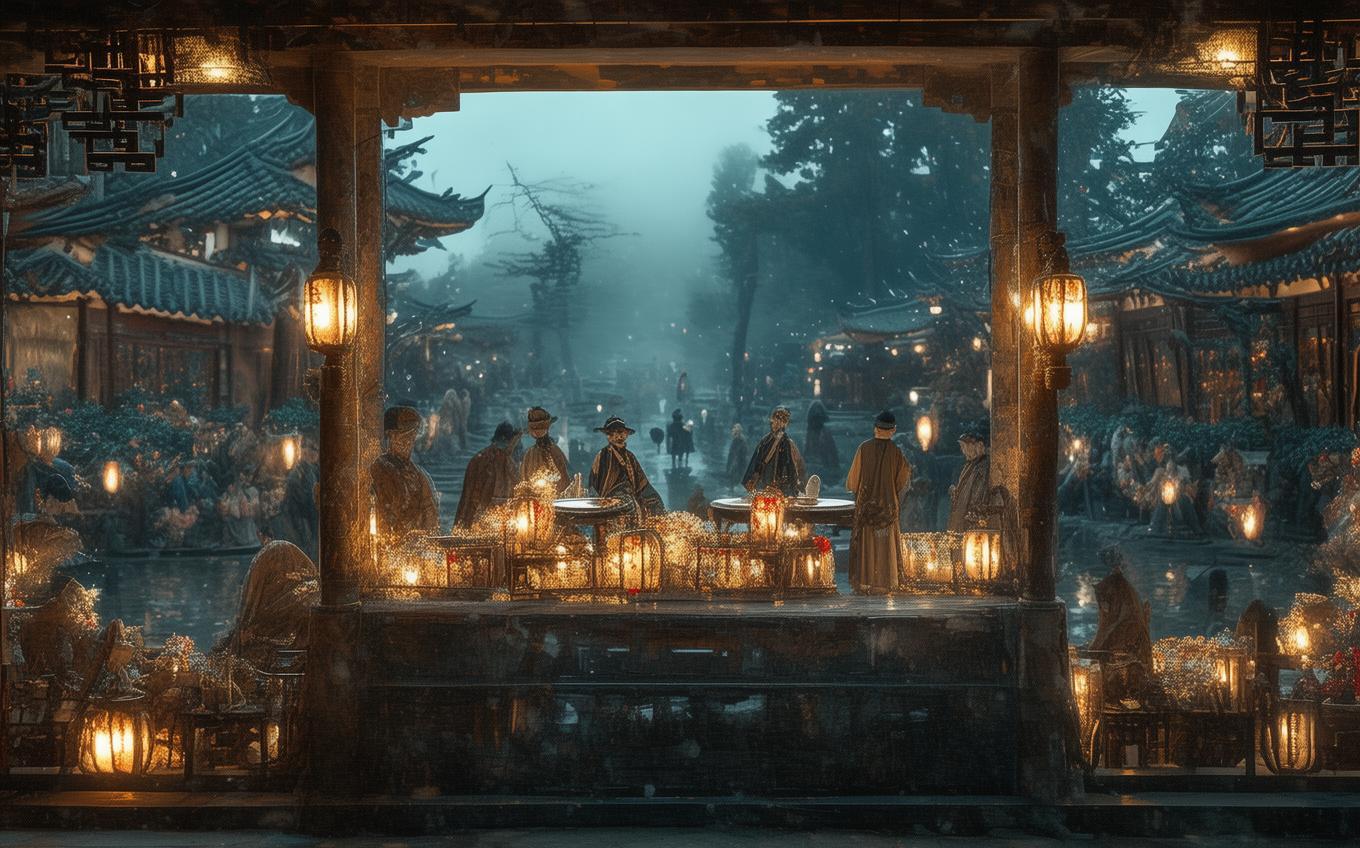
戚里申高宴
“戚里” (qī lǐ) designated the residential quarter of imperial in-laws and relatives in Chang’an. The word “申” (shēn – to extend, to express) hints that the feast was not merely a physical banquet but an unfolding of familial warmth. “高宴” (gāo yàn) suggests both the elevated status of the hosts and the refined tone of the gathering.
平台奏雅歌
“平台” (píng tái) is a flat terrace suitable for musical performances, possibly alluding to King Wen of Zhou’s famed “Platform of the Soul” where music and virtue were cultivated. “雅歌” (yǎ gē) – elegant, classical songs – evokes the Confucian ideal of yǎ yuè (雅乐, refined music) that nurtures the soul and promotes moral order. The rhyme-word 歌 (gē) becomes the centerpiece of this couplet: the terrace resounds with precisely the kind of music that, according to ancient belief, harmonizes a family and a state.
复寻为善乐
“为善乐” (wéi shàn lè) points to the Confucian teaching that the highest joy springs from doing good. By “again seeking” (复寻, fù xún) this joy, the emperor implies a continuous, conscious moral striving. The banquet and the music are not mere entertainment; they are occasions to reaffirm virtue.
方验保山河
The poem closes on a grand political scale. “保山河” (bǎo shān hé) – “preserve the mountains and rivers” – is a metaphor for safeguarding the entire realm. The character “验” (yàn – to verify, to prove) transforms preceding feelings into a concluded truth: only by cultivating personal and family virtue can a ruler truly secure the empire. The personal and the political are proven inseparable.
Themes and Symbolism
The poem operates on several interlocking themes:
- Fraternal Love and Filial Virtue: Rooted in historical models (the Lu–Wey bond) and embodied by the emperor’s own actions, brotherly affection becomes a microcosm of social order.
- The Joy of Refined Art: The “elegant songs” (雅歌) are more than entertainment – they symbolize moral cultivation. In Confucian thought, proper music aligns the heart with cosmic harmony.
- Virtuous Governance: The final couplet crystallizes a key idea from The Great Learning: that personal cultivation, family harmony, and the good ordering of the state form a single, unbroken chain.
- Symbolism of the Terrace and Feast: The elevated “平台” suggests a space that physically lifts participants closer to heaven, while the feast represents both hospitality and the sharing of moral joy. The imperial crown (冕旒) stands for authority tempered by familial humility.
Cultural Context
To appreciate the poem fully, one must understand the Tang dynasty’s literary culture. Banquet poetry with assigned rhymes (分韵赋诗) was a social art, testing wit and refinement. The rhyme “歌” (gē) was not merely a technical obligation; it invited the poem to orbit around music and celebration. Tang Xuanzong himself was a passionate lover of music, credited with founding the Pear Garden (梨园), the first imperial academy of performing arts. Thus, a poem that climaxes with music performed on a terrace is deeply autobiographical.
Furthermore, the historical background of Li Chengqi’s voluntary abdication in favor of his younger brother added layers of meaning. The poem publicly rehearses Xuanzong’s gratitude and reaffirms the bond that had ensured a peaceful succession – a lesson in political conduct wrapped in the silk of a family visit. The Confucian ideal of the virtuous ruler who first puts his own house in order is here not a dry maxim but a lived, festive experience.
Conclusion
“过大哥宅探得歌字韵” may read as a simple greeting composed under the constraint of a rhyme, yet it reveals an entire worldview. Through allusions to ancient brotherhood, the delicate balance of imperial identity and private tenderness, and the culmination in music that nourishes virtue, Emperor Xuanzong crafted a poem that breathes the highest ideals of his age. For modern readers, its beauty lies in that rare blend of personal sincerity and philosophical depth: a moment where a busy emperor pauses, listens to a song, and remembers that the strength of an empire begins with the love shared between two brothers. In an era of ever-shifting power, this small masterpiece reminds us that the truest “mountains and rivers” are those anchored in the heart.

Comments (0)
No comments yet. Be the first to comment!