Introduction
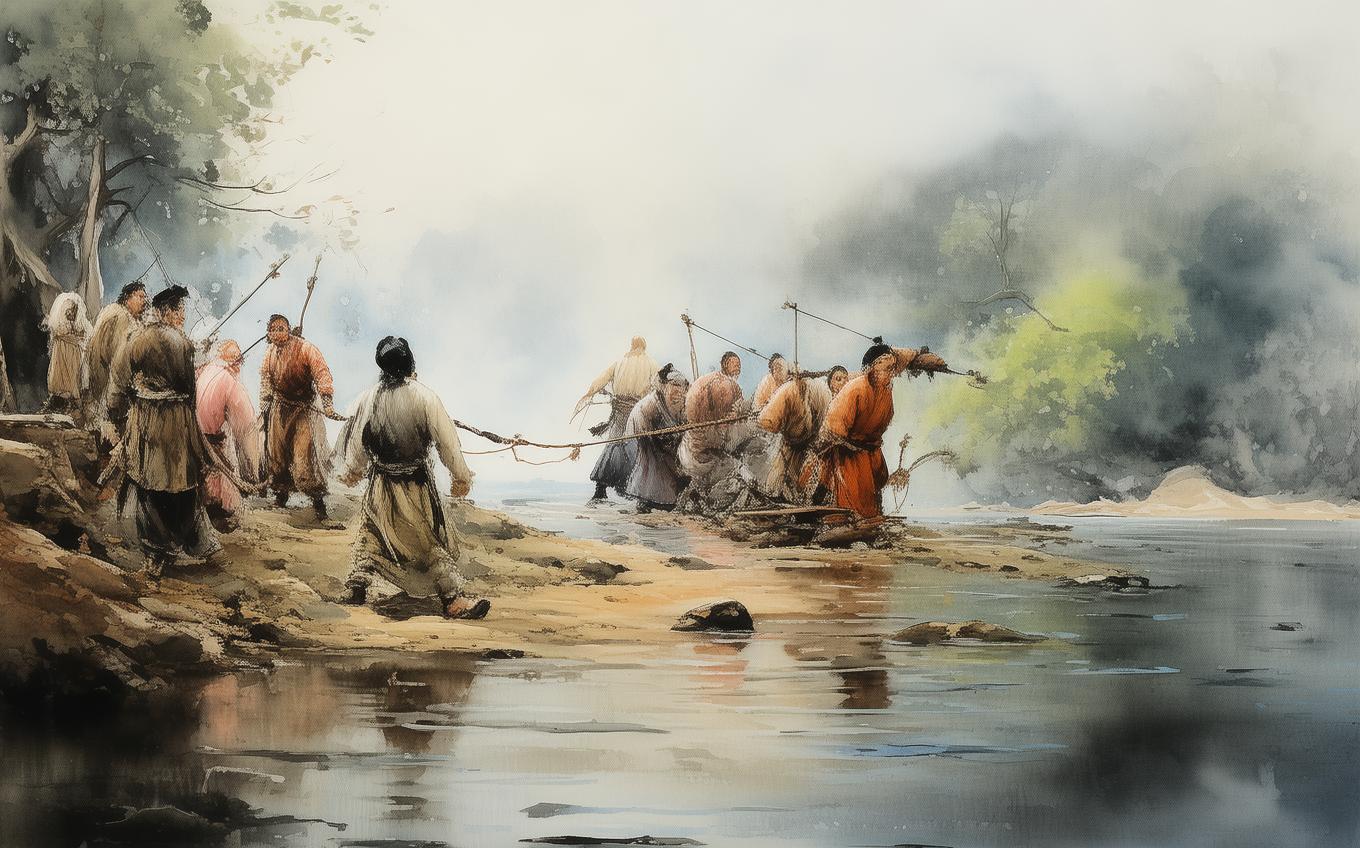
Among the many threads that weave the fabric of Tang Dynasty culture—poetry, music, painting, and sport—the simple folk game of tug-of-war holds a surprisingly evocative place. Emperor Xuanzong (Li Longji, 685–762), one of the most celebrated rulers of China’s golden age, was not only a patron of the arts but also a poet who found inspiration in the everyday life of his people. His poem “观拔河俗戏” (Guān Bá Hé Sú Xì), or “Watching the Tug-of-War Folk Game,” transforms a lively court and village pastime into a meditation on heroism, communal joy, and the rhythms of nature.
Written during the height of the Tang Dynasty, this short poem captures the thunderous energy of the game while subtly weaving in hopes for a bountiful harvest and social harmony. For English readers, it offers a unique window into how the Chinese tradition seamlessly blends physical vigor with philosophical depth, turning a sporting event into a celebration of life’s interconnected cycles.
The Poem: Full Text and Translation
壮徒恒贾勇,
Zhuàng tú héng gǔ yǒng,
Stalwart youths constantly display their courage,
拔拒抵长河。
Bá jù dǐ cháng hé.
Pulling and resisting, they strain against the long river.
欲练英雄志,
Yù liàn yīng xióng zhì,
If one wishes to forge a hero’s resolve,
须明胜负多。
Xū míng shèng fù duō.
One must clearly grasp the multitude of victories and defeats.
噪齐山岌嶪,
Zào qí shān jí yè,
Their shouts rise in unison—the mountain seems to tremble,
气作水腾波。
Qì zuò shuǐ téng bō.
Their spirit surges like water churning into waves.
预期年岁稔,
Yù qī nián suì rěn,
They anticipate a year of abundant harvest,
先此乐时和。
Xiān cǐ lè shí hé.
And beforehand, they delight in this seasonal harmony.
Line-by-Line Analysis
壮徒恒贾勇,拔拒抵长河。
The opening couplet places us directly at the rope. “壮徒” (stalwart youths) refers not just to strong men but to those in their prime, full of vitality. The phrase “贾勇” (gǔ yǒng) literally means “to peddle courage,” a playful yet vivid way of saying they are putting their bravery on full display. The tug-of-war becomes a stage for masculine virtue. “拔拒” (bá jù) describes the two opposing actions of pulling and resisting—a dynamic equilibrium of force. The “长河” (long river) could refer to the rope stretched between the two sides, likened to a flowing river, or perhaps to a real river separating the teams. Either way, the image merges human effort with the natural landscape, suggesting that the contest is as ancient and elemental as a river’s current.
欲练英雄志,须明胜负多。
Here, the emperor-poet steps back as a moralist. The game is not merely about brute force; it is a method of “练” (liàn)—tempering or refining—a heroic will. The line echoes the Confucian ideal that character is built through discipline and endurance. “须明胜负多” (one must clearly understand the many victories and defeats) conveys that true heroism lies not in winning every battle but in comprehending the balance of success and failure. The phrase “多” (many) hints at life’s repeated trials. This couplet elevates a simple sport into a philosophical exercise: by grappling with ropes, the players practice for the larger struggles of existence.
噪齐山岌嶪,气作水腾波。
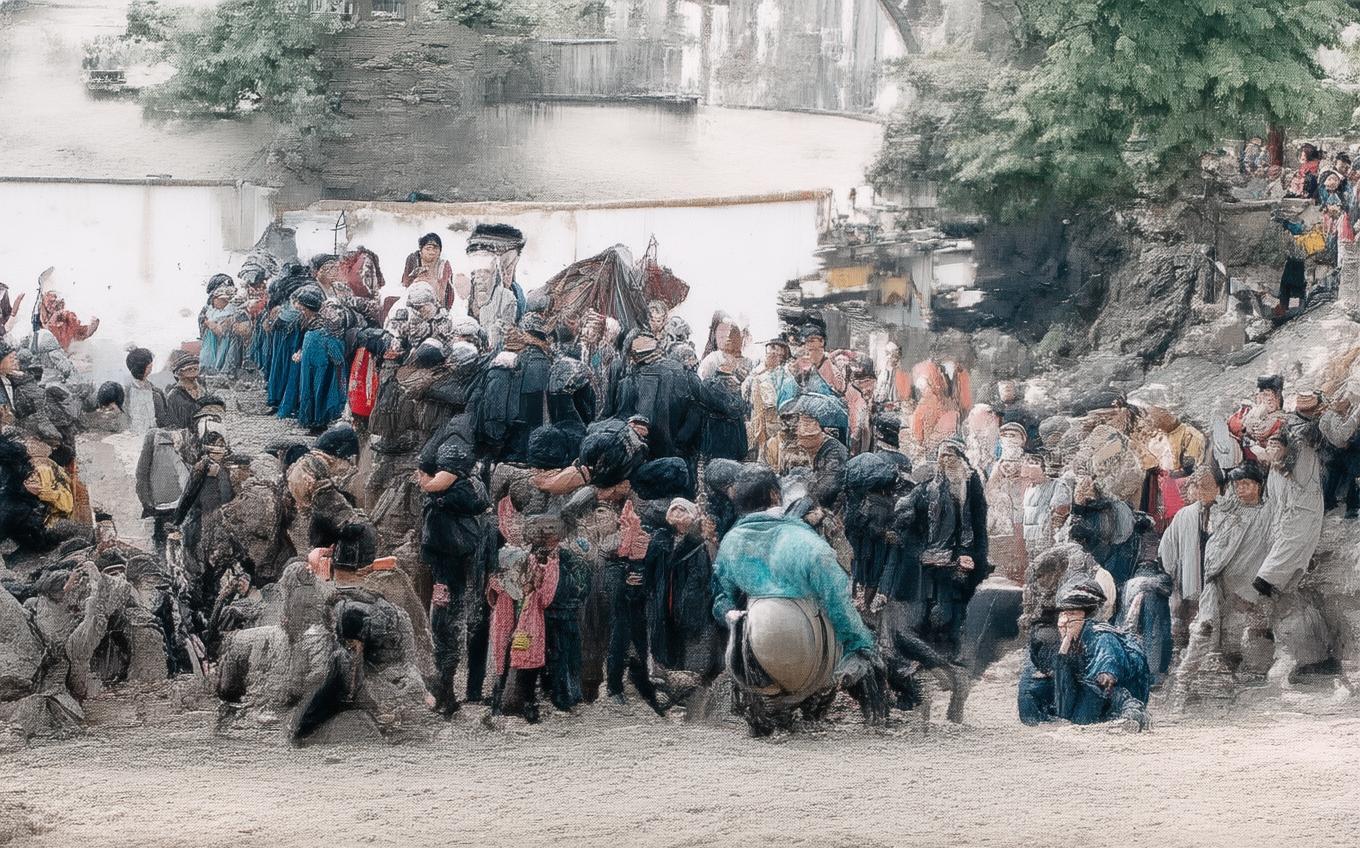
With these two lines, the scene explodes into sensory overload. “噪齐” (shouts in unison) captures the communal voice—spectators and players become one roaring entity. The sound is so immense that it seems to shake “山岌嶪” (the towering, precipitous mountain). The trembling mountain is a hyperbolic metaphor borrowed from classical descriptions of cosmic battles or divine forces, elevating the game to a near-mythic scale. Then the focus shifts from sound to spirit: “气” (qì), the vital energy or breath of the crowd, transforms into “水腾波” (water leaping into waves). The imagery aligns with the Daoist notion of qi animating all things, here made visible as a turbulent river. The tug-of-war is no longer just a game; it is a microcosm of nature’s own surging energies.
预期年岁稔,先此乐时和。
The final couplet reveals the deeper purpose of the festivity. “预期年岁稔” (anticipating a year of ripe harvest) connects the physical contest to agricultural cycles. Tug-of-war was often performed during seasonal festivals to pray for good crops, the pulling motion symbolizing the drawing up of earth’s fertility. “稔” (rěn) specifically means a bumper harvest, a word laden with the security and plenty that a good year brings. The closing line “先此乐时和” (beforehand, they delight in this seasonal harmony) wraps the poem in a serene, almost ritualistic joy. The word “和” (hé)—harmony—is the philosophical cornerstone: harmony between man and nature, between effort and reward, between ruler and people. The game, with all its thunder and strife, ultimately births peace and collective hope.
Themes and Symbolism
Physical Valor as Moral Training
At its surface, the poem celebrates athletic prowess. But Emperor Xuanzong, steeped in both martial and Confucian traditions, frames the tug-of-war as a crucible for character. “英雄志” (heroic resolve) is not a gift but a discipline—forged through the clarity that winning and losing are both instructive.
Unity and Communal Spirit
The noise that shakes mountains is not the cry of an individual but a coordinated shout. The poem emphasizes collective action, a value deeply rooted in Chinese agrarian society where cooperation meant survival. Tug-of-war becomes a symbol of social cohesion, the rope a literal tie that binds the community.
Harmony with Cosmic Rhythms
The final focus on “年岁稔” and “时和” shifts the frame from human to universal time. The game is performed in anticipation of harvest, aligning human joy with the seasons. This reflects the ancient Chinese worldview that human ceremonies, if properly conducted, resonate with the cycles of heaven and earth, bringing prosperity.
Symbols:
- The River/Rope (“长河”): Serves as both barrier and bond, representing challenges that must be overcome through unified effort. It also symbolizes the flow of life and the passage of time.
- The Shaking Mountain (“山岌嶪”): Stands for the solidity of nature awakened by human vitality—a reminder that even the mighty earth responds to sincere collective passion.
- Churning Water (“水腾波”): A dynamic manifestation of qi, illustrating how inner spirit becomes outward force, and mirroring the agricultural need for lively, well-watered fields.
Cultural Context
Emperor Xuanzong reigned during the Tang Dynasty’s cultural zenith (712–756), a period often likened to a Chinese Renaissance. His court was a magnet for poets like Li Bai and Du Fu, and he himself was an accomplished calligrapher, musician, and poet. The tug-of-war, or “拔河” (bá hé), was a popular folk custom, often staged during the Cold Food Festival or the Dragon Boat Festival, blending athletic competition with ritual significance.
In the imperial context, such folk games were not trivial. They served as a means for the emperor to connect with his subjects, demonstrating a sympathetic interest in their lives. The poem, therefore, is both a personal observation and a subtle political statement: a wise ruler finds joy in the people’s joy, and under his benevolent care, society pulls together like one team.
The composition of “观拔河俗戏” occurs against a backdrop of agricultural anxiety and military campaigns. The Tang empire was expansive but required constant reinforcement, both in grain and in martial spirit. By celebrating a game that marries these two needs, Xuanzong crafts an ideal image of his reign—a time when strength was cultivated not for war alone but for the fertile peace that follows.
Conclusion
“观拔河俗戏” may be a short occasional poem, yet its compact lines hold the roar of a crowd, the weight of a mountain, and the quiet hope of a full granary. Emperor Xuanzong’s genius lies in his ability to see a tug-of-war and find within it a mirror of the empire: taut with effort, ringing with shared voice, and ultimately aimed at harvest and harmony.
For modern readers, the poem transcends its medieval origins. It reminds us that sports can be more than entertainment—they can be rituals that bind communities, teach resilience, and celebrate the cyclical gifts of nature. In an age of digital distance, the image of hands gripping a rope together, pulling toward a common horizon, resonates as a timeless call to unity. The next time you witness a simple game, perhaps you’ll hear, as Tang Emperor did, the mountain beginning to tremble with life.
Comments (0)
No comments yet. Be the first to comment!