Analysis of "中和节赐百官燕集因示所怀" – Classical Chinese Poetry
Introduction
The Tang Dynasty (618–907 CE) is often celebrated as a golden age of Chinese poetry, when verse was not only a personal art but also a tool of statecraft. Emperors themselves composed poems to convey political ideals, celebrate rituals, and bond with their officials. One such piece is “中和节赐百官燕集因示所怀” (On the Zhonghe Festival, Bestowing a Banquet to the Hundred Officials and Expressing My Feelings) by Emperor Dezong (personal name Li Kuo, r. 779–805). Written for a court feast on the Zhonghe Festival—a holiday he personally instituted—this poem blends the joy of spring with a Confucian vision of harmonious rule. It offers modern readers a rare glimpse into the mind of a Tang monarch seeking to align nature, music, and governance into a single, benevolent order.
The Poem: Full Text and Translation
The poem is an extended regulated verse (páilǜ 排律), consisting of twelve five-character lines, each rigorously conforming to tonal patterns and parallelism. Below, each line is presented in Chinese characters, its Pinyin transliteration with tone marks, and a faithful English translation that prioritizes meaning over poetic rhyme.
至化恒在宥
Zhì huà héng zài yòu
The ultimate transformation always lies in leniency;保和兹息人
Bǎo hé zī xī rén
Preserving harmony, here I give the people rest.推诚抚诸夏
Tuī chéng fǔ zhū Xià
With sincere heart I soothe all the lands of Huaxia;与物长为春
Yǔ wù cháng wéi chūn
Together with all beings, I long to make an eternal spring.仲月风景暖
Zhòng yuè fēng jǐng nuǎn
In the second month, the scenery grows warm;禁城花柳新
Jìn chéng huā liǔ xīn
Within the Forbidden City, flowers and willows are fresh.芳时协金奏
Fāng shí xié jīn zòu
This fragrant season harmonizes with the bronze bells’ music;赐宴同群臣
Cì yàn tóng qún chén
I bestow a banquet, together with all my ministers.丝竹岂云乐
Sī zhú qǐ yún lè
Can strings and pipes alone be called true joy?忠贤惟所亲
Zhōng xián wéi suǒ qīn
It is loyal and worthy men whom I hold close.庶洽朝野意
Shù qià cháo yě yì
Thus I hope to unite the wills of court and countryside,旷然天地均
Kuàng rán tiān dì jūn
Vastly, like Heaven and Earth impartially balanced.
Line-by-Line Analysis
The poem opens with a declaration of governing philosophy. “至化恒在宥” invokes the Daoist-inflected concept of wú wéi (non-coercive action), asserting that the most profound civilizing transformation (至化) is achieved through leniency and tolerance (宥). The second line, “保和兹息人,” links this leniency to the preservation of cosmic and social harmony (保和), framing the emperor’s role as one who grants the people peace and respite—an echo of the Confucian ideal that a virtuous ruler brings tranquility to all under heaven.
The next couplet expands the circle of benevolence. “推诚抚诸夏” suggests that the emperor governs all the Chinese states (诸夏) with utmost sincerity (推诚), not through force but moral influence. “与物长为春” employs the metaphor of an everlasting spring to express the wish that all creatures (物) under his reign flourish continuously—a vision of political paradise where the ruler’s virtue, like the season of rebirth, renews life eternally.
The seasonal imagery becomes concrete in the middle pair. “仲月” refers to the second month of the lunar calendar, when the Zhonghe Festival falls, and the warming winds and burgeoning life are captured succinctly. “禁城花柳新” narrows the focus to the imperial palace (禁城), where new blossoms and willow shoots symbolize both the actual spring and the rejuvenating effect of the emperor’s sagely rule. Nature and politics mirror each other.
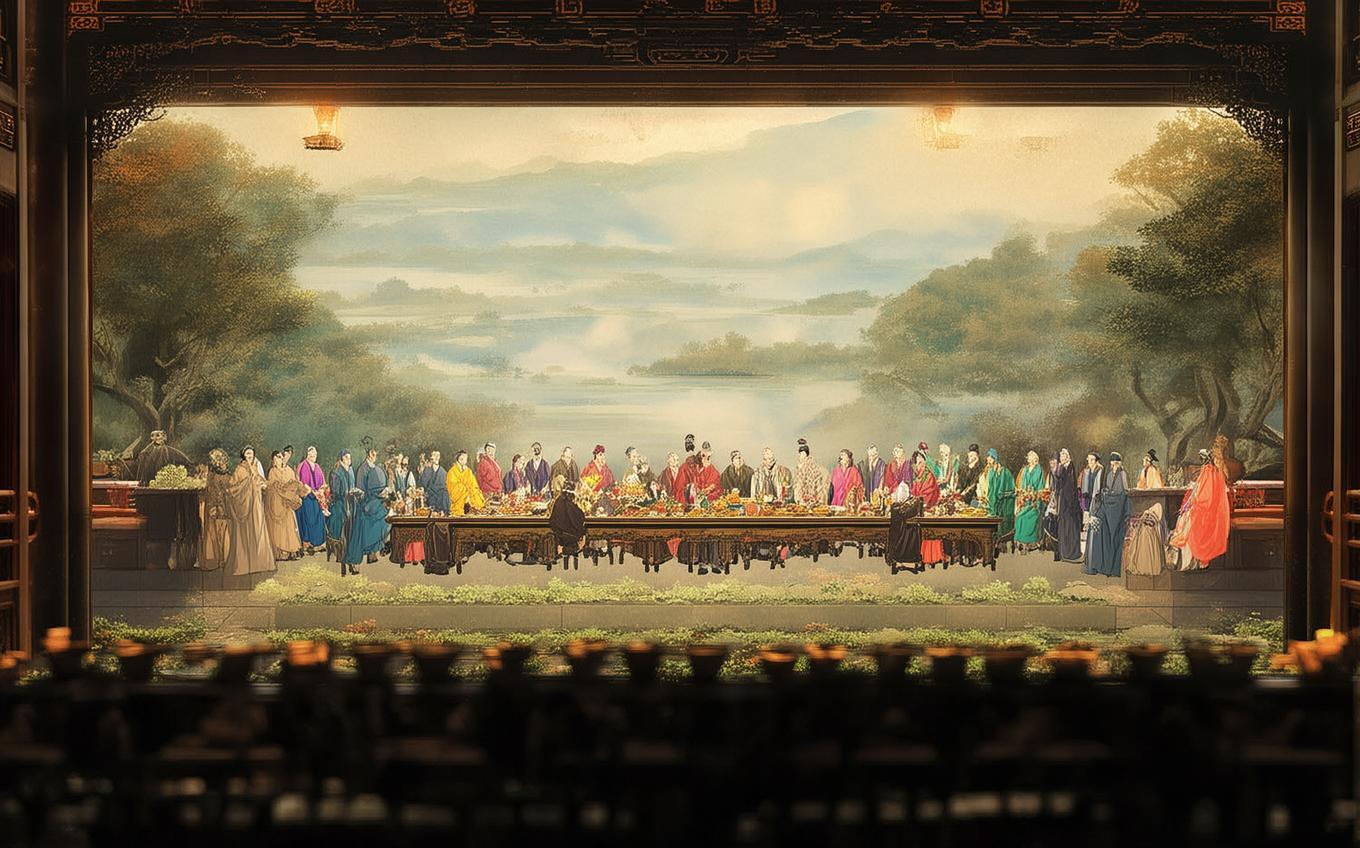
With the scene set, the poem moves to the festival banquet itself. “芳时协金奏” describes how the fragrant season perfectly accompanies the music of bronze bells (金奏, ritual court instruments). The harmony of time and music suggests a universe in tune with the emperor’s actions. “赐宴同群臣” is a straightforward statement of the event—a feast bestowed upon all the officials—but it also underscores the ideal of shared joy between ruler and subject.
The poet then poses a rhetorical question: “丝竹岂云乐” – can the melodies of strings and bamboo flutes alone be called true happiness? The expected answer is no. The real delight comes not from sensory pleasures but from being surrounded by loyal and worthy men: “忠贤惟所亲.” This couplet reveals the Confucian conviction that the ruler’s joy lies in virtuous ministers, not in hedonistic entertainment, and it subtly praises the assembled courtiers.
The final couplet elevates the personal gathering to a cosmic scale. “庶洽朝野意” expresses the hope that the banquet will harmonize the intentions and feelings of the court (朝) and the common people in the countryside (野), erasing the gap between rulers and ruled. “旷然天地均” completes the vision with the image of a vast, open equanimity—the emperor aspires to be as impartial and all-embracing as Heaven and Earth, distributing blessings evenly without favoritism.
Themes and Symbolism
Harmonious Rule – The central theme is the Confucian-Daoist synthesis of governance through virtue, sincerity, and non-interference. The poem treats the banquet not as mere festivity, but as a ritual act that reinforces cosmic and social harmony.
Eternal Spring – Spring symbolizes renewal, benevolence, and the life-giving power of a sage ruler. The desire for an “eternal spring” reflects the emperor’s hope to perpetuate peace and prosperity under his reign – a common trope in Chinese imperial poetry.
Music as Metaphor – The sound of bells and strings (丝竹, 金奏) represents order and civilization. Music in Confucian thought is a measure of good government; when music is properly tuned, so is the state. The question “丝竹岂云乐” unveils a deeper moral music: the harmonious relationship between sovereign and worthy ministers.
Impartiality of Heaven and Earth – “天地均” invokes the cosmic principle that Heaven and Earth nourish all things without discrimination. The emperor aspires to mirror this impartiality, linking his banquet to a universal, benevolent order.
Cultural Context
The Zhonghe Festival (中和节) was established by Emperor Dezong in 789 CE on the first day of the second lunar month, replacing an older spring rite. Designed to balance the dual forces of yin and yang and to celebrate agricultural renewal, the festival involved offering sun cakes, planting trees, and exchanging poems. The emperor’s composition of “中和节赐百官燕集因示所怀” was part of this larger ritual program—an act of policy as much as poetry. By writing and sharing such a poem at a state banquet, Dezong positioned himself as the pivot between Heaven, Earth, and human society, reinforcing the Tang dynasty’s ideology that the emperor’s virtue directly influenced both nature and politics.
The poem also reflects the Tang court’s literary culture, where poetry was a medium of political communication. An emperor who could craft elegant verse demonstrated the refinement and moral sensibility expected of a Son of Heaven. For modern readers, this poem offers a window into how classical Chinese poetry often dissolved the boundary between personal emotion and public duty, making the imperial “I” a voice for collective order.
Conclusion
“中和节赐百官燕集因示所怀” is more than a graceful description of a spring banquet. It is a carefully constructed declaration of political philosophy, woven with images of blossoming flowers, harmonious music, and the eternal cycles of nature. Emperor Dezong uses the form to express a ruler’s highest aspiration: to be so benevolent and impartial that the entire world shares an everlasting spring. For English speakers exploring Chinese literature, this poem reveals how even state occasions in Tang China were infused with lyrical beauty and philosophical depth—a reminder that in classical Chinese tradition, governing well and writing well were, at their best, one and the same.
Comments (0)
No comments yet. Be the first to comment!