Introduction
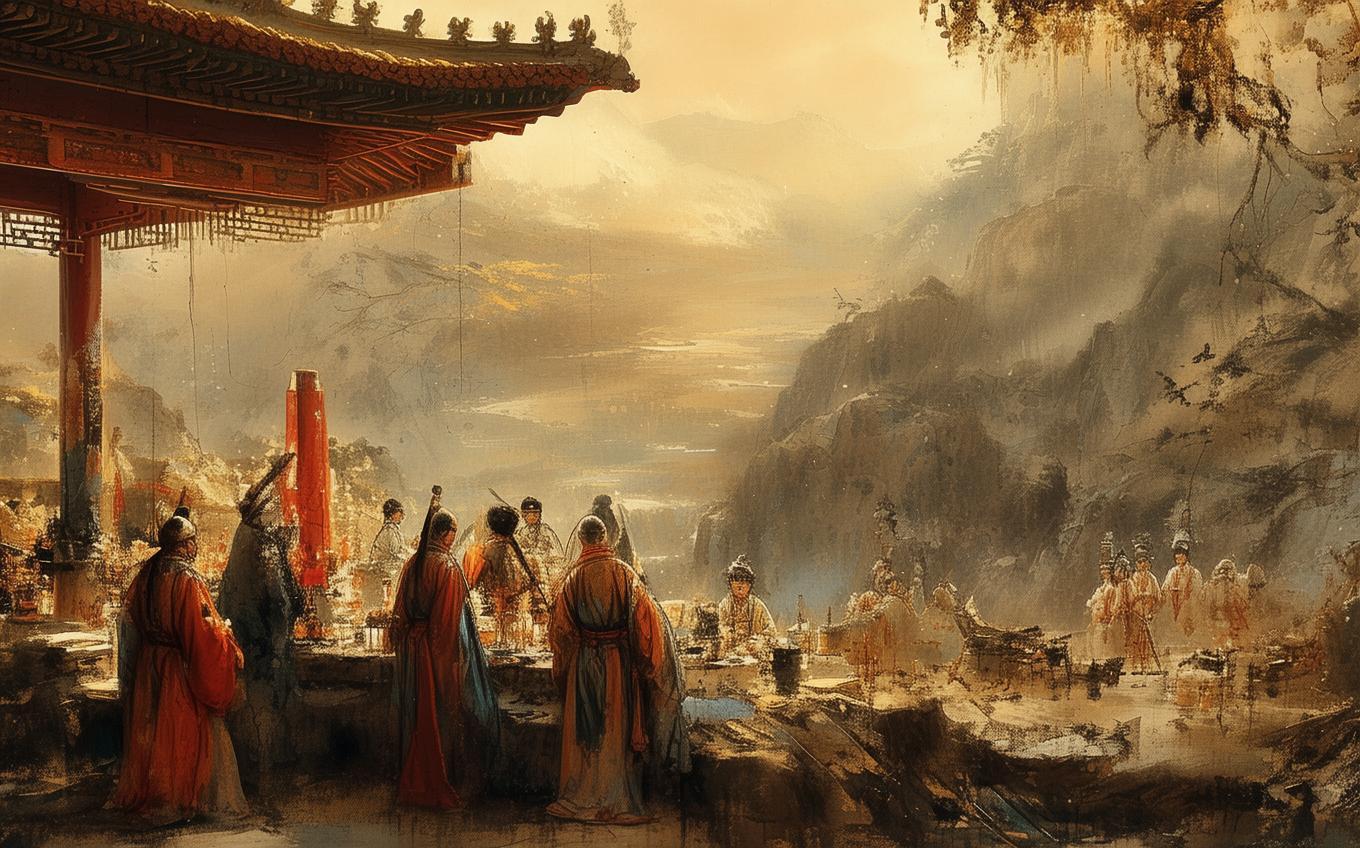
The poem “麟德殿宴百僚” (Líndé Diàn Yàn Bǎi Liáo), which translates to “Banquet for the Hundred Officials at Linde Hall,” was composed by Emperor Xuanzong of Tang (唐玄宗, Táng Xuánzōng), personal name Li Longji (李隆基). Reigning from 712 to 756, Xuanzong presided over the zenith of the Tang dynasty, a golden age of culture, military power, and economic prosperity known as the Kaiyuan era (開元盛世). This poem, believed to have been written in the spring during the early, vigorous phase of his rule, captures the emperor’s vision of benevolent governance, collective joy, and the Confucian ideal of harmony between a sage ruler and his loyal ministers.
Poems written by emperors for court banquets are a distinct subgenre of classical Chinese verse. They served not only as entertainment but as political acts, reinforcing hierarchy, confirming shared values, and projecting an image of cosmic order. “麟德殿宴百僚” stands out for its warmth, its gratitude toward the officials, and its unpretentious celebration of a peaceful empire. For English readers, it offers a window into the elegant world of Tang courtly life and the deep-rooted philosophical ideals that shaped imperial China.
The Poem: Full Text and Translation
忧勤承圣绪,
yōu qín chéng shèng xù,
With anxious diligence I inherit the sacred legacy;
开泰喜时康。
kāi tài xǐ shí kāng,
Opening an age of prosperity, I rejoice in the times’ health.
恭己临群后,
gōng jǐ lín qún hòu,
Reverent in my own person, I preside over all the feudal lords;
垂衣御八荒。
chuí yī yù bā huāng,
With robes hanging down, I govern the eight distant wilds.
务闲春向暮,
wù xián chūn xiàng mù,
Affairs are at ease, spring moves toward evening;
朝罢日犹长。
cháo bà rì yóu cháng,
Court is dismissed, the daylight still lingers long.
紫殿初筵列,
zǐ diàn chū yán liè,
In the Purple Hall the banquet is newly laid out;
彤庭广乐张。
tóng tíng guǎng yuè zhāng,
In the Vermilion Court grand music is spread forth.
成功归辅弼,
chéng gōng guī fǔ bì,
The accomplishment of success goes to my aids and supporters;
致理赖忠良。
zhì lǐ lài zhōng liáng,
Reaching good order depends on the loyal and good.
共此欢娱事,
gòng cǐ huān yú shì,
Let us share this joyous and delightful occasion;
千秋乐未央。
qiān qiū lè wèi yāng,
For a thousand autumns the joy shall never end.
Line-by-Line Analysis
Opening Couplet: The Ruler’s Burden and Joy
The poem begins not with a flourish of imperial majesty but with a confession of “anxious diligence” (忧勤, yōu qín). Even for the most powerful man in the world, leadership is presented as a heavy heirloom – a “sacred legacy” handed down from ancestors. The phrase “圣绪” (shèng xù) specifically refers to the line of sage emperors, emphasizing that Xuanzong’s rule is part of a divine continuum. Yet the second line shifts immediately to optimism: the empire is experiencing an open and prosperous phase (开泰, kāi tài, a term from the Yijing), and the ruler can finally “rejoice in the times’ health.” This coupling of earnest responsibility with genuine gladness sets the emotional tone for the entire poem.
Second Couplet: The Ideal Confucian Ruler
Lines three and four are densely packed with political philosophy. “恭己” (gōng jǐ) – being reverent in one’s own person – alludes directly to the Analects: “If a ruler makes himself correct, what difficulty will he have in governing?” The phrase “垂衣” (chuí yī, “robes hanging down”) comes from the Book of Documents and the Yijing, describing the effortless governance of the mythical sage-kings. Rather than ruling through force, the ideal monarch maintains order simply through moral virtue, like robes falling naturally. “八荒” (the eight distant wilds) encompasses the entire known world. The emperor portrays himself not as a conqueror but as a serene moral center, radiating stability to the farthest frontiers.
Third Couplet: A Moment of Peaceful Pause
After the grand vision of world order, the poem zooms in to a specific afternoon. State business is described as “at ease” (务闲, wù xián) – not absent, but handled so smoothly that the emperor and his ministers can pause. Spring drifts toward evening, and court has just concluded, yet “the daylight still lingers long.” This lingering light is both literal and symbolic: the dynasty is in a long, golden afternoon of peace, stretching out invitingly before the feast begins. The rhyming words “暮” (mù, dusk) and “长” (cháng, long) create a gentle tension – recognizing the passage of time while celebrating its fullness.
Fourth Couplet: Imperial Splendor Unleashed
Now the poem’s setting blazes into color. “紫殿” (zǐ diàn, Purple Hall) is an epithet for Linde Hall itself – purple was the color of the pole star, the celestial emperor’s abode, and by extension the earthly emperor’s palace. The banquet is “newly laid out,” a fresh array of delicacies and ceremonies. “彤庭” (tóng tíng, Vermilion Court) paints the courtyard a warm, auspicious red, while “广乐张” (guǎng yuè zhāng) evokes the grand court music filling the air. The vigorous verb “张” (spread/stretch) makes the music almost visual, unfurling like festive banners. The couplet is a masterclass in synesthetic imagery, engaging sight, sound, and even implied taste and smell.
Fifth Couplet: Humility and Gratitude
In the climax of the poem, Xuanzong does what the best Confucian rulers should: he deflects credit. The empire’s achievements are not his alone; “success” “归辅弼” (guī fǔ bì) – belongs to his close advisors, the “assistants and supporters” who steer the ship. The phrase “致理” (zhì lǐ, reaching good order) is a refined way of describing political harmony, and it “赖忠良” (lài zhōng liáng) – depends upon the loyal and virtuous. A Tang official hearing these lines would feel recognized, their own moral worth seen and praised by the Son of Heaven. This is less manipulation than a genuine expression of the symbiotic ideal that made the Tang bureaucracy strong.
Final Couplet: Eternal Joy Shared
The poem closes on an open, exultant note. “共此欢娱事” – let us share this joyous thing. The emperor does not stand apart observing the fun; he participates in it. And the joy transcends the moment: “千秋乐未央” (for a thousand autumns the joy shall never end). 千秋 means both “a thousand years” and is a euphemism for “eternally,” while 未央 (not yet ended / never reaches its midpoint) is a remarkably rich phrase. It echoes the name of the great Han dynasty palace, Weiyang Palace, which symbolized the unending vitality of the empire. Thus, a spring banquet becomes a promise of perpetual prosperity, with the emperor and his hundred officials as co-creators of timeless happiness.
Themes and Symbolism
Harmonious Governance (治世, zhìshì)
The central theme is the Confucian vision of a well-ordered state where the ruler’s virtue matches the merit of his ministers. The poem repeatedly credits the officials (“辅弼”, “忠良”) with the empire’s success, reflecting the Tang ideal of a collaborative, merit-based bureaucracy rather than autocratic whim.
The Joy of Shared Celebration
Unlike poems of solitary imperial power, this one emphasizes “共” (gòng, together). The feast is not a display of superiority but a communion. The final line promises that the joy is not the emperor’s alone, but a shared inheritance extended across time.
Spring and Perpetual Renewal
Springtime, with its long evenings and gentle air, symbolizes a dynasty in bloom. Moving toward dusk, it suggests maturity rather than decline – a peak of civilization where urgency has given way to cultivated leisure.
Purple and Vermilion
The colors are heavy with cosmic symbolism. Purple (紫) links the emperor to the celestial pole, while vermilion (彤) is the color of fire, south, and vibrant yang energy. Together they frame the feast as an earthly reflection of heavenly order.
“未央” (Never-Ending)
This single word carries enormous cultural weight, alluding to the Weiyang Palace and the wish for a dynasty that never sets. It transforms a pleasant evening into a prayer for immortality.
Cultural Context
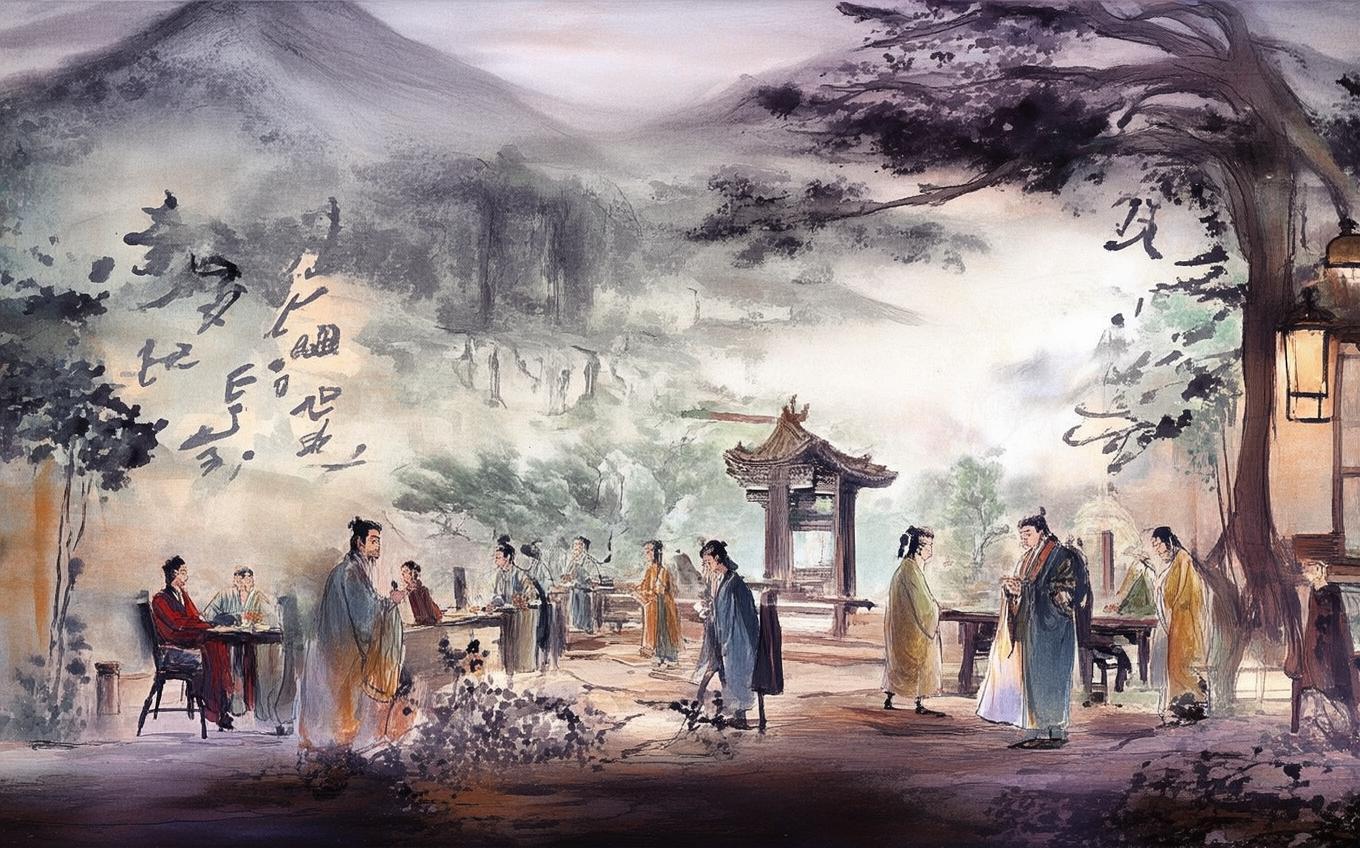
The Tang dynasty (618–907) was a cosmopolitan golden age where poetry was not merely art but a tool of statecraft. Court banquets were carefully choreographed occasions at which the emperor might compose a poem and invite officials to match it in rhyme and theme – a practice called “应制” (yìngzhì, responding to imperial command). These poetic exchanges reinforced the bond between ruler and subject, making loyalty and shared aesthetic sensibility almost indistinguishable. Linde Hall (麟德殿) within the Daming Palace complex was the largest banquet hall, capable of hosting thousands, and was specifically associated with state ceremonies and foreign embassies.
Emperor Xuanzong, himself a talented poet, calligrapher, and musician, embodied the wen (文, culture/civility) that Tang ideology prized alongside martial prowess. In the early part of his reign, he surrounded himself with capable ministers like Yao Chong and Song Jing, and implemented reforms that created one of the most effective governments in Chinese history. This poem reflects that moment of confidence, before the disastrous An Lushan Rebellion would shatter the empire and his own reign. The poem’s optimism, therefore, is both genuine and poignantly vulnerable – a snapshot of a world soon to vanish.
For Chinese thinkers, a peaceful banquet was never just a party; it was a microcosm of the state. When the ruler and his “hundred officials” shared food, music, and verse in harmony, it ritually enacted the social and cosmic order. Reading “麟德殿宴百僚” today, we witness not just a historical event but the performance of an entire worldview.
Conclusion
“麟德殿宴百僚” is far more than a festive piece of court verse. In just twelve lines, Emperor Xuanzong paints a self-portrait of the ideal Chinese monarch: earnest yet serene, powerful yet humble, joyfully dependent on the loyalty of his subjects. The poem’s gentle spring setting, lavish colors, and resonant cultural allusions come together to celebrate a moment of perfect balance – a world at peace, where work has given way to shared delight and even a thousand autumns seem not enough.
For modern readers, the poem’s beauty lies in its timeless human core: the happiness of hard-won success acknowledged together. It reminds us that true leadership finds its fulfillment not in solitary glory but in the gratitude it can express to those who share the burden. And in the tender line “the daylight still lingers long,” there is an invitation we can all accept – to pause, to feast, and to believe, if only for an evening, that joy might indeed have no end.
Comments (0)
No comments yet. Be the first to comment!