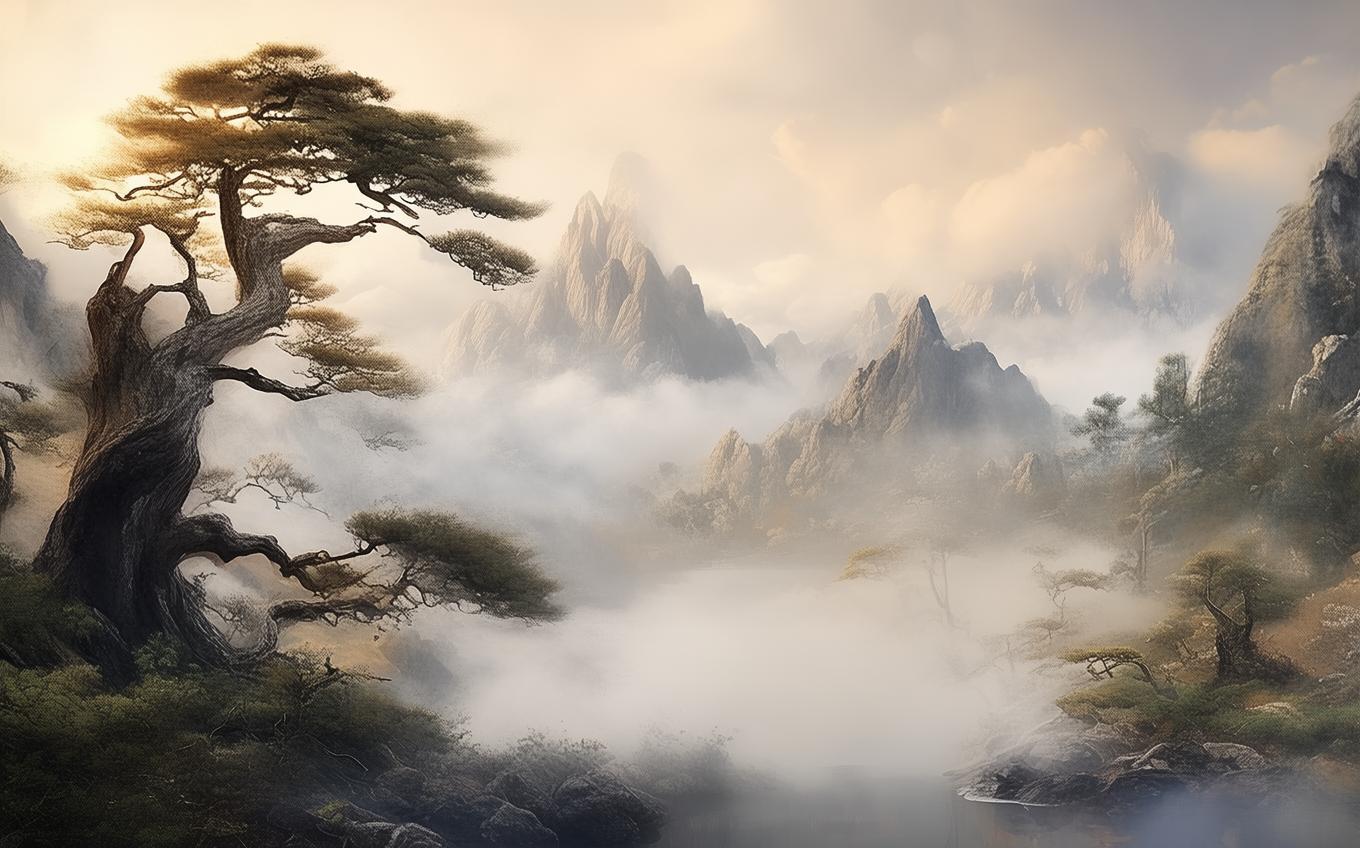
An exploration of Li Bai’s quatrain often referred to as “九日绝句” (A Double Ninth Quatrain) and its full title “九日龙山饮” (Drinking on Dragon Mountain on the Double Ninth).
Introduction
Among the countless treasures of classical Chinese poetry, few quatrains capture the rebellious spirit of the Tang dynasty as vividly as Li Bai’s “九日龙山饮” (Jiǔ Rì Lóng Shān Yǐn), a poem frequently cited simply as “九日绝句” for its compact, song-like form and its setting on the Double Ninth Festival. Li Bai (701–762), the legendary “Poet Immortal,” wrote this five-character quatrain during a period of political exile, transforming personal misfortune into a defiant celebration of wine, nature, and untamed joy. The poem stands as a miniature manifesto of Li Bai’s Daoist-infused philosophy—finding transcendence in the present moment, no matter the circumstances.
The Poem: Full Text and Translation
九日龙山饮,
jiǔ rì lóng shān yǐn,
Drinking on Dragon Mountain on the Double Ninth,
黄花笑逐臣。
huáng huā xiào zhú chén.
The yellow chrysanthemums laugh at this banished official.
醉看风落帽,
zuì kàn fēng luò mào,
Drunk, I watch the wind blow off my hat;
舞爱月留人。
wǔ ài yuè liú rén.
I dance, loving how the moonlight detains me.
Line-by-Line Analysis
Line 1 – Setting the Scene
“九日龙山饮” immediately anchors the poem in the Double Ninth Festival (the ninth day of the ninth lunar month) and a specific place: Dragon Mountain. In Chinese tradition, the Double Ninth was a day for climbing heights, drinking chrysanthemum wine, and warding off misfortune. Li Bai chooses Dragon Mountain, a site already rich in literary memory, to stage his act of personal liberation. The mention of “drinking” (yǐn) announces a theme that runs through the entire poem: intoxication as both a physical state and a metaphor for spiritual freedom.
Line 2 – The Laughing Chrysanthemums
“黄花笑逐臣” introduces the festival’s iconic flower, the chrysanthemum (huáng huā—literally “yellow flower”), which blooms proudly in autumn’s chill. But here the chrysanthemums are personified: they laugh at the speaker, who identifies himself as a “逐臣” (zhú chén—a banished or exiled official). This self-mocking reference points to Li Bai’s own turbulent political life. After becoming entangled in the An Lushan Rebellion, Li Bai had been exiled to the remote Yelang region (in modern Guizhou). Rather than wallow in shame, the poet turns the scorn of the flowers into a badge of honor, suggesting that even nature’s laughter cannot diminish his spirit. The chrysanthemums, symbols of resilience and reclusion, mock the exile, yet the mockery is playful—perhaps even a nod of recognition between fellow outsiders.
Line 3 – The Hat Blown Off by the Wind
“醉看风落帽” contains a famous literary allusion. The image of a hat blown off by the wind recalls the story of Meng Jia, a Jin dynasty official known for his carefree elegance. During a mountain gathering on the Double Ninth, Meng Jia’s hat was swept away by a gust of wind, yet he remained so engrossed in the joy of the moment that he didn’t notice. Li Bai, drunk and unguarded, watches his own hat fly off—not with embarrassment, but with calm acceptance. This deliberate reference elevates the act of losing one’s hat to a symbol of transcendental carelessness: a gentleman so absorbed in the Dao that mundane propriety ceases to matter. The phrase “醉看” (zuì kàn—drunk, I watch) suggests a mind floating between consciousness and dream, observing the world’s fleeting nature with equanimity.
Line 4 – Dancing with the Moon
“舞爱月留人” concludes the quatrain with a burst of ecstatic movement. The poet dances, not for an audience, but for the moon itself. The moon (yuè) in classical Chinese poetry is a tireless companion, a silent witness to human emotion and a bridge to the infinite. Li Bai projects his desire onto the moonlight, claiming it “detains” him (liú rén)—a graceful way of saying he wants the night to last forever. Dancing under the moon, the exiled official becomes a cosmic figure, his loneliness transformed into a private festival shared only with nature. The line captures the Daoist ideal of ziran (naturalness): acting without contrivance, moving in harmony with the spontaneous rhythm of the universe.
Themes and Symbolism
Joy as Defiance
Li Bai’s poem refuses to let exile define him. Neither political disgrace nor the symbolic laughter of the chrysanthemums can puncture his festive mood. The Double Ninth, typically a day for family reunion and longing, becomes a personal triumph—a celebration of self-sufficiency. Wine, wind, and moonlight serve as his chosen companions, more reliable than the fickle imperial court.
Transcendence through Nature
Every element in the poem—chrysanthemums, wind, moon—belongs to the natural world, yet Li Bai anthropomorphizes them as participants in his revelry. This fusion of human emotion and natural phenomenon reflects the Daoist belief in the unity of all things. The poet does not dominate nature; he joins it, allowing the wind to take his hat and the moon to guide his dance.
The Meng Jia Allusion and the Ideal of Carefree Elegance
The reference to Meng Jia’s blown-off hat is not merely decorative. It anchors Li Bai in a cultural tradition that values fengliu (风流)—a kind of cultivated, unstudied grace. By claiming that lineage, Li Bai elevates his drunken antics to a historical and aesthetic ideal, proving that one can be both a banished official and a hero of refinement.
Cultural Context
The Double Ninth Festival (重阳节, Chóngyáng Jié) is deeply rooted in Chinese cosmology: the number nine is yang, and the double ninth represents an excess of yang energy, believed to be dangerous. To protect themselves, people would climb mountains, drink chrysanthemum wine, and wear dogwood. Over time, the festival also became a time for missing distant loved ones, immortalized in poems like Wang Wei’s “九月九日忆山东兄弟.”
Li Bai’s treatment of the festival is characteristically irreverent. Where others might lament separation, he celebrates the solitude that gives him freedom. Chrysanthemums, traditionally associated with the reclusive poet Tao Yuanming (who was a hero to Li Bai), are here turned into mocking observers—a twist that shows Li Bai’s ability to subvert convention even as he embraces it.
The poem was likely written around 758–759 CE, during or shortly after Li Bai’s exile to Yelang. Although pardoned before reaching his destination, Li Bai’s spirit had already become that of a wanderer at odds with the political machine. “九日龙山饮” embodies the resilience of a man who could lose everything and still find the universe dancing at his side.
Conclusion
Li Bai’s “九日龙山饮” endures because it speaks to a timeless human truth: dignity does not come from status, but from the courage to remain joyful in the face of misfortune. The quatrain’s tight structure—just twenty Chinese characters—contains a whole philosophy of life, a snapshot of cosmic hilarity. As the wind steals the hat and the moonlight invites a dance, Li Bai reminds us that even the most disgraced exile can become, for one luminous night, the emperor of the mountain and the beloved of the moon. For modern readers, this poem offers not only a window into Tang dynasty culture but also a lesson in the art of losing with style.
Comments (0)
No comments yet. Be the first to comment!