Introduction
Zhu Xi (1130–1200) is best known as the great synthesizer of Neo-Confucian philosophy, a thinker whose commentaries shaped East Asian civilization for centuries. Yet he was also a sensitive poet, capable of capturing the fleeting moods of nature with the same precision he brought to moral philosophy. His short poem "百丈山" (Bǎizhàng Shān, "Hundred-Zhang Mountain") is a jewel of Southern Song dynasty landscape poetry: a seven-character quatrain that distills a moment of mountain ascent into a vision of universal harmony. For English readers, this poem offers not only a glimpse of medieval Chinese aesthetics but also a doorway into the Daoist- and Confucian-inflected ways of seeing the natural world.
The Poem: Full Text and Translation
蹑石扪萝上翠微,
Niè shí mén luó shàng cuì wēi,
Treading stones, grasping creepers, I climb the green-tinged slope;
环山怪木郁参天。
Huán shān guài mù yù cān tiān.
Around the mountain, strange trees luxuriantly reach the heavens.
白云欲散松风起,
Bái yún yù sàn sōng fēng qǐ,
White clouds on the verge of scattering, a pine wind rises;
吹作人间雨百川。
Chuī zuò rén jiān yǔ bǎi chuān.
It blows and turns into rain for the hundred rivers of the human world.
Line-by-Line Analysis
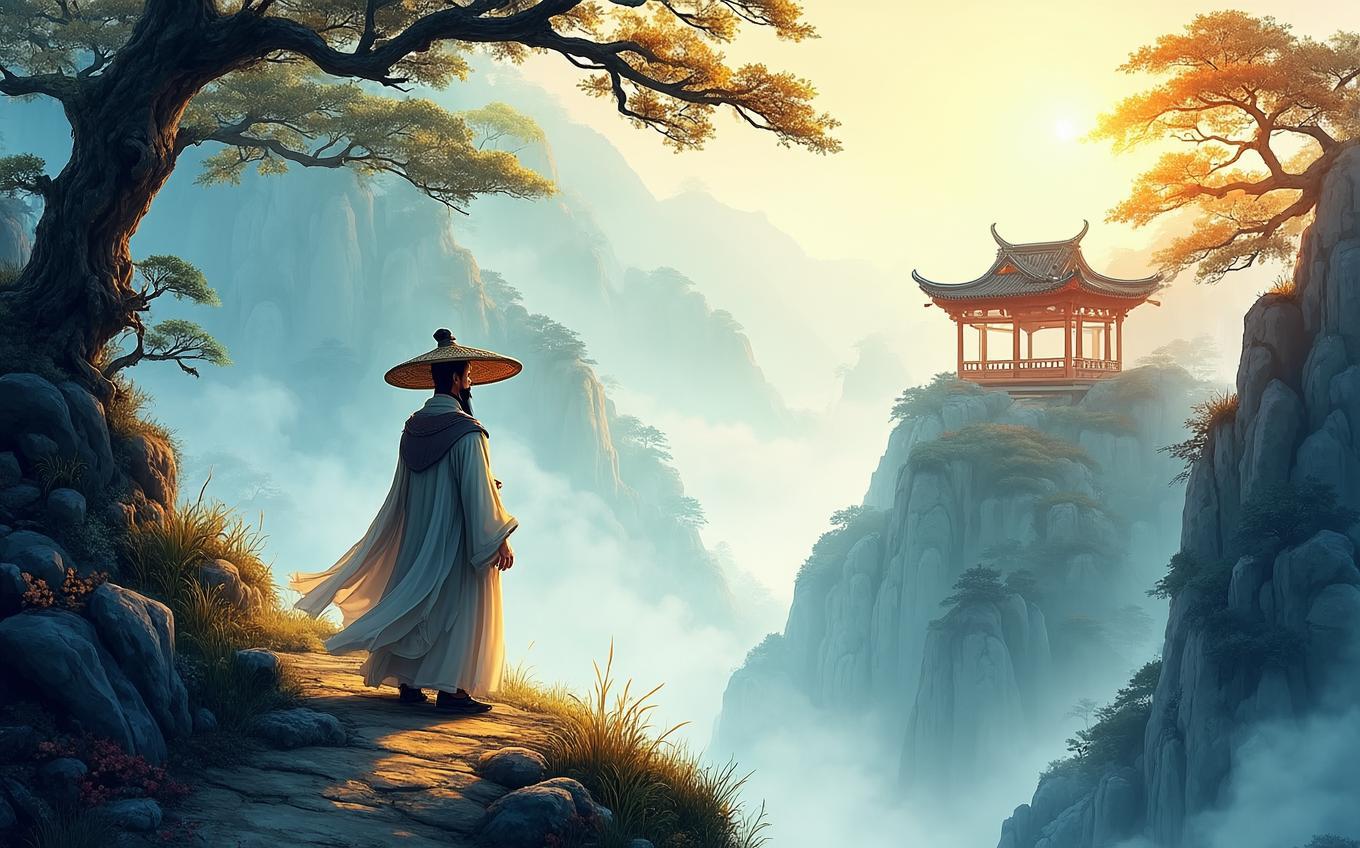
蹑石扪萝上翠微 – The poem opens with the physical act of climbing. “蹑石” (niè shí, treading on rocks) and “扪萝” (mén luó, clutching creepers) paint a vivid picture of an untamed mountain path: this is no manicured garden, but a wild space that demands effort. The word “翠微” (cuì wēi) literally means “azure green shimmer” and is an ancient poetic term for the hazy, greenish lower slopes of a mountain. Already the speaker is embedded in the landscape, his body intertwined with rock and vine. The line suggests both exertion and intimacy — to know the mountain, one must touch and be touched by it.
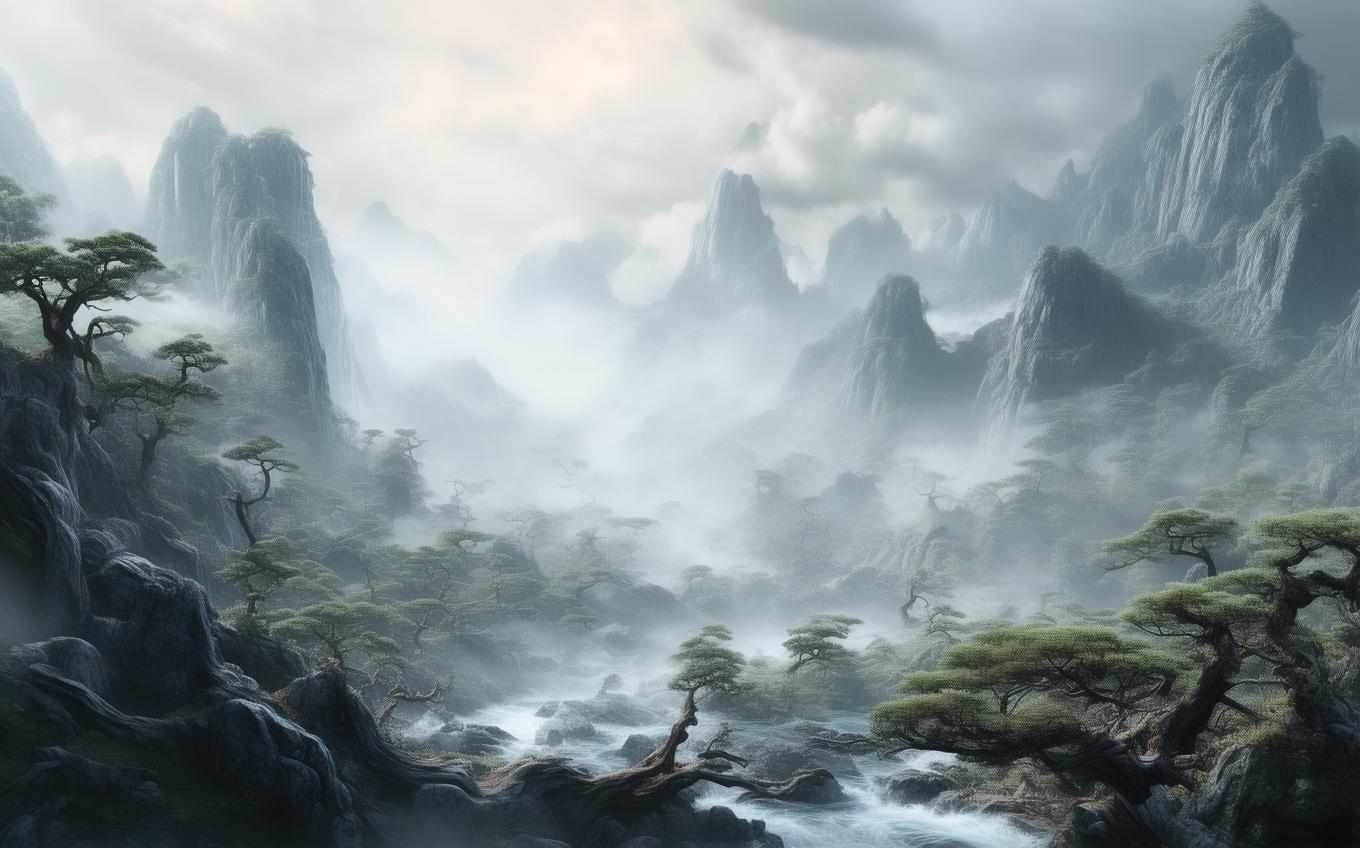
环山怪木郁参天 – Arriving at a higher vantage, the climber is surrounded by “怪木” (guài mù, strange or gnarled trees). In Chinese nature poetry, “strangeness” is often a term of aesthetic wonder, not fear: these old, twisted forms display nature’s unscripted creativity. The adjective “郁” (yù) conveys dense, flourishing growth, while “参天” (cān tiān, reaching to the sky) gives the trees a soaring verticality. Together, the line evokes a primeval forest, its branches so thick they almost block the heavens — a vibrant, living cathedral.
白云欲散松风起 – A subtle shift in weather energizes the scene. White clouds are “欲散” (yù sàn, about to break apart), hovering on the edge of dissolution. Then a wind rouses itself among the pines. The pairing of clouds and pine wind is a classic trope in Chinese poetry, often carrying overtones of spiritual transcendence. Pine trees, because they stay green through winter, symbolize resilience and the steadfast junzi (gentleman) in Confucian thought. The rising wind suggests an active, breathing mountain, a momentary brush with the unseen forces that govern the world.
吹作人间雨百川 – The final line unfolds the ecological and metaphysical magic. That same pine-scented wind now transforms the parting clouds into rain, which falls not just on this mountain but into “百川” (bǎi chuān, the hundred rivers) of the human realm. The mountain’s local weather feeds the entire watershed; what begins as a private, intimate encounter with nature becomes a gift to society. The poem thus arcs from the personal to the universal, echoing the Confucian ideal that individual cultivation ultimately nourishes the world.
Themes and Symbolism
One dominant theme is the unity of nature and humanity. Zhu Xi’s mountain is not a passive backdrop but an active agent: the trees, clouds, wind, and rain work together in a seamless cycle. The poet begins as a solitary climber, yet by the poem’s end, he is part of this flowing network. This reflects the Neo-Confucian concept of li (理, principle), the underlying pattern that connects all things.
The mountain itself is a powerful symbol. In Chinese culture, mountains are dwelling places of immortals and sources of spiritual insight. “百丈山” (Hundred-Zhang Mountain) suggests towering height, but the poem does not emphasize a summit view; instead, it immerses us in the process of ascent and the interconnected ecosystem. The pine wind symbolizes endurance and the voice of nature — in Chinese art, the sound of pines is often compared to the music of a zither, a harmonious resonance that calms the heart. The rain falling into “hundred rivers” carries a quiet political message: the wise ruler, or the cultivated self, sends blessings far beyond the source, without striving or force.
Cultural Context
Zhu Xi lived in the Southern Song dynasty, a period of military threats from the north and intense philosophical reexamination. As a scholar-official, he saw harmony between self-cultivation and social responsibility as essential. Landscape poems were never mere decoration; they were a form of spiritual discipline, a way of “investigating things” (gé wù) to understand the moral order of the universe.
This poem also sits within the tradition of shanshui (山水, mountain-water) poetry, which began with Xie Lingyun in the fifth century and flowered during the Tang and Song. Like earlier masters, Zhu Xi uses precise, unadorned language to let the scene speak. There is no explicit emotional outburst — no “I am lonely” or “I am joyful” — yet the entire movement of the imagery conveys a profound, calm exhilaration. This restraint is highly valued in classical Chinese verse; by emptying the self, the poet makes room for the landscape to reveal its truth.
Conclusion
Zhu Xi’s “百丈山” may be only four lines, but it encapsulates a worldview. From grasping vines on a rough path to watching mountain mist turn into rain that feeds distant rivers, the poem traces a journey from individual effort to cosmic connectedness. For modern readers, it is a reminder that nature is not a static postcard but a dynamic, giving presence. In an age of environmental crisis, this thousand-year-old quatrain quietly insists that the mountain and the human world drink

Comments (0)
No comments yet. Be the first to comment!