Introduction
"瀑布联句" (Pùbù Liánjù), or "A Couplet on the Waterfall," is a unique jewel of Tang dynasty poetry—a work born from two minds in a moment of spiritual and worldly insight. It was composed jointly by the Chan Buddhist master Huangbo Xiyun (黄檗希运) and his disciple, who was living incognito as a monk: Li Chen (李忱), the later Emperor Xuanzong of Tang. The poem crystallizes an encounter where a master saw the hidden majesty in his student. As they gazed at a cascading waterfall, Huangbo recited the first two lines, and the exiled prince completed the verse with lines that unwittingly foretold his own destiny. This short poem, merely twenty-eight characters, bridges the tranquility of Chan Buddhism and the roar of imperial ambition, making it a perennial favorite in Chinese literary tradition.
The Poem: Full Text and Translation
千岩万壑不辞劳
Qiān yán wàn hè bù cí láo
Through a thousand cliffs and ten thousand ravines, it never shirks the toil.
远看方知出处高
Yuǎn kàn fāng zhī chūchù gāo
Viewed from afar, one then knows its source is lofty.
溪涧岂能留得住
Xī jiàn qǐ néng liú de zhù
How can the mountain streams hope to hold it back?
终归大海作波涛
Zhōng guī dà hǎi zuò bō tāo
In the end, it returns to the great sea to make towering waves.
The first two lines were offered by Chan Master Huangbo Xiyun; the last two were spoken by Li Chen.
Line-by-Line Analysis
Line 1: 千岩万壑不辞劳
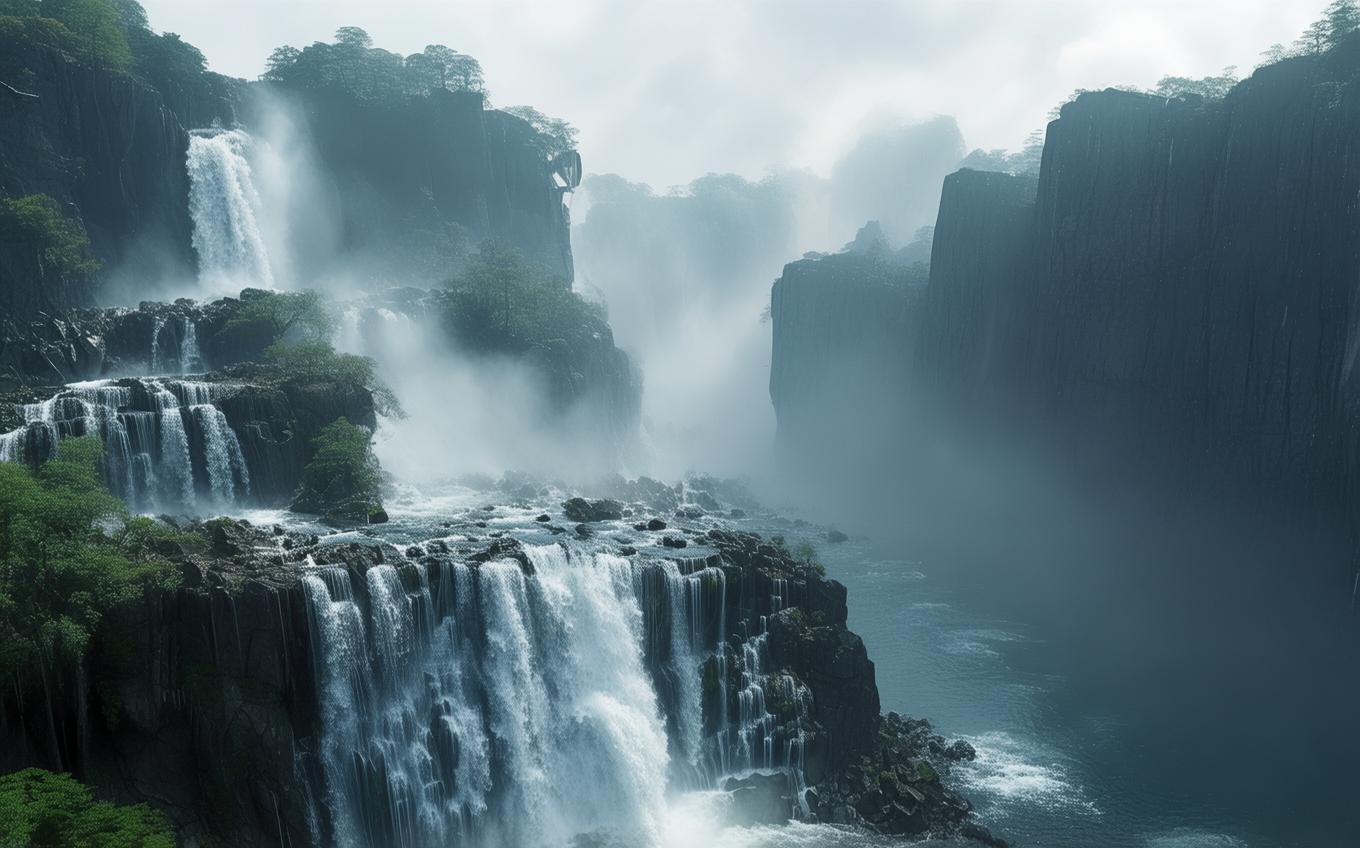
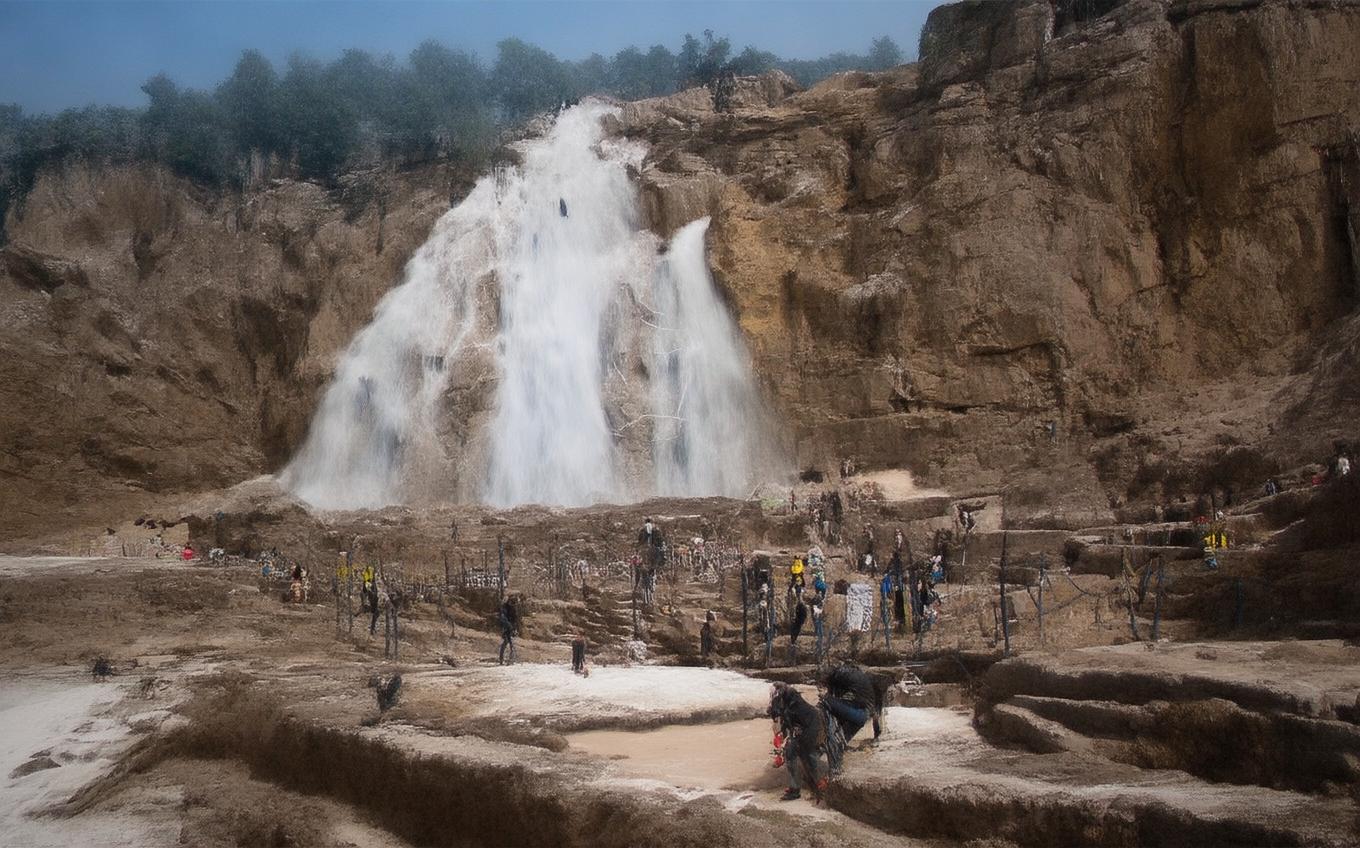
The poem opens with the image of water making its way through an impossible landscape—"a thousand cliffs and ten thousand ravines." The words qiān (thousand) and wàn (ten thousand) are not literal counts but evoke boundlessness, a Chinese poetic device to suggest the immense and innumerable obstacles. Bù cí láo (does not refuse the toil) personifies the waterfall as a determined traveler. It does not merely flow; it labors willingly. This line already hints at a larger-than-life spirit, a force of nature that accepts hardship as part of its journey.
Line 2: 远看方知出处高
The perspective shifts dramatically. Only by stepping back—yuǎn kàn (viewing from afar)—can one perceive the true height of the water’s origin. This is both a physical truth about waterfalls and a profound metaphor for discerning a person's inner stature. Huangbo, the Chan master, subtly looks at his student Li Chen as he speaks. Up close, the prince appears to be an ordinary monk, but from a distance of insight, his noble origin and lofty spirit become visible. The line operates on two levels: landscape description and a master’s quiet recognition of hidden greatness.
Line 3: 溪涧岂能留得住
Now it is Li Chen who speaks. He moves from description to prophecy. Xī jiàn (mountain brooks and narrow ravines) represent the confining, small channels of ordinary existence—or in his case, the monastic life he has been forced into. The rhetorical question qǐ néng liú de zhù (how can they possibly hold it back?) brims with confidence. The waterfall/persona cannot be contained by such petty boundaries. The tone here shifts from observation to declaration; the disciple reveals the ambition that the master had already glimpsed.
Line 4: 终归大海作波涛
The final destination is dà hǎi (the great sea), where the water will not merely merge but zuò bō tāo (make towering waves). This is not a passive disappearance but an active, powerful transformation. The sea is the vast stage worthy of the waterfall’s origin and effort. For Li Chen, the sea was the imperial throne, and the waves were the grand acts of governance he would one day undertake. The line completes the metaphor with a majestic finality—small streams cannot contain a force destined for the ocean.
Themes and Symbolism
The poem’s central theme is hidden greatness and inevitable destiny. The waterfall is a classic Chinese symbol for a person of exceptional ability temporarily concealed by circumstances. Water, in Daoist and Buddhist thought, represents the Way—yielding yet unstoppable, soft yet able to overcome all hardness. Here, water’s relentless journey from high peaks to the open sea mirrors the trajectory of a noble soul moving inexorably toward its rightful place.
A second theme is the master-disciple relationship. Huangbo’s lines are an act of seeing, a spiritual recognition. Li Chen’s response is an act of self-revelation. The coupling of their verses suggests that true insight comes from this meeting of enlightened perception and honest self-knowledge. The poem is a dialogue, not a monologue, and thus embodies the Chan ideal of sudden, mutual awakening.
Symbolically, the "thousand cliffs" represent the prince’s sufferings and exile, the "lofty source" his royal blood, the "mountain streams" his confined life as a monk, and the "great sea" his future empire. Every element of the natural landscape maps onto a chapter of Li Chen’s biography.
Cultural Context
This poem emerged during the late Tang dynasty, a period rife with court intrigue. Li Chen was the thirteenth son of Emperor Xianzong. To escape the murderous jealousy of his nephew, the reigning Emperor Wuzong, he fled the palace and took refuge in Buddhist temples, eventually studying under the fierce Chan master Huangbo. Chan Buddhism, with its emphasis on direct experience beyond words, provided a perfect disguise—and a philosophical lens for his hardship.
The "瀑布联句" is thus steeped in the unique fusion of Buddhist detachment and Confucian responsibility. Huangbo, an enlightened master, cared little for secular rank, yet he could see the Dharma purpose in Li Chen’s worldly destiny. The poem reflects the Chinese concept of tiānmìng (天命), the Mandate of Heaven: a true ruler cannot remain hidden forever; his virtue will manifest like a waterfall visible from afar. After Wuzong’s death, Li Chen indeed ascended the throne and became one of the Tang’s most capable later emperors, known for strict but benevolent rule—just as the poem foretold.
Conclusion
"瀑布联句" endures because it captures a moment of pure, crystalline insight shared between two hearts. In four short lines, a waterfall becomes a mirror for the human spirit: its labor, its hidden loftiness, its refusal to be confined, and its thunderous arrival into a destiny of vast scale. The collaboration between a Chan master and a hidden emperor makes the poem a cultural treasure, blending the stillness of meditation with the roar of history. Reading it today, we are reminded that true stature cannot be measured up close, and that all streams, no matter how winding their paths, are drawn to the great sea within them.
Comments (0)
No comments yet. Be the first to comment!