
Introduction
When we think of classical Chinese poetry, we often imagine the quiet voices of reclusive scholars or lovesick wanderers. It is rare—and deeply fascinating—to encounter a poem written by an emperor, especially the only woman ever to rule China in her own name. Wu Zetian (武则天, 624–705 CE), the formidable Tang dynasty empress, left behind a small but intriguing body of poetry. Among her surviving works, “游九龙潭” (Visiting the Nine Dragon Pool) stands out as a luminous example of her literary sensibility. Composed during an excursion to a scenic mountain pool, the poem weaves together Daoist immortals, imperial splendor, and a quiet, almost melancholic, reverence for nature. It offers a rare window into the mind of a ruler who balanced earthly power with a yearning for transcendent beauty.
The Poem: Full Text and Translation
山窗游玉女
Shān chuāng yóu yù nǚ
At the mountain window, jade maidens roam;
涧户对琼峰
Jiàn hù duì qióng fēng
Stream-side doors face a peak of purest jade.
岩顶翔双凤
Yán dǐng xiáng shuāng fèng
Above the cliff tops, a pair of phoenixes soar;
潭心倒九龙
Tán xīn dào jiǔ lóng
In the pool’s heart, nine dragons are reflected upside down.
酒中浮竹叶
Jiǔ zhōng fú zhú yè
In the wine float bamboo leaves;
杯上写芙蓉
Bēi shàng xiě fú róng
Upon the cup, a lotus blossom is traced.
故验家山赏
Gù yàn jiā shān shǎng
Thus I test the pleasures of my home mountains—
惟有风入松
Wéi yǒu fēng rù sōng
Yet only the wind moves through the pines.
Line-by-Line Analysis
The poem opens with a sudden lifting of the veil between the human and the divine: “山窗游玉女” (At the mountain window, jade maidens roam). A “mountain window” is a natural rock opening framing a distant view, but here it becomes a threshold where ethereal yù nǚ—Jade Maidens, female immortals of Daoist lore—gracefully wander. This is no ordinary landscape; it is a dwelling place of spirits. The second line, “涧户对琼峰” (Stream-side doors face a peak of purest jade), anchors the celestial vision in the physical world. The “stream-side doors” likely refer to a lodge or pavilion by the water, while qióng fēng, the “jade peak,” is both a literal description of a gleaming mountain and a deliberate link to the immortals’ precious stone. The parallelism sets up a dialogue between the otherworldly and the tangible.
With the third and fourth lines, the poem takes flight. “岩顶翔双凤” (Above the cliff tops, a pair of phoenixes soar) paints a majestic image of two mythical birds circling the crags. In Chinese culture, the phoenix (fèng) symbolizes high virtue, grace, and the empress herself—so a pair of them suggests not just scenic splendor but an imperial omen. The next line delivers the pool’s namesake: “潭心倒九龙” (In the pool’s heart, nine dragons are reflected upside down). The Nine Dragon Pool is said to contain nine boulders or rock formations that resemble submerged dragons. Wu Zetian cleverly turns a static geological feature into a dynamic reflection, making it seem as if the dragons are truly alive beneath the surface. The inversion (dào) of the image hints at a world turned upside down—a quiet, poetic claim to the kind of cosmic reversal she herself embodied as a female emperor.
The couplet on wine and drinking vessels shifts the focus from epic scenery to intimate detail. “酒中浮竹叶” (In the wine float bamboo leaves) may refer to actual bamboo leaves used to flavor the wine or simply to leaves drifting onto the cup’s surface. Either way, the image is delicate and transient. “杯上写芙蓉” (Upon the cup, a lotus blossom is traced) evokes a painted or carved lotus on the drinking vessel. The lotus (fúróng) is a symbol of purity emerging from muddy water, often associated with Buddhist enlightenment—a faith Wu Zetian actively patronized. Together, these two lines suggest a moment of refined pleasure, a pause amid the grandeur to appreciate the smallest, most ephemeral beauties.
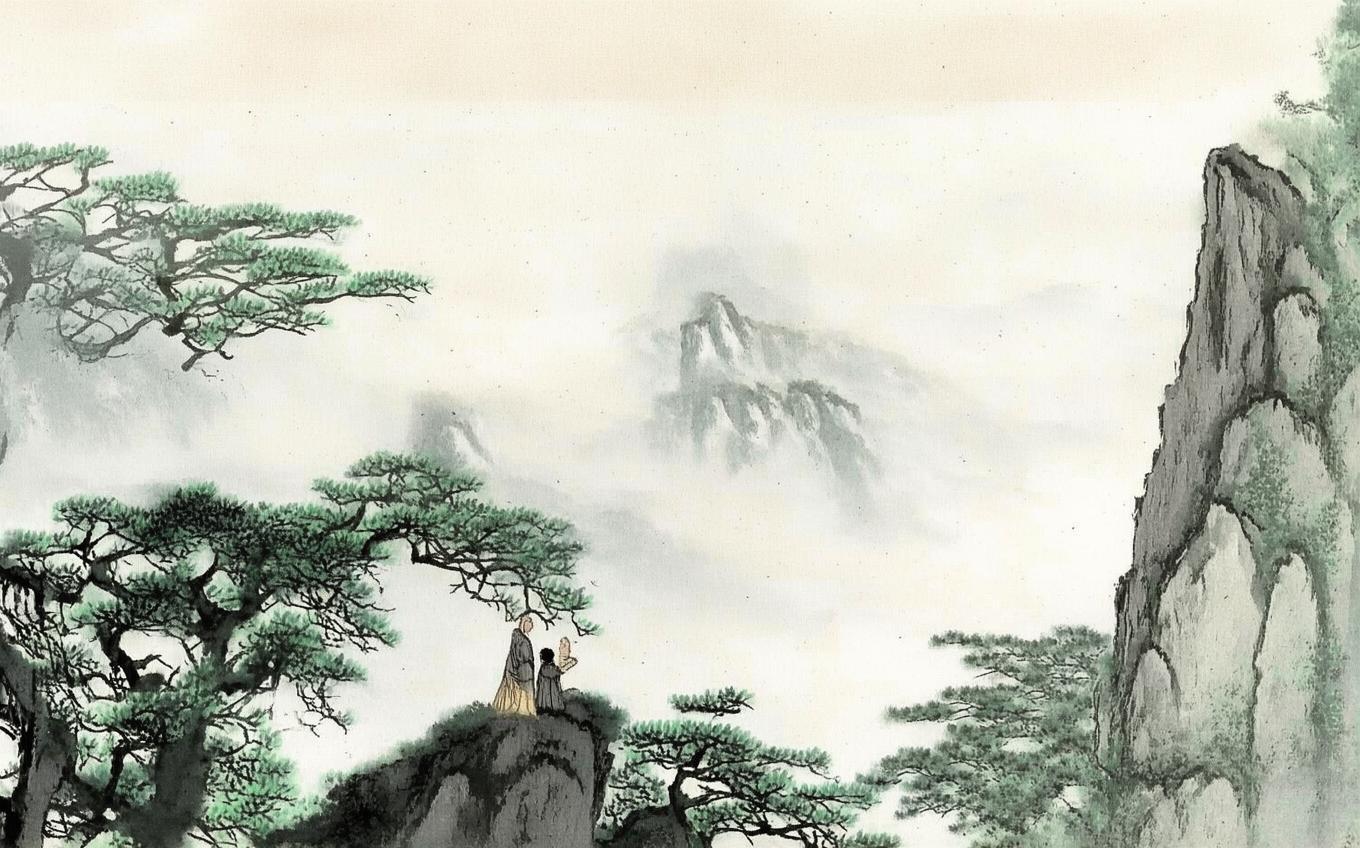
The poem concludes with a startling, introspective turn. “故验家山赏” (Thus I test the pleasures of my home mountains) reveals that the speaker is deliberately measuring the experience of this famous pool against the remembered landscapes of her homeland. The word gù (thus, therefore) implies a purposeful comparison. Then the final line delivers a quiet epiphany: “惟有风入松” (Yet only the wind moves through the pines). No matter how spectacular the jade peaks, flying phoenixes, or dragon shadows, what truly endures—and what speaks most deeply to the soul—is the simple, eternal sound of wind sighing through the pine trees. It is an unexpectedly humble and universal note from an emperor who commanded vast power.
Themes and Symbolism
Nature and the sacred lie at the poem’s heart. Wu Zetian does not merely describe a landscape; she sacralizes it through Daoist and Buddhist imagery. Jade maidens, jade peaks, phoenixes, and dragons transform a mountain outing into a journey through a mythological realm. This reflects the Tang dynasty’s deep fascination with the Daoist pursuit of immortality and the belief that certain mountains and waters were gateways to other worlds.
Another key theme is the tension between imperial grandeur and personal introspection. The phoenixes are both a realistic bird and an imperial insignia; the nine dragons allude to the emperor’s symbolic number. Wu Zetian’s choice of such imagery cannot be accidental—it announces her own majestic presence. Yet the final couplet undercuts this magnificence with an almost pastoral longing for simplicity. “Home mountains” (jiā shān) is a phrase charged with nostalgia, and the wind in the pines is a classic trope in Chinese poetry for solitary contemplation. The poem thus becomes a meditation on where true value lies: not in the spectacular visions of power, but in the enduring, quiet voice of nature.
The lotus on the cup also carries a subtle Buddhist message. Wu Zetian famously promoted Buddhism, linking her rule to the ideal of a compassionate, enlightened monarch. The lotus, rising unstained from the mud, serves as a quiet emblem of her self-image as a ruler who could transcend the chaos of politics and attain a purer state.
Cultural Context
To fully appreciate this poem, one must understand the extraordinary figure of Wu Zetian. She entered the court as a concubine of Emperor Taizong, later became the empress consort of his son Emperor Gaozong, and eventually seized the throne herself, declaring her own Zhou dynasty in 690 CE. Her reign was both ruthlessly pragmatic and culturally brilliant. She patronized the arts, commissioned massive Buddhist cave temples, and encouraged poetry. Her own verses, though few, reveal a ruler who sought legitimacy not only through statecraft but also through cultural and spiritual expression.
“游九龙潭” was likely written during an imperial excursion, a common practice among Tang rulers who traveled to scenic and sacred sites to affirm their connection to the land and the cosmos. The Nine Dragon Pool itself may be located in Songshan (Mount Song) in Henan province, one of China’s sacred Daoist mountains, or in a nearby scenic area favored by the court. By composing a poem at such a site, Wu Zetian followed the tradition of emperor-poets like her father-in-law Taizong, but she infused the genre with a distinctly feminine and self-reflective sensibility. The final couplet, with its wistful mention of “home mountains,” has been read by some scholars as a veiled reference to her own distant origins—she was born in Wenshui, Shanxi, far from the Tang capital Chang’an—and perhaps a quiet acknowledgment that even absolute power cannot fully replace a sense of belonging.
Conclusion
Wu Zetian’s “Visiting the Nine Dragon Pool” endures because it balances soaring myth with a remarkably personal ending. For the English-speaking reader, it offers more than a picturesque travelogue. It is a poem about how we measure experience, how we seek the sacred in nature, and how even a monarch can be humbled by the sound of wind through pines. In a world that often worships spectacle, this poem’s gentle reminder that true beauty often lies in simplicity remains as resonant today as it was thirteen centuries ago. Through her words, the only female emperor of China invites us all to pause, look closely at a floating leaf or a painted lotus, and listen for the ancient whisper that needs no throne to be heard.
Comments (0)
No comments yet. Be the first to comment!