Introduction
The poem "赠胡天师" (Zèng Hú Tiānshī, "Presented to the Celestial Master Hu") is a striking example of Tang-dynasty Daoist poetry, authored by one of the most extraordinary figures in Chinese history — Wu Zetian (武则天, 624–705), the only woman to ever rule China as emperor in her own right. Wu Zetian was not merely a political titan; she was also a deeply cultured patron of literature, Buddhism, and Daoism, and her court became a crucible for religious and artistic expression. This poem, addressed to a Daoist master named Hu, crystallizes the empress’s fascination with the Daoist quest for immortality, the eremitic ideal, and the transformative power of alchemy. It offers modern readers a rare glimpse into the spiritual landscape of early medieval China, where the boundaries between earthly power and celestial aspiration were often blurred.
The Poem: Full Text and Translation
高人叶高志,
Gāo rén yè gāo zhì,
A noble person matches his lofty will;
山服往山家。
Shān fú wǎng shān jiā,
In mountain garb he departs for a mountain home.
超迹绝尘网,
Chāo jì jué chén wǎng,
Transcendent traces cut off the dusty net;
清心入烟霞。
Qīng xīn rù yān xiá,
A pure heart enters the mist and rosy clouds.
欲验长生诀,
Yù yàn cháng shēng jué,
Wishing to test the secret of long life,
先开五月花。
Xiān kāi wǔ yuè huā,
First he opens the flowers of May.
仙童迎橘叟,
Xiān tóng yíng jú sǒu,
Immortal boys greet the elder orange-gatherer;
天女送丹砂。
Tiān nǚ sòng dān shā,
Celestial maidens deliver cinnabar.
Line-by-Line Analysis
Line 1: “高人叶高志”
The poem opens with an elegant parallelism: gāo rén (高人, “noble person”) is set against gāo zhì (高志, “lofty will/aspiration”). The character 叶 (yè), which literally means “leaf,” here functions as a verb meaning “to harmonize with” or “to match.” The line suggests that Master Hu’s inner moral stature naturally aligns with his elevated spiritual ambitions. It immediately places the subject within the Confucian-Daoist ideal of the junzi (君子) or “sage,” but already tilts toward a Daoist transcendence of worldly norms.
Line 2: “山服往山家”
The phrase shān fú (山服) refers to the simple, rustic clothing worn by mountain hermits — a deliberate rejection of courtly silks. The repetition of shān (山, “mountain”) in shān jiā (山家, “mountain home”) reinforces the total immersion into a life of reclusion. The movement “departs for” (往) signals not just a physical journey but a symbolic renunciation of the secular world. Wu Zetian, who ruled from the apex of political power, here admires — perhaps even envies — the master’s retreat to a purer existence.
Line 3: “超迹绝尘网”
Chāo jì (超迹) means “traces that transcend” — the visible marks of an enlightened being who has moved beyond ordinary existence. Chén wǎng (尘网, “dusty net”) is a powerful Buddhist-Daoist metaphor for the entanglements of mundane life: desire, wealth, fame, and social obligations that trap the unenlightened. To “cut off” (绝) the dusty net is to achieve liberation. This line reveals the poem’s core theme: the pursuit of spiritual freedom from the world’s snares.
Line 4: “清心入烟霞”
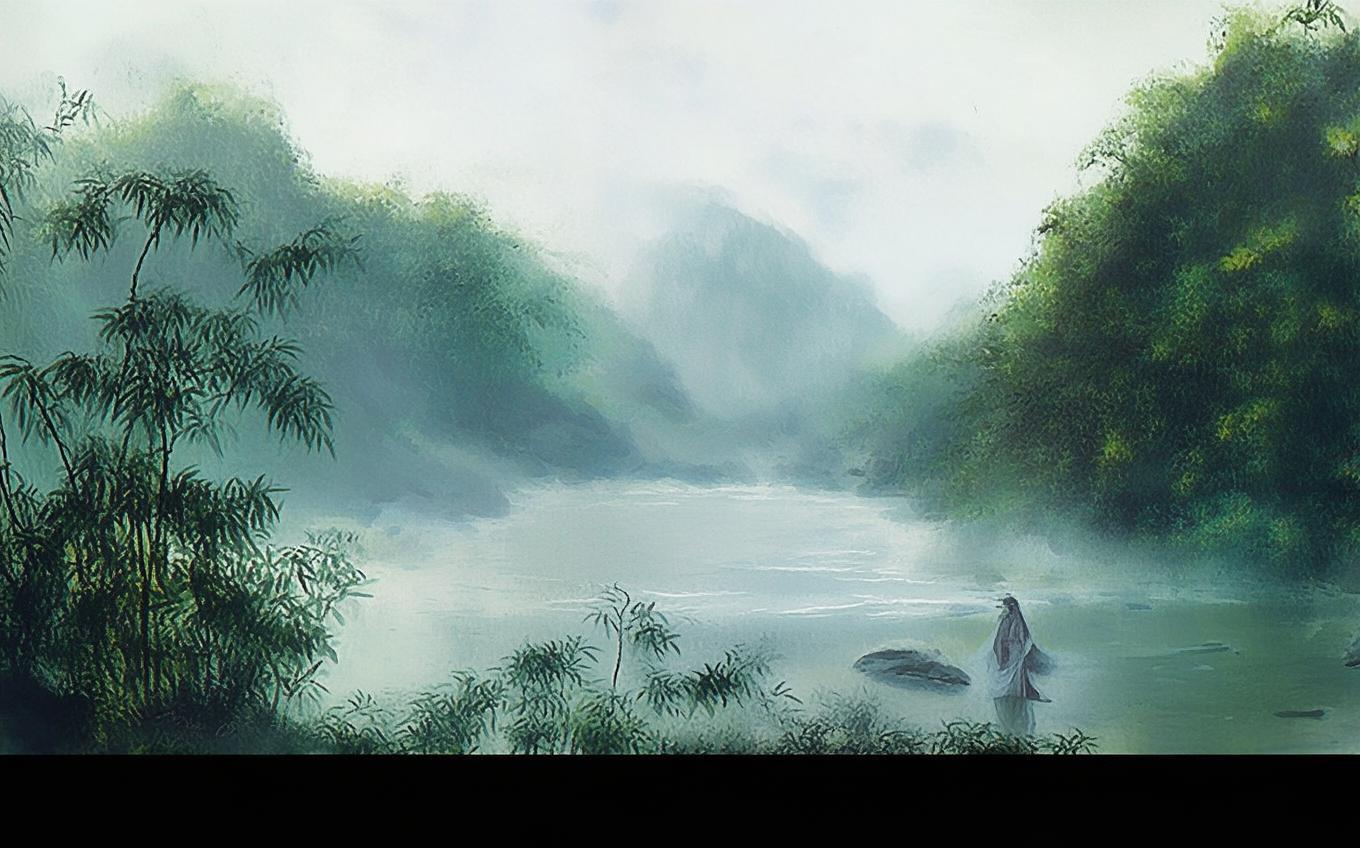
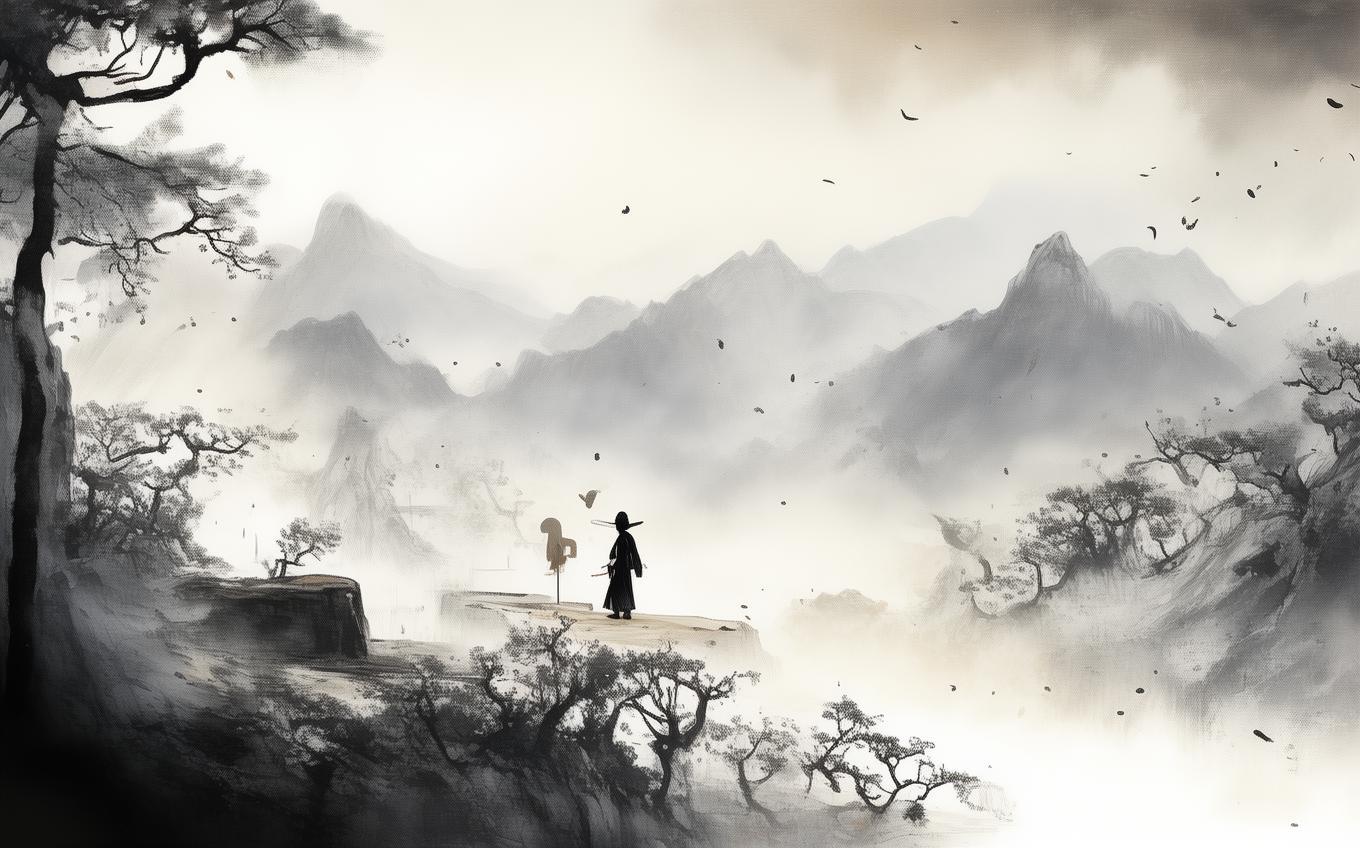
A “pure heart” (qīng xīn, 清心) is a mind cleansed of desire and distraction — a prerequisite for Daoist meditation and alchemical work. Yān xiá (烟霞, “mist and rosy clouds”) symbolizes both the literal mists of the sacred mountains and the ineffable realm of the Dao. Entering the mist is a metaphor for merging with the natural cosmic order, the ultimate goal of the Daoist adept. The line is intensely visual, evoking a landscape painting in words.
Line 5–6: “欲验长生诀,先开五月花”
Here the poem shifts to alchemical practice. Cháng shēng jué (长生诀) is the “secret formula for long life” — the elusive elixir of immortality. The act of “testing” or “verifying” (验) it underscores the empirical, almost scientific dimension of Daoist alchemy. Opening the “May flowers” (wǔ yuè huā) likely refers to a seasonal alchemical process, as many elixir recipes called for gathering herbs or minerals at specific times when their qi was most potent. It may also symbolize the inner blossoming that precedes spiritual transformation, a springtime of the soul.
Line 7–8: “仙童迎橘叟,天女送丹砂”
The poem concludes with a tableau of celestial welcome. Jú sǒu (橘叟, “elder orange-gatherer”) alludes to a Daoist immortal from folklore — an old man who grew magical oranges and later ascended to heaven. By identifying Master Hu with this figure, the poet suggests he, too, will achieve apotheosis. Immortal boys (仙童) serve as guides, while celestial maidens (天女) offer dān shā (丹砂, “cinnabar”), the primary ingredient of the immortality elixir. The imagery is sumptuous and courtly, yet entirely otherworldly: Wu Zetian projects a heavenly parallel to her own earthly majesty, legitimizing both her power and her spiritual aspirations.
Themes and Symbolism
Renunciation and Transcendence
The poem glorifies the eremitic ideal — the conviction that true wisdom lies outside the “dusty net” of society. Master Hu’s retreat into the mountains symbolizes a radical break with mundane attachments, a theme deeply rooted in both Daoism and Chan Buddhism.
Immortality and Alchemy
The quest for cháng shēng (long life) pervades the text. Cinnabar, May flowers, and the “secret formula” are all elements of waidan (外丹, “outer alchemy”), the practice of compounding elixirs to attain physical immortality. At a deeper level, they also point to neidan (内丹, “inner alchemy”), the transformation of the body’s energies into a spiritual body.
Nature as a Sacred Realm
The mountain, the mist, the clouds, and the seasonal cycles are not mere scenery — they are the very fabric of the Dao. To “enter the mist” is to return to the undifferentiated source, a concept known as wuji (无极) in Daoist cosmology.
Court Meets Celestial
Uniquely, the poem bridges two worlds: the empress’s imperial court and the hermit’s mountain refuge. The final couplet’s celestial pageantry mirrors Tang palace rituals, suggesting that the heavenly realm is structured like a perfected empire. Wu Zetian’s voice, though gracious, is unmistakably that of a sovereign, conferring recognition on a spiritual master.
Cultural Context
The Tang dynasty (618–907) was a golden age of cultural openness and religious syncretism. Daoism, in particular, enjoyed imperial favor because Laozi, the mythical founder of Daoism, was said to share the surname Li with the Tang royal family. Wu Zetian’s own relationship with Daoism was pragmatic and multifaceted: she patronized Daoist institutions to bolster her legitimacy after she usurped the throne and declared her own Zhou dynasty (690–705). This poem was likely composed during her reign, when she was actively cultivating ties with renowned Daoist adepts.
Master Hu himself remains historically elusive, but his title Tiānshī (天师, “Celestial Master”) ties him to the Way of the Celestial Masters (天师道), one of the earliest organized Daoist schools. By writing such a poem, the empress publicly aligned herself with the Daoist quest for immortality, a powerful symbolic gesture in a culture where longevity and sagely rule were deeply intertwined.
The poem also reflects the broader Tang fascination with youxian (游仙, “roaming immortals”) poetry, a genre in which poets imagined journeys to transcendent realms. Wu Zetian here elevates that genre from a literary fantasy to a personal, almost diplomatic, communication with a living adept.
Conclusion
Wu Zetian’s “赠胡天师” is far more than a courteous inscription to a religious figure — it is a window into the soul of an empress who yearned for what even absolute power could not grant: transcendence of the dusty net of mortal existence. In eight tightly woven lines, she paints a portrait of a sage who harmonizes with nature, masters the secrets of alchemy, and is welcomed into the celestial court. The poem’s enduring appeal lies in its fusion of imperial grandeur with spiritual humility, its lush imagery, and its timeless meditation on the human longing for permanence. For modern readers, it serves as a reminder that the most powerful among us may still gaze upward, hoping to catch a glimpse of the misty peaks where the immortals dwell.

Comments (0)
No comments yet. Be the first to comment!