Introduction
"从驾幸少林寺" (Cóng jià xìng Shàolín Sì), often translated as "Accompanying the Imperial Carriage on a Visit to Shaolin Temple," is a poem by Wu Zetian (武则天), the only woman to rule China as emperor in her own name. As an imperial consort, empress dowager, and eventually founder of the Zhou dynasty, Wu Zetian was a powerful patron of Buddhism, and her reign saw the faith flourish. This poem, composed during a visit to the legendary Shaolin Monastery, blends regal formality with deep personal piety, offering a rare glimpse into the inner world of a ruler often remembered for political ruthlessness. It stands as a graceful example of Tang dynasty court poetry, where imperial processions, natural beauty, and Buddhist aspiration merge into a single, luminous tableau.
The Poem: Full Text and Translation
陪銮游禁苑,
Péi luán yóu jìn yuàn,
Attending the phoenix carriage, I roam the forbidden park;
侍从幸少林。
Shìcóng xìng Shàolín.
Serving in escort, we visit Shaolin.
翠微横半岭,
Cuìwēi héng bàn lǐng,
Emerald mist spreads across the mid-slope,
白云生远岑。
Báiyún shēng yuǎn cén.
White clouds rise from distant peaks.
泉飞疑度雨,
Quán fēi yí dù yǔ,
A spring plunges – I mistake it for passing rain;
石净似无尘。
Shí jìng sì wú chén.
The rocks are so pure they seem free of all dust.
愿以此功德,
Yuàn yǐ cǐ gōngdé,
May the merit gained from this visit
普及于一切。
Pǔjí yú yīqiè.
Extend universally to all beings.
Line-by-Line Analysis
“陪銮游禁苑,侍从幸少林。”
The poem opens with a stately, almost ceremonial tone. “銮” (luán) refers to the imperial carriage, often decorated with bells, and here it stands metonymically for the emperor himself. By placing herself in the role of an attendant, Wu Zetian adopts the proper humility expected of a consort, yet she also positions herself at the very heart of power. “禁苑” (jìn yuàn) — the forbidden gardens — evokes the exclusive royal parks within the palace compound, a space removed from the ordinary world. The journey outward to Shaolin Temple thus becomes a passage from worldly magnificence to spiritual sanctuary.
“翠微横半岭,白云生远岑。”
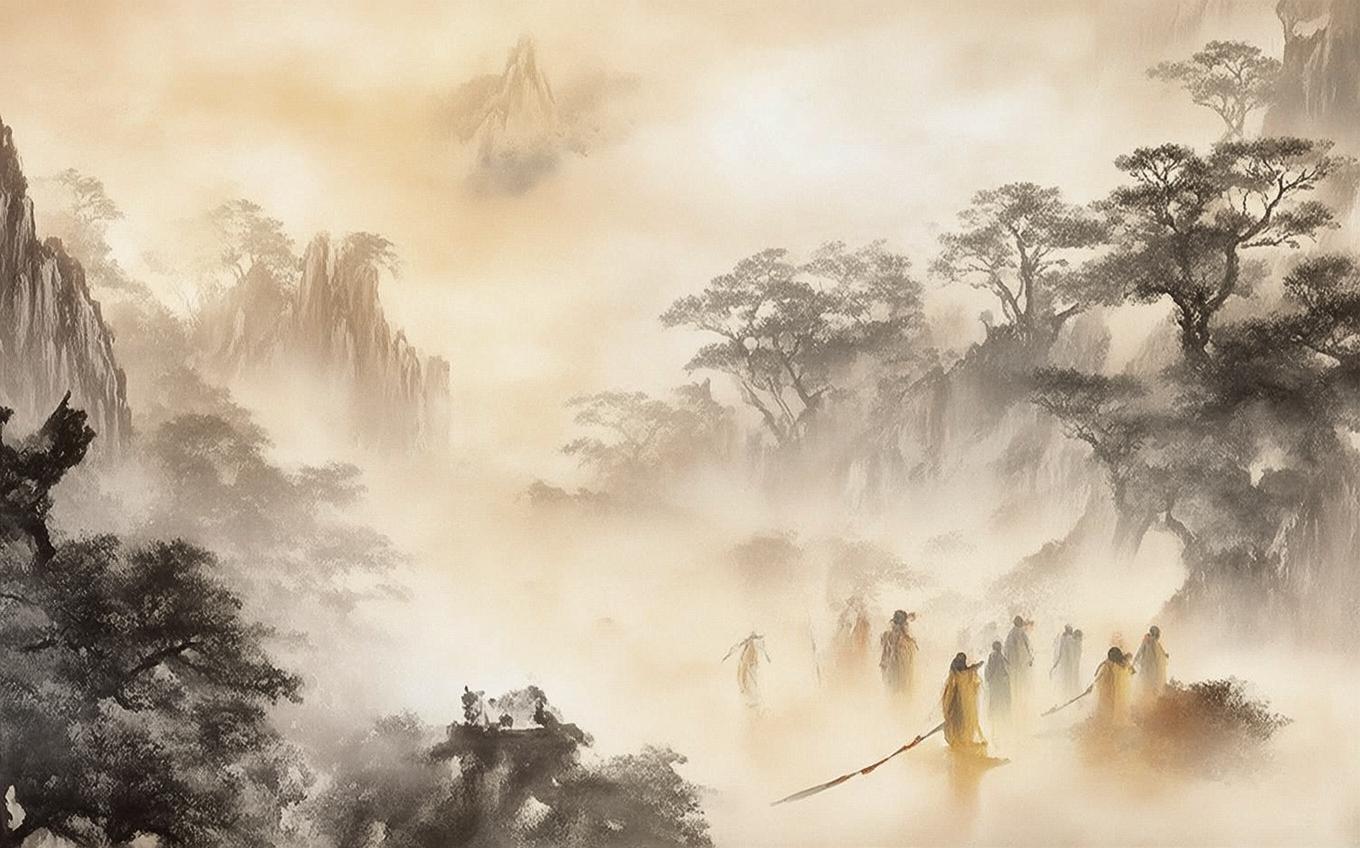
The focus shifts dramatically from ritual to landscape. “翠微” (cuìwēi) is a delicate phrase, literally “emerald faintness,” describing the translucent green haze of mountain foliage seen from a distance. It “spreads horizontally” across half the slope, creating a sense of serene, enveloping beauty. The image of white clouds rising from far-off peaks (“远岑”) reinforces the scale and remoteness of the scene. These two lines do more than paint a picture — they suggest that the farther one travels from the court, the closer one comes to a world of natural purity, a prelude to the Buddhist environment of Shaolin.
“泉飞疑度雨,石净似无尘。”
This couplet brings us into the temple’s immediate surroundings with sharp sensory immediacy. The spray of a waterfall is so fine and continuous that the observer momentarily mistakes it for rain. The word “疑” (yí, “suspect” or “mistake”) captures that fleeting perceptual illusion. Then the next line shifts to stillness: the stones are so immaculately clean they appear entirely free of worldly dust. “尘” (chén, dust) is a loaded Buddhist term, symbolizing the defilements of desire and ignorance that obscure the mind. Thus, the pure rocks become a metaphor for spiritual cleansing — the landscape itself embodies the ideal state of non-attachment.
“愿以此功德,普及于一切。”
The closing couplet is a direct Buddhist dedication. The “merit” (功德, gōngdé) refers to the spiritual rewards accrued through good deeds, such as a pilgrimage to a holy site. By vowing to share this merit universally, the poet expresses the Mahayana ideal of compassion, where one’s own spiritual progress is inseparable from the liberation of all sentient beings. The language is simple, almost formulaic, but when seen in the context of an empress’s voice, it becomes profoundly moving: the most powerful woman in the world bends her authority toward a prayer for universal well‑being.
Themes and Symbolism
-
Pilgrimage and Transition: The journey from the “forbidden park” to the remote temple mirrors an inner movement from temporal power to spiritual reflection. The restricted, man‑made world of the court yields to the boundless, natural realm of the sacred mountain.
-
Nature as a Mirror of Purity: The green mist, white clouds, flying spring, and dustless stones are not merely decorative; each element carries moral and spiritual weight. Water cleanses, rock remains unmoved by defilement, and clouds drift unburdened — all pointing toward an ideal of detachment and clarity.
-
Buddhist Devotion and Empathy: The final dedication transforms a descriptive travel poem into a votive act. The poem itself becomes an offering, its words intended to generate and spread merit, reflecting the profound integration of art and religion in Tang culture.
-
Imperial and Spiritual Harmony: Wu Zetian presents herself simultaneously as a devoted consort following the emperor’s lead and as a Buddhist practitioner seeking transcendence. The double role reflects a broader Tang ideal: the ruler’s mandate was both political and cosmic, and imperial patronage of Buddhism reinforced the dynasty’s claim to benevolent, universal rule.
Cultural Context
Shaolin Temple, located on Mount Song in Henan, was already a renowned Buddhist monastery by the Tang dynasty, famous for its Chan (Zen) meditation tradition and, later, its martial arts. In 683 CE, Emperor Gaozong and Empress Wu visited the temple, and this poem was likely composed during that excursion. Empress Wu’s personal attachment to Buddhism was genuine and politically astute — she sponsored the translation of sutras, financed cave temples at Longmen, and claimed her reign was prophesied in Buddhist scripture. Her use of the humble, even self‑effacing tone in this poem must be read against her formidable historical image; it illustrates how a ruler could deploy humility as a form of sacred authority. The phrase “普及于一切” (“extend universally to all”) echoes the phrasing of Buddhist liturgical formulas, rooting the poem in actual ritual practice.
Conclusion
“从驾幸少林寺” is a gem of Tang court poetry — deceptively simple, yet rich in layered meaning. It captures a ruler’s rare moment of quiet devotion, wrapping a prayer for universal salvation in the delicate imagery of mountain mist and running water. For modern readers, the poem offers a window into how spiritual life and political power were intertwined in medieval China, and how even the most formidable personalities could pause before nature’s purity and aspire to something far larger than themselves. The poem’s enduring beauty lies in this fusion: a brief, shimmering instant where an empress stood at the edge of a sacred mountain and wished for peace, not for herself alone, but for all the world.

Comments (0)
No comments yet. Be the first to comment!