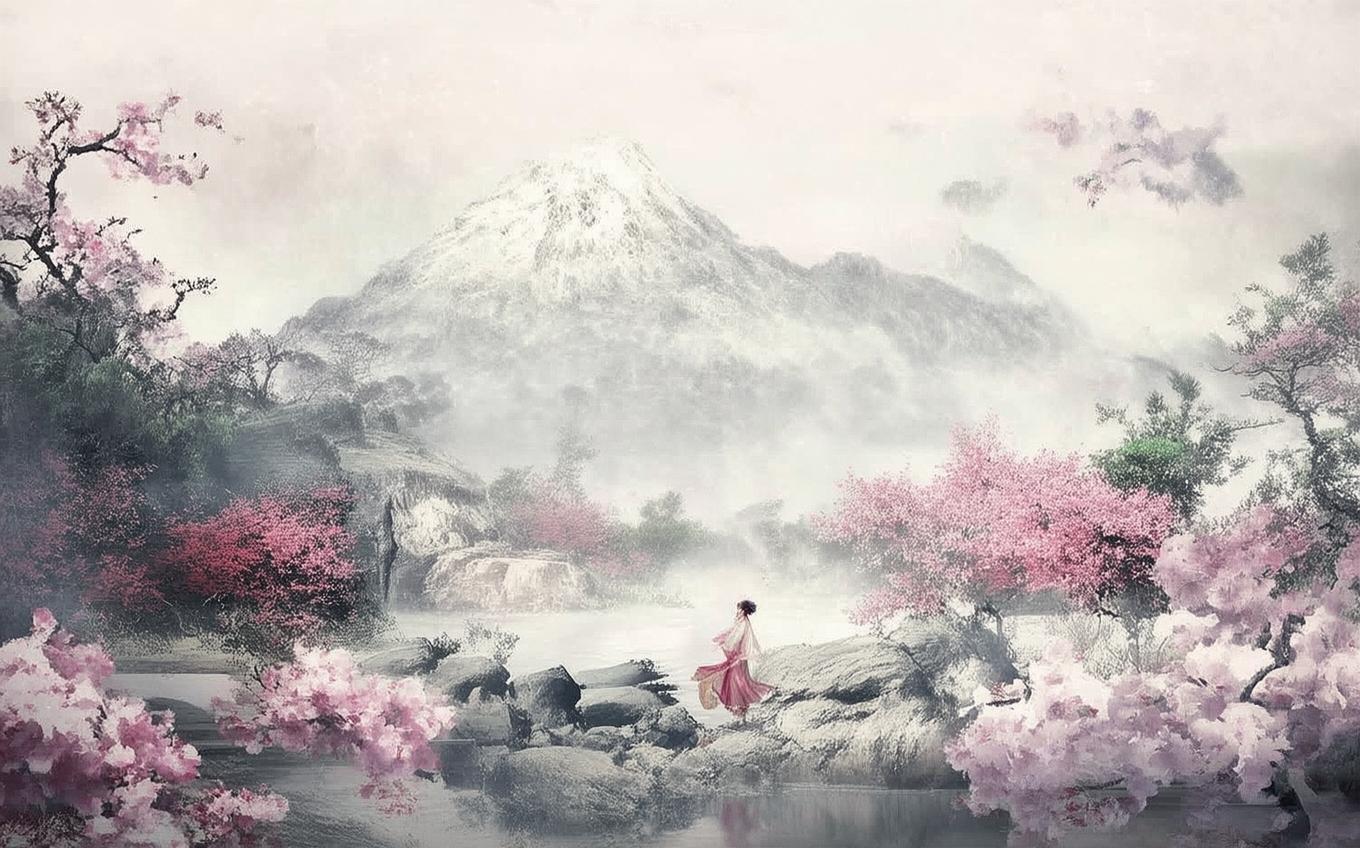
Analysis of "赋得北方有佳人" - Classical Chinese Poetry
Introduction
Few poems in Chinese history have managed to capture the fatal allure of beauty as succinctly and powerfully as the one attributed to Li Yannian (李延年), a court musician during the Western Han dynasty. The poem, sometimes referred to as "Fù dé Běifāng Yǒu Jiārén" (赋得北方有佳人, "Composed on the Theme: There is a Beauty in the North"), is more commonly known simply as "Běifāng Yǒu Jiārén" or "Li Yannian's Song." Composed in the 2nd century BCE, it was not merely a literary exercise but a strategic performance that would change the course of imperial favor. Tradition holds that Li Yannian performed this song before Emperor Wu of Han, extolling the charms of a mysterious northern beauty—who turned out to be his own sister, later to become the beloved Consort Li. This short poem, with its hypnotic rhythm and escalating consequences of beauty, remains one of the most quotable works in the Chinese poetic canon.
The Poem: Full Text and Translation
北方有佳人,
Běifāng yǒu jiārén,
In the north there is a beauty
絕世而獨立。
Juéshì ér dúlì.
Unmatched in the world, she stands alone.
一顧傾人城,
Yī gù qīng rén chéng,
One glance from her topples a city,
再顧傾人國。
Zài gù qīng rén guó.
A second glance topples a state.
寧不知傾城與傾國?
Nìng bù zhī qīng chéng yǔ qīng guó?
How could one not know that cities and states may fall?
佳人難再得。
Jiārén nán zài dé.
[But] a beauty like this is hard to find again.
Line-by-Line Analysis
"In the north there is a beauty" (北方有佳人) opens the poem with an air of distance and legend. The word “north” (běifāng) was not only a geographical marker but also a cultural signifier in the Han dynasty, often evoking the exotic, the untamed, and the alluringly different. To the court in Chang’an, a “northern beauty” would suggest a woman of northern frontier regions, perhaps with a distinctive grace that set her apart from the conventionally admired southern belles.
"Unmatched in the world, she stands alone" (絕世而獨立) intensifies the mystique. The phrase juéshì literally means “severed from the world” or “without equal in the age.” This isolation is both a statement of singular beauty and a hint of tragic solitude. She is not merely the most beautiful; she exists on a plane entirely apart, suggesting an almost unearthly perfection that transcends ordinary human comparison.
"One glance from her topples a city, / A second glance topples a state" (一顧傾人城,再顧傾人國) forms the rhetorical and metaphorical centrepiece. Here the poet deploys hyperbole with devastating elegance. The verbs qīng (傾, to tilt, topple, overthrow) transform the act of looking into a weapon of mass destruction. The progression from “city” (chéng) to “state” (guó) mirrors an escalation: a single look can ruin a fortified city, a prolonged gaze can bring down an entire kingdom. The imagery draws on a long-standing historical anxiety in Chinese culture about the femme fatale — the concubine whose beauty distracts rulers into folly and dynastic collapse.
"How could one not know that cities and states may fall?" (寧不知傾城與傾國?) injects a rhetorical question that acknowledges the danger. The speaker fully understands the risk — the ruin of cities and nations is no secret. This line acts as a tragic refrain, a moment of moral clarity that makes the final line all the more shocking.
"[But] a beauty like this is hard to find again" (佳人難再得) delivers the unforgettable conclusion. The conjunction nìng (would rather) implied earlier gives way to a resigned obsession: knowing the catastrophic consequences, the speaker still deems the beauty worth it. The word nán (難, difficult) underscores the extreme rarity. The logic of the poem is not that one should avoid such a beauty to preserve the state, but rather that her value exceeds that of cities and kingdoms because she cannot be replaced. It is a breathtaking inversion of Confucian cautionary tales.
Themes and Symbolism
The dominant theme is the destructive power of supreme beauty. The poem operates on a fault line between desire and morality, echoing a trope familiar from Chinese historiography: the “disastrous beauty” (hóngyán huòshuǐ). By making the beauty the active agent whose glance topples fortifications, Li Yannian transforms passive allure into a force of nature — one that renders the rational calculations of statecraft futile.
A second theme is rarity and transience. The closing line grounds the hyperbolic fantasy in a simple, almost economic truth: some things are irreplaceable. A city, even a nation, can be rebuilt, but a woman of such extraordinary allure appears perhaps once in a lifetime. This sentiment taps into a Daoist-tinged melancholy about the fleeting nature of all rare things.
Symbolically, the glance (顧) carries enormous weight. It is not the woman’s full body, her voice, or her actions that cause destruction, but merely her eyes meeting those of a ruler. This minimalistic trigger makes the power seem magical, almost supernatural. The north symbolizes distance, otherness, and virgin allure, while the city and state function as metonyms for everything solid and political — the world of men that can be undone by a single woman’s gaze.
Cultural Context
Li Yannian composed this poem during the reign of Emperor Wu of Han (r. 141–87 BCE), a period of military expansion, economic prosperity, and cultural florescence. The emperor was a patron of music and poetry, and the court was filled with performers who could rise to influence through their art. Li Yannian himself was a musician of the Imperial Music Bureau, and his performance of this song was a masterstroke of political engineering.
According to the Book of Han, when Emperor Wu heard the poem, he sighed and lamented that such a woman could not exist. Li Yannian’s sister, then a dancer, was subsequently introduced, and the emperor was captivated. She became Consort Li, cementing the family’s status. The poem thus doubled as an advertisement and a prophecy that fulfilled itself. The phrase “qīng chéng qīng guó” (傾城傾國, “ruin cities and ruin states”) entered the Chinese lexicon as a set expression for devastating female beauty, used in literature and everyday speech to this day.
The poem also reflects an ambivalence deeply rooted in Chinese philosophy. Confucian historiography often warned against the seductive allure of women who led kings astray (like Baosi or Daji). Yet here, the warning is uttered and then casually dismissed in favor of aesthetic and emotional fulfillment. This tension between duty and desire, public order and private passion, animates centuries of Chinese poetry and drama.
Conclusion
Li Yannian’s “北方有佳人” endures because it does what great lyric poetry should: it distills an entire dramatic world into a few tensile lines. Its logic is absurd and undeniable at once. The poem holds a mirror to the irrational calculus of desire — we know the risks, yet we plunge headlong because something irreplaceable hangs in the balance. For modern readers navigating a world of calculated safety, this ancient song reminds us that the most valuable things often carry the highest price. Through its haunting musicality and razor-sharp progression, it captures a truth as old as civilization: beauty is not merely pleasant, it is perilous, precious, and impossible to forget.

Comments (0)
No comments yet. Be the first to comment!