Introduction
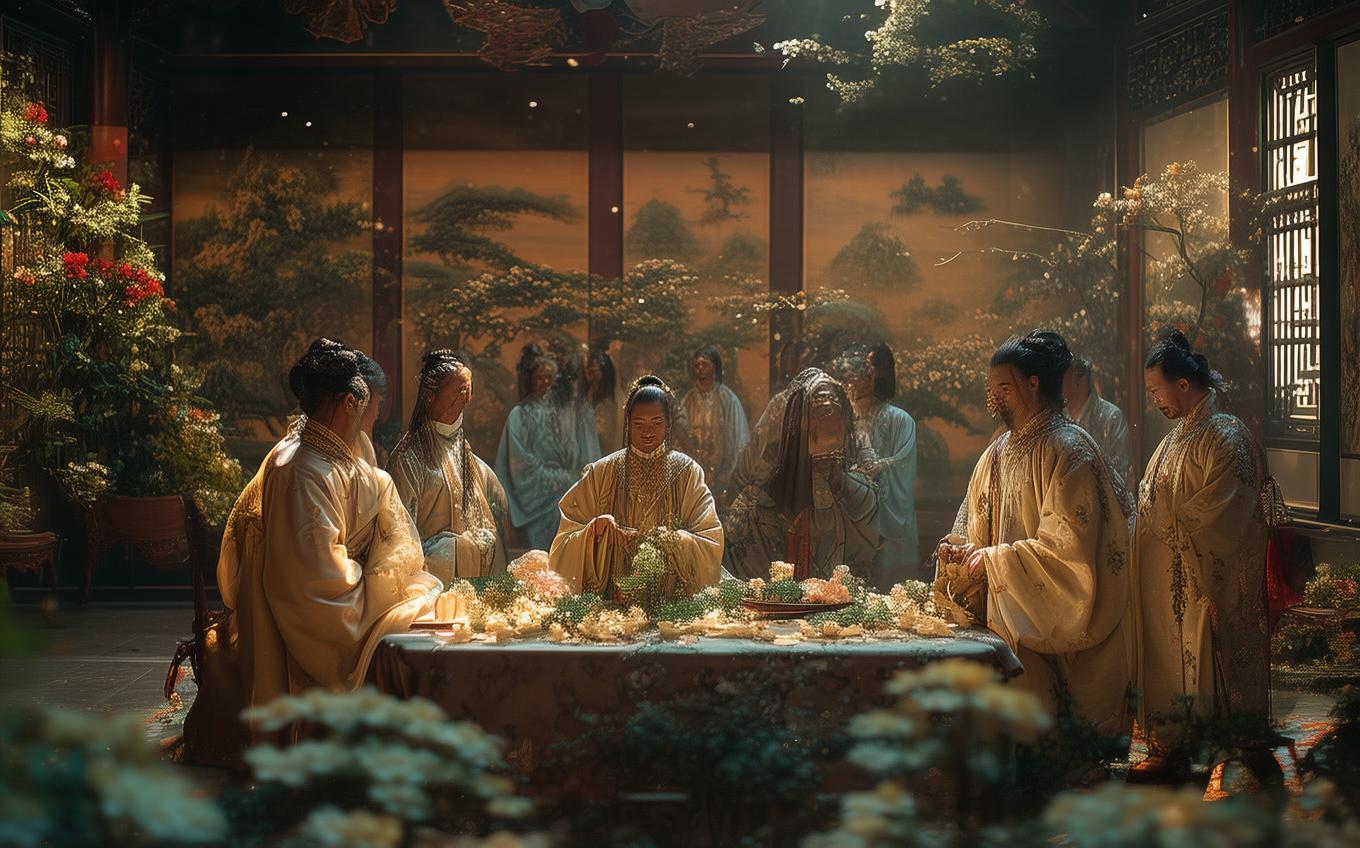
Composed in the early eighth century, this poem is a brilliant example of Tang dynasty occasional verse—poetry written for a specific court event. The author is Shangguan Wan’er (上官婉儿, 664–710), one of the most remarkable women in Chinese literary history. A trusted secretary and poet under Empress Wu Zetian and later Emperor Zhongzong, she was famed for her wit, learning, and ability to compose graceful verse on command. The title tells us everything about the occasion: “Respectfully Harmonizing with His Majesty’s Poem on the Beginning of Spring, at a Banquet in the Inner Palace, on the Theme of Cut-out Colored Flowers” (奉和圣制立春日侍宴内殿出翦彩花应制). The emperor wrote a poem, and Shangguan Wan’er was asked to match it—a demonstration of both literary skill and courtly tact. Her poem takes the artificial cut-paper flowers decorating the palace and turns them into a playful, philosophical meditation on the boundary between the real and the made. It is a small masterpiece that lets us glimpse the elegance, humor, and intellectual finesse of Tang high culture.
The Poem: Full Text and Translation
密叶因裁吐,
Mì yè yīn cái tǔ,
Dense leaves emerge because of the cutting;
新花逐剪舒。
Xīn huā zhú jiǎn shū.
Fresh flowers unfold following the scissors.
攀条虽不谬,
Pān tiáo suī bú miù,
Climbing a branch would not be a mistake;
摘蕊讵知虚。
Zhāi ruǐ jù zhī xū.
Yet picking a stamen—how would one know it’s hollow?
春至由来发,
Chūn zhì yóu lái fā,
When spring arrives, they burst forth as ever;
秋还未肯疏。
Qiū huán wèi kěn shū.
Even in autumn, they still refuse to thin.
借问桃将李,
Jiè wèn táo jiāng lǐ,
May I ask the peach and the plum:
相乱欲何如。
Xiāng luàn yù hé rú.
If you are all mingled together, what will you do?
Line-by-Line Analysis
The poem opens with a startling claim: “Dense leaves emerge because of the cutting.” In nature, leaves unfold from buds; here, the scissors are the creator. The verb cái (裁, to cut, tailor, fashion) immediately links the making of paper flowers to the refined arts of sewing and design. The second line parallels the first: “Fresh flowers unfold following the scissors.” The paper blossoms do not grow; they are released by the movement of the blades. These two lines form a couplet that celebrates human artifice as a kind of second nature—a very Tang idea, in which culture perfects and rivals the natural world.
Couplet two shifts into doubt and play. “Climbing a branch would not be a mistake” suggests that the paper creation is so lifelike that a viewer might genuinely try to grasp a limb. But the poet immediately undercuts the illusion: “Yet picking a stamen—how would one know it’s hollow?” The word xū (虚, empty, insubstantial, void) is philosophically loaded. In Daoist terms, emptiness is the source of all usefulness, yet here it becomes a little trick—the flower looks real but has no sap, no pollen, no inner life. The joy of the verse lies in the recognition that we have been fooled, and that the deception is itself an art.
The third couplet plays with time. Real spring flowers bloom naturally (“when spring arrives, they burst forth”), but these paper blooms refuse to obey the seasons: “Even in autumn, they still refuse to thin.” The cut-out flowers possess a permanent spring; they are untouched by decay. This is at once a compliment to the maker’s skill and a gentle nod to the eternal spring the emperor’s court aims to embody—an artificial, perfect world suspended from the ravages of time.
The closing couplet pushes the game to its witty extreme. The poet addresses real peach and plum blossoms directly: “May I ask the peach and the plum: if you are all mingled together, what will you do?” The cut flowers are so convincing that they can be confused with the genuine article. The question is both charming and slightly unsettling: in a world where artifice can perfectly mimic nature, what happens to the value of the real? The poem never answers; it simply leaves us smiling at the elegant confusion.
Themes and Symbolism
Artifice and Nature: The central theme is the blurring of boundaries between the human-made and the natural. The cut paper flowers are not inferior copies; they possess a cleverness that nature cannot match—they never wilt, they arrive precisely on command. The poem thus reflects the Tang court’s self-image as a place where art, ritual, and civilization refine the raw world.
Perception and Illusion: The hollow stamen becomes a symbol of the gap between appearance and reality. The delight in being deceived, and then realizing the trick, mirrors the aesthetic pleasure of poetry itself—language that can make us see what isn’t there.
Imperial Time: By refusing to follow the seasonal cycle, the paper flowers represent a kind of controlled, timeless realm governed by the emperor, in whose presence spring is not just a natural event but a cultural performance. The poem, written to harmonize with the emperor’s own verse, enacts that control in miniature.
Cultural Context
The practice of jiǎncǎi (翦彩, cut-out colored paper or silk) was a popular folk and court art in Tang China, especially at the Beginning of Spring (Lìchūn, 立春). Thin sheets of paper or silk were snipped into flowers, swallows, and other spring emblems to decorate hairpins, screens, and banquet halls. The court banquet described in the title was a formal occasion where the emperor, his ladies, and high officials composed poetry on set themes. A “harmonizing” poem (fènghé, 奉和) had to match the rhyme scheme and subject of the imperial original—a delicate task requiring both deference and originality.
Shangguan Wan’er’s unique position gave this poem extra weight. As a woman who wielded literary and political influence in the male-dominated court, she often judged poetry competitions on behalf of Empress Wu and Zhongzong. Her own verse had to be impeccable, because every word reflected not only her talent but her fitness for power. In this light, the poem’s playful anxiety about what is real and what is made might also be read as a subtle commentary on the theatrical nature of court life, where performance was everything.
Conclusion
“奉和圣制立春日侍宴内殿出翦彩花应制” is more than an occasional verse about paper flowers. It is a miniature work of wit that celebrates human creativity while quietly probing the illusions that sustain a court. Through crisp couplets and a gently teasing voice, Shangguan Wan’er turns scissors and colored paper into a meditation on permanence, perception, and the artfulness that can rival nature. For the modern reader, the poem offers a window into the sophistication of Tang literary culture and the sharp mind of a poet who could turn a command performance into a lasting pleasure. Its enduring appeal lies in that delighted moment of confusion: when the paper seems to bloom, we, like the peach and plum, are not quite sure what to do—except to smile, and read again.
Comments (0)
No comments yet. Be the first to comment!