Introduction
In the luminous galaxy of Tang Dynasty poetry, Shangguan Wan'er (上官婉儿, 664–710) shines as a remarkable female voice — a courtier, politician, and poet who navigated the treacherous currents of the imperial court under Empress Wu Zetian. Her poem "彩书怨" (Cǎishū Yuàn, "Complaint on a Colored Letter") is a jewel of feminine sensibility, distilling the ache of separation into a mere forty Chinese characters. Written as a regulated verse (lǜshī), it belongs to the tradition of "boudoir lament" poems, yet its restrained emotion and exquisite imagery transcend any single genre. For English readers, this poem opens a window onto Tang notions of love, distance, and the intimate art of letter-writing — all woven into a tapestry of dying leaves, cold quilts, and silent moonlit screens.
The Poem: Full Text and Translation
叶下洞庭初
Yè xià Dòngtíng chū
Leaves fall at the beginning by Dongting Lake.
思君万里余
Sī jūn wànlǐ yú
I think of you, my lord, ten thousand li away.
露浓香被冷
Lù nóng xiāng bèi lěng
Heavy dew, the scented quilt is cold.
月落锦屏虚
Yuè luò jǐn píng xū
The moon sets, the brocade screen is empty.
欲奏江南曲
Yù zòu Jiāngnán qǔ
I wish to play a melody of Jiangnan.
贪封蓟北书
Tān fēng Jìběi shū
But I am engrossed in sealing a letter to Jibei.
书中无别意
Shū zhōng wú bié yì
In the letter there is no other meaning,
惟怅久离居
Wéi chàng jiǔ lí jū
Only melancholy for our long separation.
Line-by-Line Analysis
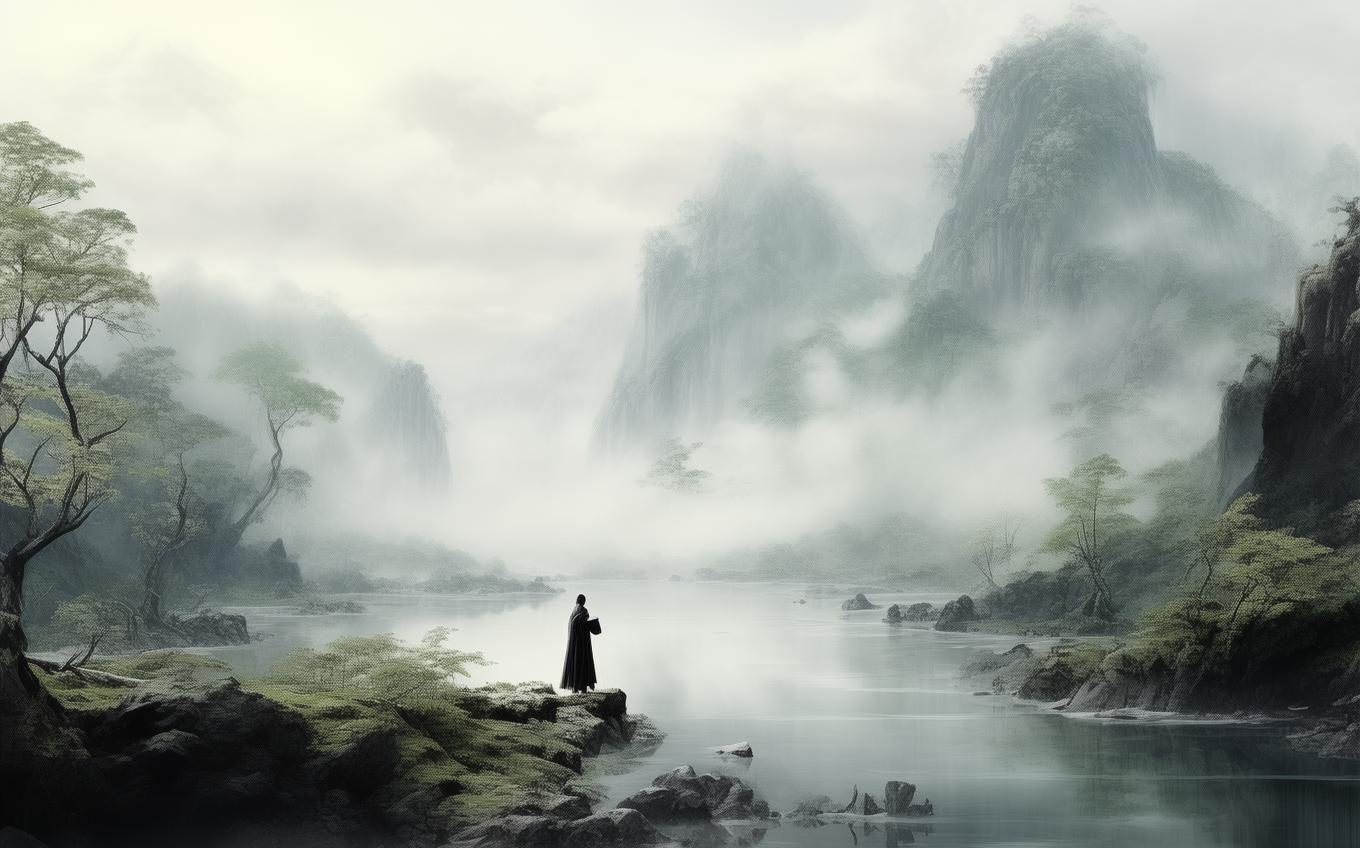
"Leaves fall at the beginning by Dongting Lake." The poem opens not with the speaker, but with a landscape — an autumnal scene charged with literary memory. Dongting Lake, in the south, was immortalized in Qu Yuan’s ancient verses: “The autumn wind blows, Dongting’s waves under leaves fall.” By echoing this line, Shangguan Wan'er immediately sets a mood of yearning and transience. The falling leaves signal both the end of the year and the beginning of sorrow; “beginning” (初) subtly hints that this longing is only beginning to unfold. The southern lake also establishes a geographical anchor, while the absent beloved is far in the north.
"I think of you, my lord, ten thousand li away." Direct yet dignified, this line names the emotion. “Ten thousand li” is the Tang hyperbole for unbridgeable distance — not a literal measurement but a felt chasm. The term “my lord” (君, jūn) could refer to a husband, lover, or even sovereign, but within a boudoir poem it almost certainly addresses a beloved. The emotional core is crystal clear: across this vast space, the speaker’s thoughts are fixed on one person.
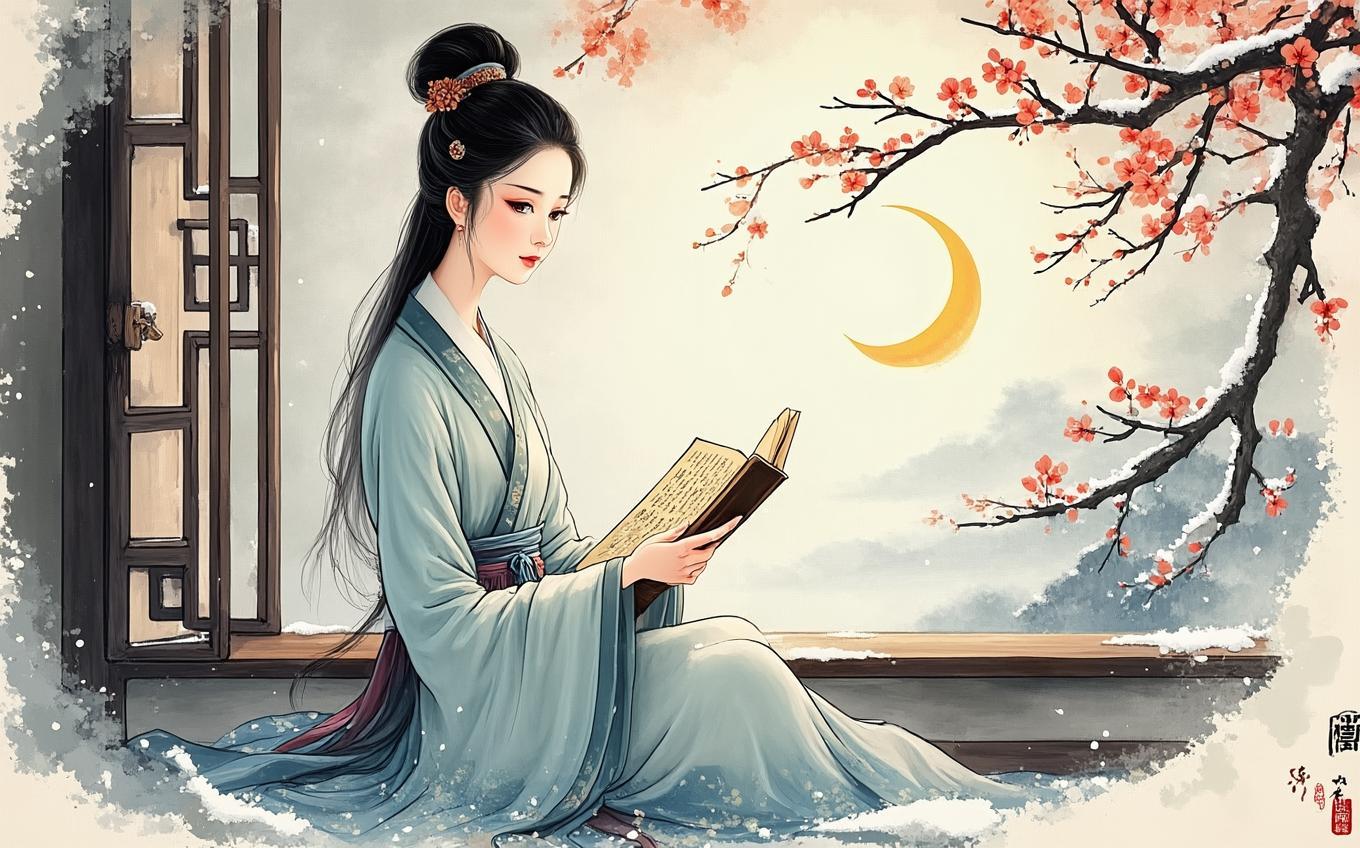
"Heavy dew, the scented quilt is cold." Shangguan draws the camera inward, into the bedchamber. Dew, heavy and luminous, suggests late night and unshakeable chill. The quilt, once fragrant with the warmth of two bodies, is now scented only with perfume — a hollow remnant. The word “cold” (冷, lěng) is both physical and psychological; it is the cold of solitude creeping through silk and skin.
"The moon sets, the brocade screen is empty." The moon, that eternal companion of the sleepless lover, sinks below the horizon, leaving only a decorative screen. The screen, covered in brocade patterns, ordinarily provides intimacy and enclosure, but now it stands “empty” (虚, xū) — a void that mirrors the speaker’s heart. There is a ghostly quality here: with the moonlight gone, the room dissolves into a dark emptiness that no embroidered silk can fill.
"I wish to play a melody of Jiangnan." A sudden shift — the speaker reaches for her instrument. Jiangnan, the region south of the Yangtze, was associated with love songs, lute melodies, and gentle romance. Playing such a tune would be a natural outlet for her feelings. But the word “wish” (欲, yù) signals hesitation; the desire is there, yet something holds her back.
"But I am engrossed in sealing a letter to Jibei." The word “engrossed” (贪, tān, literally “greedy”) reveals her real compulsion — writing and sealing a letter to her beloved in Jibei, a northern frontier region. She cannot even spare the time for music; her hands are busy with brush and paper, then wax and seal. This line captures the quiet urgency of a woman whose only connection to a distant lover is the written word. The contrast between the pleasurable southern melody and the urgent northern letter underscores her isolation and devotion.
"In the letter there is no other meaning, / Only melancholy for our long separation." The closing couplet is devastating in its simplicity. The letter bears no news, no gossip, no demands — just a single, unfiltered emotion: sadness for the long parting. This is the essence of the “colored letter” of the title: a piece of fancy stationery, perhaps decorated with paintings or patterns, containing only the rawness of longing. The repetition of “separation” (离居, lí jū) drives the point home: the physical distance, stretching through months and seasons, has become a permanent ache.
Themes and Symbolism
Absence and Presence. The poem’s every image is defined by what is missing — the beloved is absent, the moon has set, the quilt lacks warmth, the screen encloses only air. Even the letter, charged with words, ultimately conveys a single negative space: the sorrow of not being together.
The Art of Letter-Writing. For Tang women of the upper class, a “colored letter” (彩书) was an ornate object — dyed paper, painted edges, careful calligraphy. By making this letter the heart of her poem, Shangguan elevates it to a symbol of emotional labor and enduring connection. The act of sealing (封) becomes a ritual of hope, entombing her feelings in wax to be resurrected in another’s hands.
Nature as Mirror. The falling leaves, heavy dew, and setting moon are not mere scenery; they echo the speaker’s inner chill and fading time. This fusion of outer landscape and inner mood (情景交融, qíngjǐng jiāoróng) is a hallmark of classical Chinese poetry, and Shangguan executes it with luminous precision.
Feminine Space. The poem’s setting — boudoir, quilt, screen, musical instrument, letter — delineates a distinctly female world. In this intimate realm, longing is expressed not through heroic deeds but through cold silk and unwritten songs, making it all the more human and poignant.
Cultural Context
Shangguan Wan'er lived at the zenith of the Tang Dynasty, serving as a secretary and favored attendant to Empress Wu Zetian. Female literacy and literary talent, while exceptional, were cultivated in court circles, and Shangguan was famed for her critical eye and poetic skill. “彩书怨” reflects the refined “court and boudoir” (宫怨, guīyuàn) poetry of the era, but its emotional sincerity lifts it above mere convention. The geographic references — Dongting Lake in the south, Jibei in the north — map an imperial expanse, reminding us that Tang couples were often separated by official postings or military campaigns. The poem thus speaks to a shared female experience, transmuting personal grief into enduring art.
In Chinese culture, letters and letter-writing were deeply gendered. Women’s letters were often imagined as tear-stained and emotionally transparent. This poem, however, presents the woman as a deliberate writer: she chooses not to play music, she chooses what to write, and she presents herself with quiet dignity even in pain.
Conclusion
“彩书怨” endures because it captures a universal truth — that longing, when stripped of ornament, becomes its own strange form of companionship. Shangguan Wan'er’s forty characters are a miniature universe of autumn leaves and empty rooms, yet they pulse with a heart that refuses to be silenced by distance. For modern readers, the poem is a reminder that in an age of instant communication, the weight of a carefully sealed letter — and the patient, aching love it represents — has lost none of its power. In the end, all the embroidered screens and scented quilts pale beside one simple line: “Only melancholy for our long separation.”
Comments (0)
No comments yet. Be the first to comment!