Introduction
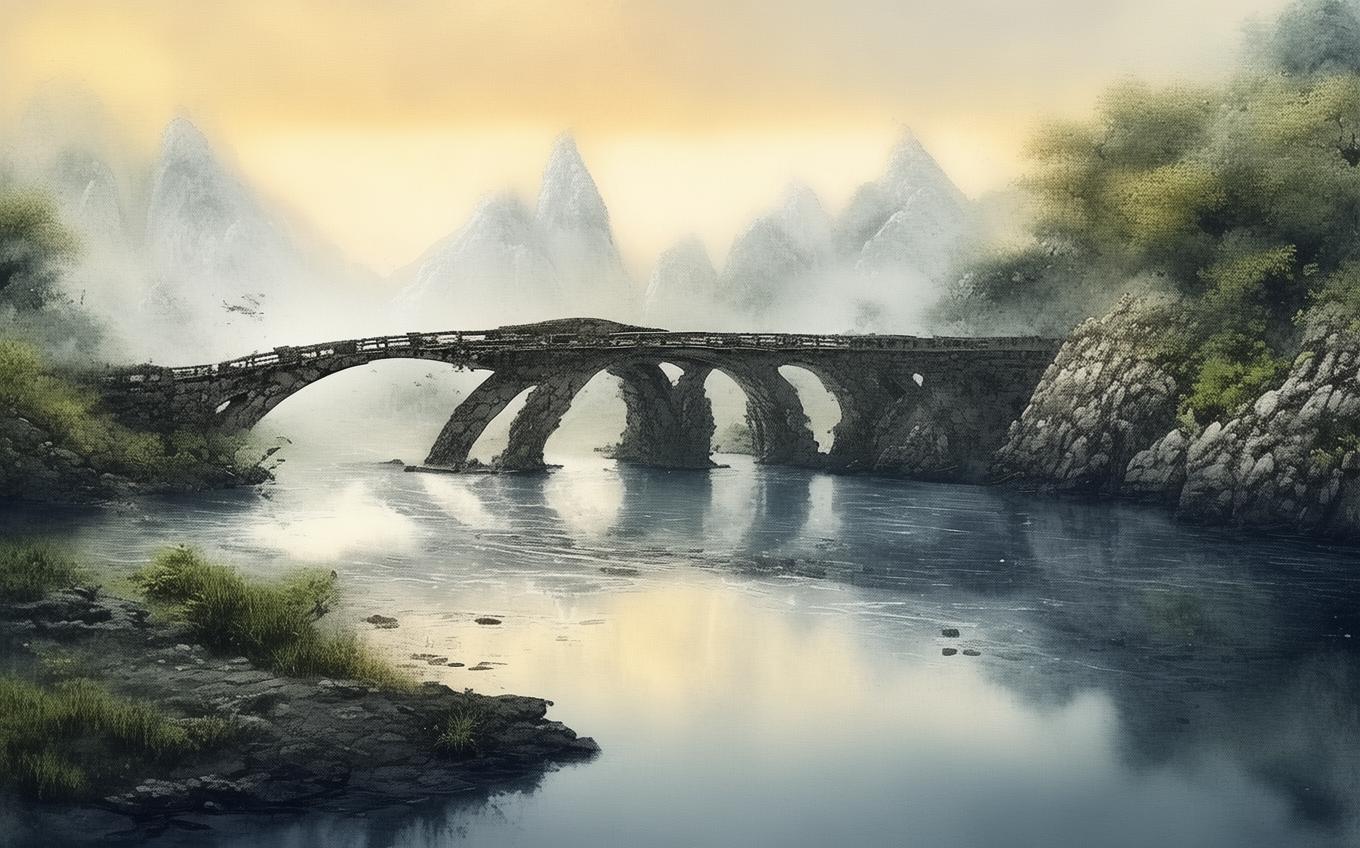
In the vast treasury of classical Chinese poetry, few images resonate as deeply as that of the shí qiáo—the stone bridge. More than a mere architectural element, the stone bridge often appears as a silent witness to human longing, a link between worlds, and a symbol of home. One of the most celebrated appearances of this motif is in the Yuan dynasty sanqu poem Tiān Jìng Shā · Qiū Sī (天净沙·秋思, “Autumn Thoughts” to the Tune of “Clear Sky over the Sand”) by Mǎ Zhìyuǎn (马致远, c. 1250–1321). This brief masterpiece, barely twenty-eight characters long, paints a landscape of desolation and fleeting warmth, centering on the iconic line “小桥流水人家”—a small bridge over flowing water, beside a cottage. In rural China, such bridges were almost always built of stone, arching gently over canals and streams. Thus, the xiǎo qiáo of the poem is, in essence, a shí qiáo, and it carries the full weight of the poet’s homesickness. Here, I will unpack this poem line by line, exploring how a simple stone bridge becomes a gateway to the deepest emotions of the human heart.
The Poem: Full Text and Translation
枯藤老树昏鸦
kū téng lǎo shù hūn yā
Withered vines, old trees, crows at dusk.小桥流水人家
xiǎo qiáo liú shuǐ rén jiā
A small bridge, flowing water, a cottage.古道西风瘦马
gǔ dào xī fēng shòu mǎ
An ancient road, west wind, a lean horse.夕阳西下
xī yáng xī xià
The evening sun sinks in the west.断肠人在天涯
duàn cháng rén zài tiān yá
A heartbroken man at the edge of the sky.
Line-by-Line Analysis
The poem opens with a stark, almost cinematic montage: “枯藤老树昏鸦.” Each element—withered vines twisting around ancient trees, crows cawing at twilight—evokes decay, age, and the inevitable movement toward night. In Chinese aesthetics, the crow is a harbinger of sorrow, and the combination of dry vines and old trees suggests a world drained of vitality. There is no verb; the images are stacked like a pile of dry leaves, creating a mood of stagnant loneliness.
Then, abruptly, the second line shifts to a scene of tender warmth: “小桥流水人家.” Here lies the heart of our stone bridge analysis. The xiǎo qiáo—a small, likely arched stone bridge—spans a stream, and beside it nestles a cottage, rén jiā, the home of a family. This image is luminous compared to the first line. Flowing water brings movement and life; the cottage speaks of shelter, companionship, and the comfort of a hearth. But the bridge is crucial: it links the outside world to that domestic haven. For the poet, however, the bridge is merely observed, not crossed. It becomes a symbol of inaccessible home, a passage to a warmth that belongs to someone else. The stone bridge, durable and steady, stands in ironic contrast to the poet’s own rootless wandering.
The third line, “古道西风瘦马,” plunges us back into hardship. An ancient road—dusty, long-traveled—stretches under a biting west wind. A lean horse trudges along, its thinness mirroring the traveler’s exhaustion and deprivation. Again, there is no verb; the horse and the road simply are, as if frozen in a painting. This line draws on the traditional Chinese theme of the lǚ rén (旅人, traveler), often an official posted far from his native place or a scholar adrift in a turbulent world.
Then the scene is crowned by a single declarative statement: “夕阳西下.” The setting sun in the west is a universal symbol of endings, of the day’s dying light, and of the passage of time. It adds a vast, cosmic dimension to the personal grief, suggesting that the traveler’s pain is part of an eternal, recurring pattern of light and darkness.
Finally, the emotional bomb detonates: “断肠人在天涯.” Duàn cháng rén—a person whose intestines are broken—is a Chinese idiom for one consumed by unbearable grief or longing. This figure is placed zài tiān yá, at the sky’s edge, at the farthest remove from home. The poet does not say “I”; he says “a man,” universalizing the experience. After the accumulation of images, this direct cry of anguish is devastating. And it is the memory of that small stone bridge, glimpsed a moment earlier, that makes the separation from home so acutely felt.
Themes and Symbolism
The central theme is homesickness and exile, a perennial subject in Chinese poetry, where scholar-officials were often dispatched to remote provinces. The poem also meditates on the transience of life: vines wither, trees age, the sun sets, and the traveler’s body grows thin, all under the indifferent march of time. There is a profound loneliness here, but also a subtle celebration of a rustic landscape that, even in its desolation, holds beauty.
The stone bridge (xiǎo qiáo) is the poem’s pivotal symbol. It is a threshold between the harsh public road and the private warmth of the cottage. In Chinese culture, a bridge signifies connection, reunion, and the crossing over from trouble to peace. Yet, for the poem’s speaker, the bridge remains an object of longing, not a path he can take. It thus becomes a symbol of unreachable home and the gap between the wanderer and the settled life. Other symbols reinforce this: the flowing water suggests the ceaseless current of time and the traveler’s endless journey; the west wind signals autumn and decline; the lean horse stands for the worn body and spirit; the evening sun presages death or the encroaching darkness of despair.
Cultural Context
Ma Zhiyuan lived during the Yuan dynasty, a period when China was ruled by the Mongol conquerors. Many Han Chinese literati found their traditional paths to governmental service blocked or chose to live in seclusion, turning to literature and drama to express their disenchantment. The sanqu form, with its looser structure and vernacular flavor, was a favorite vehicle for such personal, often melancholic, lyricism. The imagery of Autumn Thoughts draws on a long tradition of xiāo sǎ (潇洒, free and at ease) and gū jì (孤寂, solitary) aesthetics, rooted in Daoist and Buddhist notions of detachment. At the same time, the poem’s intense emotionality reveals the Confucian heart beneath the hermit’s cloak: the longing for home, family, and social belonging never truly disappears. The small stone bridge is a particularly Chinese detail; the arched stone bridges of Jiangnan (the Yangtze Delta) were celebrated for their elegance and practicality, and they often appeared in paintings as part of an idealized rustic scene. Ma Zhiyuan turns that ideal into an instrument of pain by putting it just out of reach.
Conclusion
Autumn Thoughts endures because it captures, in a handful of words, the universal anguish of the traveler who sees home in the distance but cannot reach it. The stone bridge, small and ordinary, becomes a vessel for immense emotion. It reminds us that the deepest poetry often lies in the simplest things: a bridge, a stream, a roof among trees. Ma Zhiyuan’s genius is to make that bridge stand forever as a dividing line between the world’s cold road and the warmth we all seek. Today, as we read the poem on a screen perhaps thousands of miles from our own roots, that little stone bridge still arches across the centuries, inviting us to cross, and reminding us what it means to be human.
Comments (0)
No comments yet. Be the first to comment!