Introduction
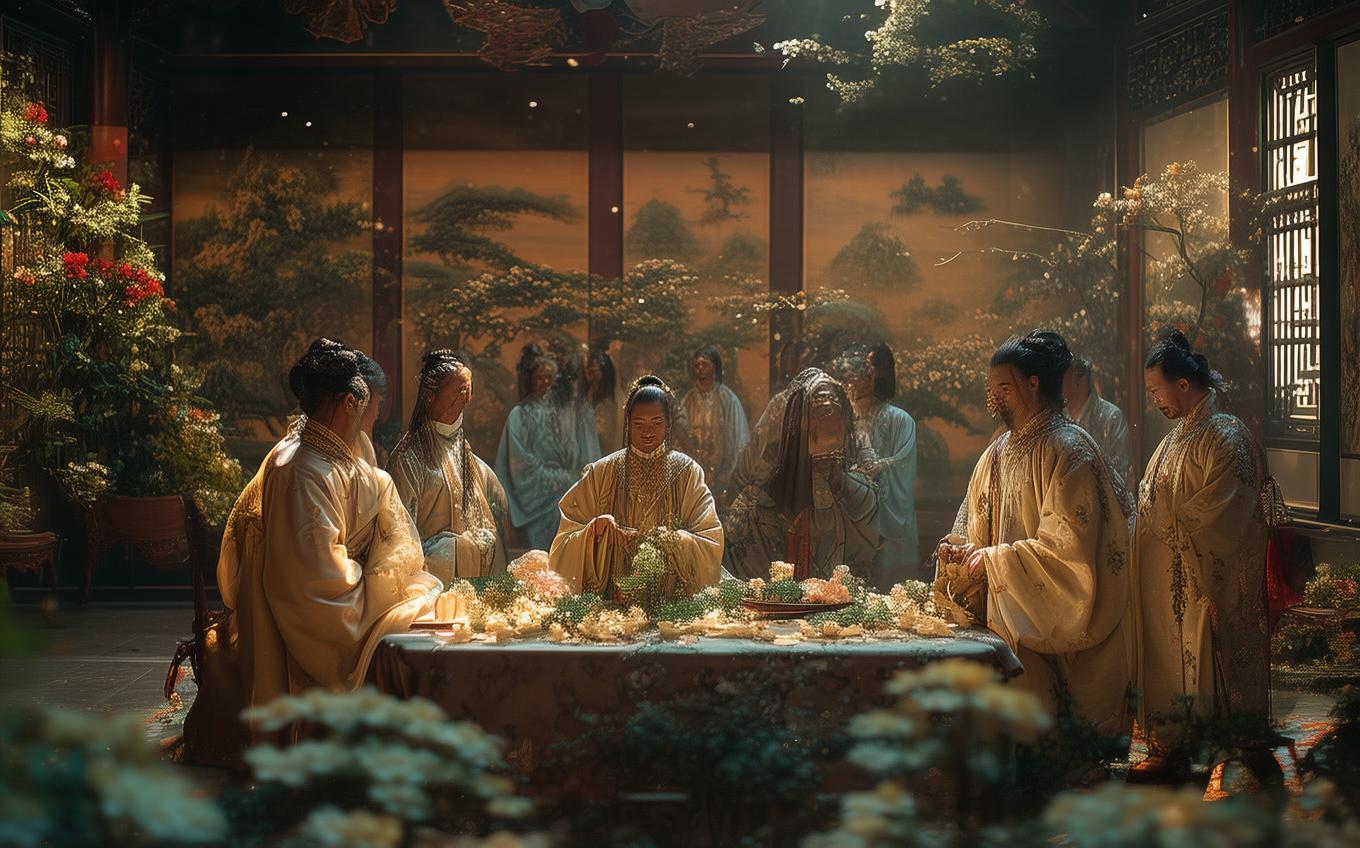
In the glittering court of Tang Emperor Xuanzong (reigned 712–756), poetry was not merely a private art but a public performance of wit, loyalty, and refinement. When the emperor composed a poem to celebrate a grand state banquet, the highest officials of the realm would respond with carefully crafted "harmonizing" verses (奉和, fènghé). This blog post explores one such response: "奉和御制麟德殿宴百僚应制" by Song Jing (宋璟, 663–737), a famously upright chancellor who, together with Yao Chong, steered the Kaiyuan era into a golden age. Though the poem operates within the strict etiquette of courtly praise, its elegant balance of imagery, historical allusion, and supple rhythm reveals the subtle art of the Tang literary statesman.
The Poem: Full Text and Translation
端拱承休命,
Duān gǒng chéng xiū mìng,
Reverent, I receive this auspicious decree,
时清荷圣皇。
Shí qīng hè shèng huáng.
In peaceful times, indebted to our sage sovereign.
四聪闻受谏,
Sì cōng wén shòu jiàn,
His all-perceiving ear welcomes remonstrance,
五服远朝王。
Wǔ fú yuǎn cháo wáng.
Envoys from the five domains pay distant homage to the king.
景媚莺初啭,
Jǐng mèi yīng chū zhuàn,
The scenery is lovely as orioles first warble,
春残日更长。
Cán chūn rì gèng cháng.
Late spring, and the daylight stretches even longer.
命筵多济济,
Mìng yán duō jǐ jǐ,
The commanded banquet gathers a stately, dignified crowd,
盛乐复锵锵。
Shèng yuè fù qiāng qiāng.
Grand music resounds with a clanging, sonorous splendor.
酆镐谁将敌,
Fēng hào shuí jiāng dí,
Who could rival the ancient capitals Feng and Hao?
横汾未可方。
Héng fén wèi kě fāng.
Even the revels by the Hengfen stream cannot compare.
愿齐山岳寿,
Yuàn qí shān yuè shòu,
May your life equal the longevity of mountains and great peaks,
祉福永无疆。
Zhǐ fú yǒng wú jiāng.
And may your blessings be boundless forevermore.
Line-by-Line Analysis
First Couplet – The Posture of Humility
Song Jing opens not with a picture of the banquet but with his own stance: 端拱 (hands folded respectfully). This gesture signals both deference and the speaker’s role as minister receiving the emperor’s “auspicious mandate” (休命). The second line credits the peaceful times to the sage ruler, using the respectful 圣皇 (sage emperor). The couplet establishes the vertical relationship between subject and throne, a necessary preliminary in court poetry.
Second Couplet – Listening and Universal Submission
The next two lines extend the emperor’s virtues. 四聪 (“four hearings”) draws from the Shangshu (Book of Documents), where the sage ruler hears through the ears of all his ministers. By welcoming remonstrance, Xuanzong displays moral clarity. 五服 refers to the five concentric zones of civilization around the royal domain – a geographical metaphor from the Zhouli – here symbolizing the entire known world coming to pay homage. The couplet links political wisdom with cosmic order: a ruler who listens draws all under his sway.
Third Couplet – A Blossom of Time
Suddenly the lens shifts to nature. 景媚莺初啭 paints a delicate spring scene: orioles just starting to sing, charming scenery. The word 媚 (bewitching) infuses the landscape with a courtly grace. Then a poignant note enters with 春残日更长: spring is waning, yet the days grow longer. This hints at the passing of a beautiful moment and the desire to savor it – a fleeting sweetness that deepens the solemnity of the assembly. In Tang poetry, late spring often carries an undercurrent of melancholic appreciation, and here it balances the splendor of the royal feast.
Fourth Couplet – The Banquet Enshrined
The poem reaches the event itself. 命筵 (“commanded feast”) reminds us that the banquet is an imperial order, a ritual of state. 济济 – stately, numerous – conveys the dignified pomp of the gathered officials. Music, 盛乐复锵锵, rings with the metallic clarity of bells and stone chimes, a hallmark of formal court music. The repetition of onomatopoeic words (济济 and 锵锵) creates a rhythmic grandeur, as if the very sound of the characters enacts the rousing atmosphere.
Fifth Couplet – Historical Visions of Glory
Song Jing now elevates the scene through historical comparison. 酆镐 were the twin capitals of the glorious Zhou dynasty, the golden age of ancient kingship that every Confucian ruler aspired to emulate. To say that these legendary seats can be rivaled by the current banquet is hyperbolic praise. 横汾 refers to the outings and feasts of Emperor Wu of Han by the Fen River, recorded in the Chuci-style “Autumn Wind” poem. By claiming that even those storied revels cannot equal the present
Comments (0)
No comments yet. Be the first to comment!