Introduction
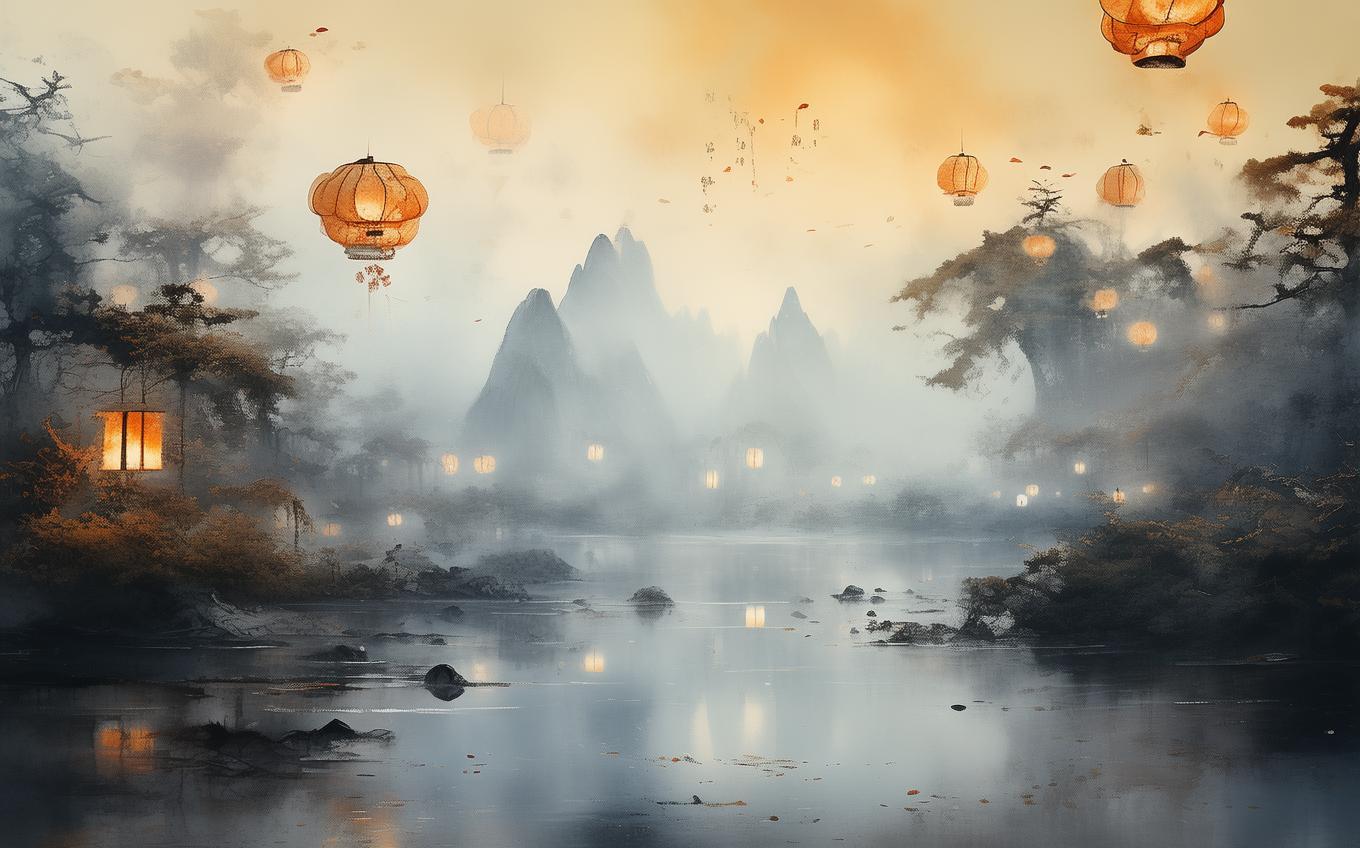
Lu Zhaolin (卢照邻, c. 634–684) was one of the celebrated “Four Paragons of the Early Tang,” a group of poets who helped revitalize Chinese verse after the ornate, overly decorative styles of the preceding Six Dynasties. He was a master of lüshi (regulated verse) and parallel prose, known for infusing his work with vivid imagery and emotional depth. While much of his life was marked by illness and tragedy, one of his most beloved poems, “十五夜观灯” (Viewing Lanterns on the Night of the Fifteenth), radiates pure joy and communal celebration. This poem is a classic yongwu (咏物, “praising an object”) poem centered on the theme of yongdeng (咏灯) — a lyrical tribute to lamps and lanterns — capturing the enchantment of the Lantern Festival, a major traditional holiday that lights up the first full moon of the lunar year.
The Poem: Full Text and Translation
锦里开芳宴,
Jǐn lǐ kāi fāng yàn,
In Brocade City a splendid feast is spread,
兰缸艳早年。
Lán gāng yàn zǎo nián.
Orchid-shaped lamps glow brilliantly in the early spring.
缛彩遥分地,
Rù cǎi yáo fēn dì,
Their rich colors stretch far across the land,
繁光远缀天。
Fán guāng yuǎn zhuì tiān.
Countless lights are strung up to the distant sky.
接汉疑星落,
Jiē hàn yí xīng luò,
Touching the Milky Way, they could be falling stars;
依楼似月悬。
Yī lóu sì yuè xuán.
Leaning against towers, they seem like suspended moons.
别有千金笑,
Bié yǒu qiān jīn xiào,
Then comes the smile of a beauty worth a thousand gold,
来映九枝前。
Lái yìng jiǔ zhī qián.
Shining before the nine-branched candlestick.
Line-by-Line Analysis
Couplet 1: Setting the Scene
The poem opens with a grand invitation: “In Brocade City a splendid feast is spread.” In lǐ (锦里) is an old name for Chengdu, famous for its silk brocades and festive atmosphere. Right away, the reader is placed in a bustling urban celebration. The second line introduces the central object — lán gāng (兰缸), “orchid-shaped lamps.” These could be oil lamps or lanterns sculpted to resemble orchids, a flower associated with elegance, purity, and spring. The word yàn (艳) suggests not just brightness but a lush, almost intoxicating beauty. Together, the couplet fuses human festivity with natural renewal: the lamps bloom like spring flowers, and the feast itself becomes a garden of light.
Couplet 2: Light Conquering Space
Lines three and four expand the scene. Rù cǎi (缛彩), “rich colors,” evokes the intricate, multi-hued designs of the lanterns, while fán guāng (繁光), “countless lights,” emphasizes their sheer number. The verbs are crucial: yáo fēn dì (遥分地) means the colors divide or spread across the land in the distance, and yuǎn zhuì tiān (远缀天) pictures the lights as jewels sewn onto the fabric of the sky. The lanterns are not confined to the streets; they extend horizontally across the city and vertically into the heavens, blurring the boundary between the human world and the cosmos.
Couplet 3: Celestial Comparison
This couplet takes the metaphor to its climax. Jiē hàn (接汉) literally means “connect with the Han River,” but hàn here refers to the Milky Way (tiānhàn, 天汉). The lanterns are so high they seem to merge with the galaxy, making viewers wonder if stars are falling to earth. In the matching line, yī lóu (依楼), “leaning against towers,” shows lamps hung from tall buildings, resembling suspended moons. Star and moon — two of the most sublime images in Chinese poetry — are brought down to the human realm, yet they are precisely crafted artifacts. The poet marvels at human artistry that can rival nature’s own lights.
Couplet 4: A Human Spark
The final couplet pivots cleverly. Amid all the dazzling illumination, the brightest image is not a lamp but a human smile. Qiān jīn xiào (千金笑), literally “a smile of a thousand gold pieces,” is a classical allusion to a peerless beauty whose smile is deemed priceless. She appears before a jiǔ zhī (九枝) — a nine-branched candlestick or a grand lantern tree. The artificial light becomes a frame for living warmth. The poem thus shifts from external spectacle to an intimate, almost romantic moment. Light is not only something to be observed; it is a backdrop for human connection, joy, and perhaps love.
Themes and Symbolism
The Transformative Power of Light
The poem is a quintessential example of yongwu poetry, where an object becomes a window into deeper meanings. Here, the lamp is more than a source of light — it is a transformative agent. Lanterns turn the city into a second sky, linking the mundane earth with the sublime Milky Way. This reflects a Daoist-influenced worldview in which art and ritual can harmonize the human and cosmic orders.
Celebration and Communal Harmony
The Lantern Festival marks the end of the Chinese New Year period, and the poem pulses with collective elation. The feast, the decorated streets, the sky full of lights — all suggest a society at peace, where people can create beauty and share it openly. The “thousand‑gold smile” symbolizes not only personal delight but also the cultural ideal of rén qíng (人情), human warmth and sentiment, which is the true radiance.
Illusion vs. Reality
By comparing lanterns to stars and the moon, Lu Zhaolin teases the boundary between the real and the artificial. The words yí (疑, “suspect, wonder”) and sì (似, “seem, resemble”) invite the reader to participate in a delightful perceptual game. Are those lights stars or lanterns? It doesn’t matter — for this night, the city has recreated the cosmos. This playful ambiguity is a hallmark of Tang poetry’s depth.
Cultural Context
“十五夜” (Fifteenth Night) refers to the Lantern Festival (Shàngyuán Jié, 上元节), celebrated on the fifteenth day of the first lunar month. During the Tang Dynasty (618–907 CE), this festival was a massive urban event. Curfews were lifted, and citizens — regardless of class or gender — poured into the streets to admire lantern displays, solve riddles on lanterns, eat yuánxiāo (glutinous rice balls), and enjoy performances. The booming cosmopolitanism of cities like Chang’an and Chengdu fostered a culture of public spectacle that poets eagerly captured.
Lu Zhaolin wrote during the early Tang, a period of reunification and renewed confidence after centuries of division. The lanterns in his poem are not only festive decorations but also symbols of imperial prosperity and civilizational brilliance. The “Brocade City” (Chengdu) was a commercial hub, and the mention of “orchid-shaped lamps” and “nine-branched candlestick” reflects the refined material culture of the elite, made accessible to all on this special night.
Interestingly, the poem’s optimism stands in stark contrast to Lu Zhaolin’s personal life. He suffered from a debilitating disease (likely rheumatoid arthritis) and eventually committed suicide. Yet in this poem, we see no trace of his private pain — only a boundless delight in shared beauty. This is a testament to the Tang poetic ideal of capturing the fleeting perfection of the world.
Conclusion
“十五夜观灯” endures as one of the finest lantern‑viewing poems in the Chinese literary canon. Through its luminous imagery, cosmic metaphors, and a final, human‑scaled smile, Lu Zhaolin shows us that a lamp is never just a lamp. It is a bridge between heaven and earth, a spark of collective joy, and a testament to the human capacity to craft beauty out of oil, wick, and paper. For English‑speaking readers, the poem opens a window onto a world where a festival of lights becomes a celebration of life itself — a message as radiant today as it was on that fifteenth night in the Brocade City.

Comments (0)
No comments yet. Be the first to comment!