Introduction
The late Tang dynasty (9th century) was an era of political decline and intense introspection in Chinese poetry, and no poet captures the mingling of beauty, sorrow, and elusive emotion quite like Li Shangyin (李商隐). Among his many masterpieces, the short poem 游后湖赏莲花 (Yóu Hòuhú Shǎng Liánhuā) stands out as a crystalline meditation on love, time, and the human condition. Often titled "暮秋独游曲江" (Late Autumn, Wandering Alone by the Winding River), the poem uses the image of lotus flowers on a lake to explore a grief so intimate that it becomes inseparable from existence itself. For English-speaking readers new to classical Chinese verse, this poem offers a perfect window into the Tang aesthetic of 含蓄 (hánxù — implicit meaning) where a fleeting natural scene reveals an entire emotional world.
The Poem: Full Text and Translation
荷叶生时春恨生
Hé yè shēng shí chūn hèn shēng
When the lotus leaves grow, spring’s regret is born.荷叶枯时秋恨成
Hé yè kū shí qiū hèn chéng
When the lotus leaves wither, autumn’s regret is complete.深知身在情长在
Shēn zhī shēn zài qíng cháng zài
I know full well: as long as this body exists, the feeling will always remain.怅望江头江水声
Chàng wàng jiāng tóu jiāng shuǐ shēng
Melancholy, I gaze toward the river’s source, and hear only the sound of the flowing water.
Line-by-Line Analysis
Lines 1–2: The Cycle of Nature and Emotion
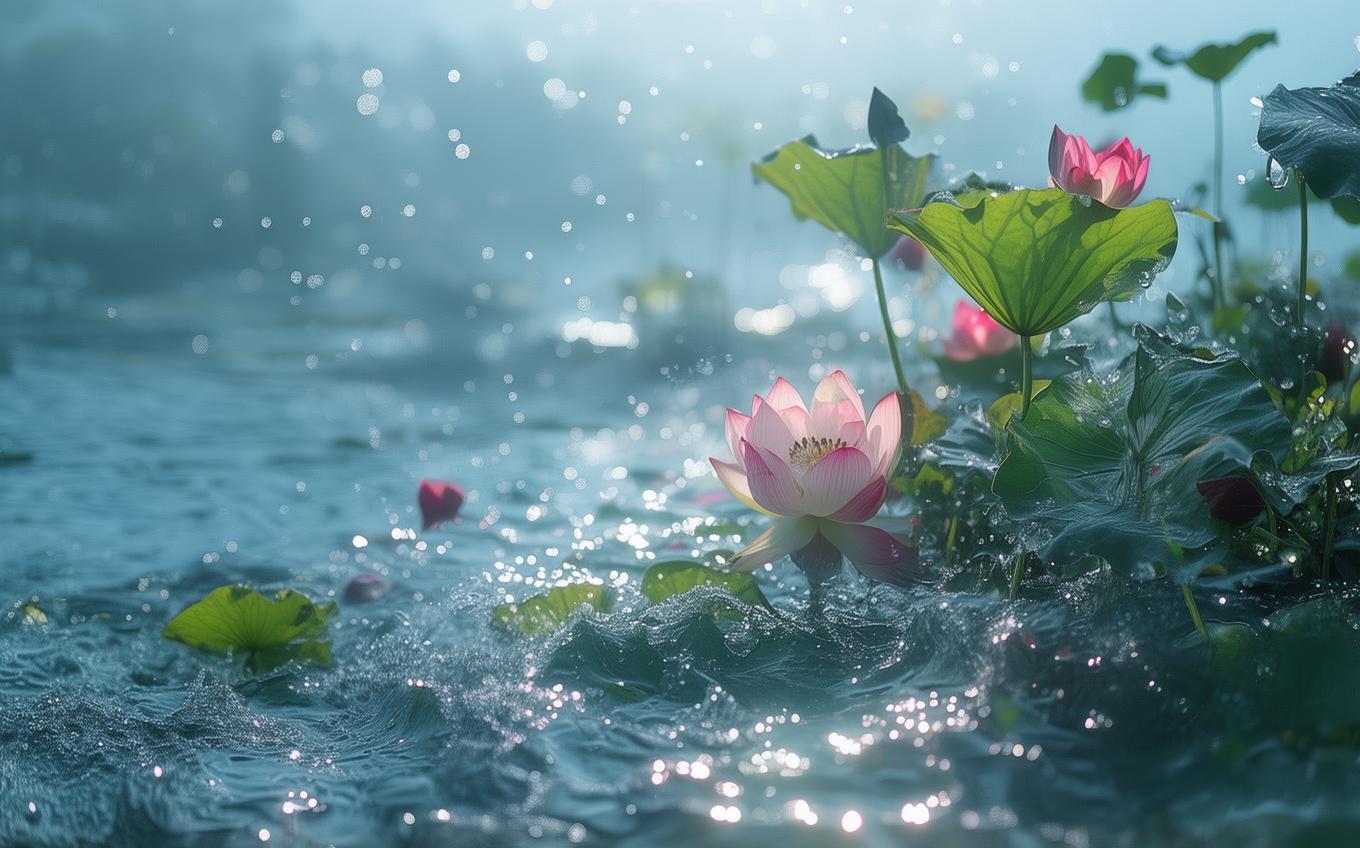
The poem opens with two parallel lines that fuse botanical observation with emotional resonance. Lotus leaves appear in early summer, yet Li Shangyin deliberately says “spring’s regret is born” when they grow, and “autumn’s regret is complete” when they wither. This apparent mismatch of seasons — lotuses belong to summer, not spring — tells us that nature here is a mirror for inner states. The word 恨 (hèn), often translated as “regret,” carries a broader weight in classical Chinese: it can be longing, sorrow, resentment, or the ache of something unbearably beautiful. Spring, the season of hope and new love, already plants the seeds of loss; autumn, the time of decay, brings that loss to fruition. The lotus, a flower that rises pure from muddy water only to fade, becomes a perfect emblem of love’s fragile glory. By linking the growth and decline of leaves directly to the birth and completion of hèn, Li Shangyin suggests that heartache is not an accident but the very fabric of life.
Lines 3–4: The Unending Self and the Sound of Water
The third line shifts from landscape to stark self-awareness. 深知 (shēn zhī) — “I know deeply” — is a moment of philosophical lucidity. The poet states a truth that is both devastating and strangely comforting: 身在情长在 — “as long as the body is here, the feeling persists.” Love, memory, grief — they are not passing moods but intrinsic to being alive. The line echoes a Buddhist recognition of impermanence, yet it also insists on the stubborn endurance of human emotion.
The final line splinters into pure sensory imagery. 怅望 (chàng wàng) — “melancholy gazing” — captures a state of wordless yearning. He looks toward the river’s head (江头, jiāng tóu), the origin, but what he perceives is not a vision or an answer; it is only the sound of the river water (江水声, jiāng shuǐ shēng). This auditory image is crucial. In Chinese poetry, the murmur of flowing water frequently symbolizes the ceaseless passage of time and unspoken sorrow. The river flows endlessly, just as his feeling flows and will never stop. The poem ends not with closure but with a lingering echo, leaving the reader suspended in that same melancholy listening.
Themes and Symbolism
The Inevitability of Sorrow and Love
The poem’s central theme is the entanglement of love and loss, where one cannot exist without the other. The cycle of lotus leaves — birth, maturity, death — parallels the emotional arc of a deep attachment. Li Shangyin doesn’t mourn a specific person; he mourns the condition of loving itself.
The Lotus as a Dual Symbol
In Chinese culture, the lotus (莲花, liánhuā) is both a Buddhist symbol of purity and a secular token of summer beauty and romance. Here, it operates on both levels: the pristine blossom emerges from mud (suffering) yet inevitably fades, just as a pure love arises from a flawed world and falls victim to time.
River Water and the Sound of Time
The “sound of the river water” at the poem’s close is a masterclass in yijing (意境) — the fusion of scene and feeling. The river’s perpetual flow mirrors the unending nature of the poet’s emotion, while the sound (rather than sight) evokes a universe where meaning is felt rather than seen. This aligns with the Daoist notion that the deepest truths are heard in silence.
Cultural Context
Li Shangyin (c. 813–858) lived during the twilight of the Tang Empire, a period of factional strife and personal hardship. His poetry often veils his actual circumstances — a lost wife, a thwarted political career, clandestine love affairs — behind dense allusions and layered imagery. The lake in the poem, sometimes identified as the Back Lake (后湖) or Qujiang (曲江) in Chang’an, was a famous scenic spot for outings and romantic assignations. To wander there alone in late autumn was to be surrounded by the ghosts of past joy. The poem thus captures not only individual grief but a broader nostalgia for the golden days of the Tang, when lotus-viewing parties filled the same shores with laughter.
Neo-Confucian and Buddhist ideas of xin (心, heart-mind) also inform the third line. The “body” (身) is not merely physical; it is the site where all experience, memory, and attachment accumulate. The assertion that feeling endures as long as life endures would have been read by contemporary audiences as a profound, if tragic, truth about the human lot.
Conclusion
游后湖赏莲花 compresses an entire philosophy of love into twenty-eight characters. With the barest of means — a lotus leaf, a river sound — Li Shangyin leads us to the edge of an abyss where beauty and sorrow are one. Its enduring appeal lies in this very tension: the poem never says “I miss you,” yet every line trembles with the weight of a loss so deep it has become part of the landscape, part of the body, part of listening itself. For modern readers across cultures, the poem reminds us that some emotions do not fade with time; they simply change form, like the river that keeps flowing long after the last lotus petal has fallen. In a world that often urges us to move on, Li Shangyin offers a dignified alternative — to sit with the sound of the water, and to understand that to have loved is to carry that love forever.

Comments (0)
No comments yet. Be the first to comment!