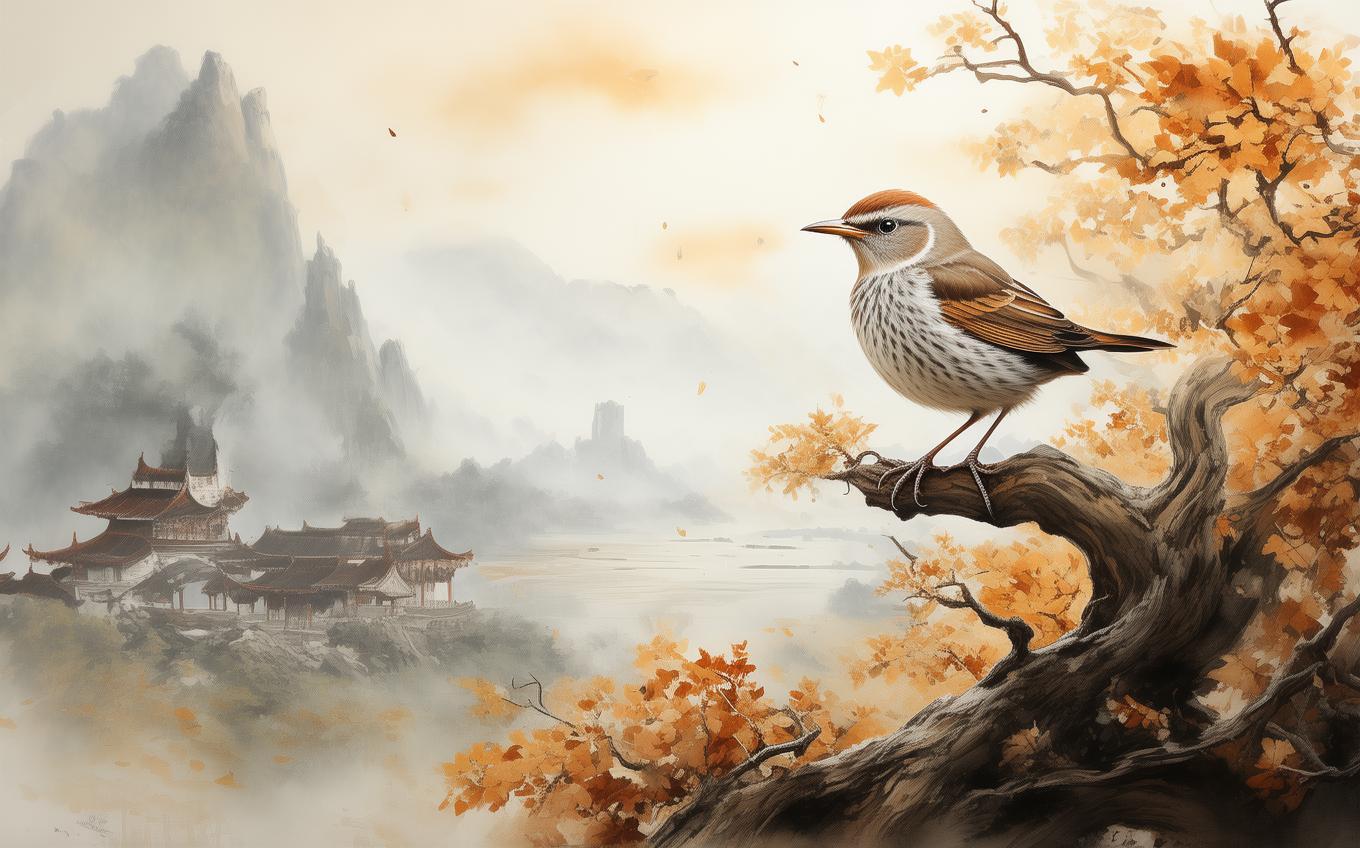
Analysis of "秋莺" - Classical Chinese Poetry
Introduction
Li Shangyin (李商隐, 813–858 CE) is one of the most enigmatic and admired poets of the late Tang Dynasty, a period often seen as a glorious sunset of Chinese poetry. Known for his densely allusive, emotionally charged, and often deeply personal verse, Li Shangyin explored themes of love, memory, loss, and political disillusionment with a subtlety that continues to fascinate readers more than a thousand years later. The poem “秋莺” (Qiū Yīng, Autumn Oriole) is a prime example of his mature style—a brief but richly layered meditation on isolation, misplaced loyalty, and the melancholy beauty of a world grown cold. Though less frequently anthologized than some of his famous “untitled” love poems, “秋莺” showcases Li’s ability to infuse a seemingly simple nature image with profound philosophical and autobiographical resonance.
The Poem: Full Text and Translation
秋莺
Qiū Yīng
Autumn Oriole
残莺何事不知秋,
Cán yīng hé shì bù zhī qiū,
Lingering oriole, why do you not know autumn?
横过幽林尚独游。
Héng guò yōu lín shàng dú yóu.
Flying across the secluded woods, still roaming alone.
老舌百般倾耳听,
Lǎo shé bǎi bān qīng ěr tīng,
With your aged tongue, in every way I strain my ears to listen,
深黄一点入烟流。
Shēn huáng yī diǎn rù yān liú.
A speck of deep yellow enters the misty flow.
栖迟背世同悲鲁,
Qī chí bèi shì tóng bēi Lǔ,
Lingering, turning your back on the world, both lamenting like the people of Lu,
浏亮如笙碎在喉。
Liú liàng rú shēng suì zài hóu.
Clear and bright, like a reed pipe shattering in your throat.
莫更留连好归去,
Mò gèng liú lián hǎo guī qù,
Do not linger any longer—it is good to return;
露华犹湿旧枝头。
Lù huá yóu shī jiù zhī tóu.
Dew’s splendor still moistens the branches of old.
Line-by-Line Analysis
The poem opens with a direct, almost accusatory question that sets the emotional tone: “Lingering oriole, why do you not know autumn?” (残莺何事不知秋). The word cán (残, lingering / remnant) is crucial. It tells us this is not a sprightly spring oriole but one that has stayed past its season, oblivious or unwilling to recognize the change. The question is not merely rhetorical—it introduces the central tension of the poem: the speaker’s identification with a creature that has missed its moment, a being out of step with the natural order.
The second line, “Flying across the secluded woods, still roaming alone” (横过幽林尚独游), paints a scene of solitary movement. The “secluded woods” (yōu lín) suggest a landscape stripped of summer’s vibrancy, silent and deserted. The oriole’s flight is horizontal (héng guò, cutting across), a deliberate yet lonely trajectory through a world that no longer welcomes it. The word “still” (shàng) hints that this roaming was once purposeful but now feels like a hollow persistence.
The next couplet shifts between auditory longing and visual evanescence. “With your aged tongue, in every way I strain my ears to listen” (老舌百般倾耳听) personalizes the bird. The “aged tongue” (lǎo shé) is a striking synecdoche—the oriole’s song is no longer youthful and effortless; it is the sound of experience, perhaps even weariness. The speaker’s straining ears convey a desperate attempt to capture something fleeting and precious. Immediately, the image dissolves: “A speck of deep yellow enters the misty flow” (深黄一点入烟流). The oriole’s brilliant color, a symbol of life and warmth, is swallowed by the cold, amorphous mist (yān liú). Beauty and song are absorbed into a world of vagueness and decay.
In the fifth line, the poem takes a distinct turn toward the personal and the historical: “Lingering, turning your back on the world, both lamenting like the people of Lu” (栖迟背世同悲鲁). Qī chí (栖迟) means to rest or linger without advancing, a state of suspended purpose. Bēi Lǔ (悲鲁, lamenting Lu) is a charged classical allusion. Lu was the home state of Confucius, and in Confucian lore, the people of Lu were known for their profound sorrow at the state’s decline and disorder. By linking the oriole’s disoriented lingering to “lamenting like the people of Lu,” Li Shangyin folds the bird’s predicament into a larger human tragedy—the lament of a loyal heart for a crumbling world, be it a state, a season, or a personal dream.
The sixth line returns to the oriole’s song, but now with tragic intensity: “Clear and bright, like a reed pipe shattering in your throat” (浏亮如笙碎在喉). The song’s clarity (liú liàng) is undiminished, yet the simile of a shattered reed pipe (shēng suì zài hóu) implies a violent break. The music is not completed; it is broken mid‑utterance. This image powerfully conveys the frustration of a voice that cannot realize its full beauty, a spirit choked by circumstance—much like the poet himself at a corrupt and declining court.
Finally, the closing couplet offers a gentle, compassionate resolution: “Do not linger any longer—it is good to return; dew’s splendor still moistens the branches of old” (莫更留连好归去,露华犹湿旧枝头). The speaker directly addresses the oriole, urging it to abandon its profitless lingering. “Return” (guī qù) is loaded with multiple meanings: return to the South for winter, return to one’s true home, return to a purer state. The last line provides a consoling image: the dew (lù huá, a word combining moisture and luminous beauty) still wets the old familiar branches. Even in a late, cold season, there is a kind of fragile tenderness left on the native perch. The message is both practical and philosophical—stop resisting the inevitable, and you will find that the old, authentic source still holds life and freshness.
Themes and Symbolism
The dominant theme of “秋莺” is the disorienting experience of lingering beyond one’s proper time. The oriole, a bird of spring and summer, should have already migrated south, but it remains, confused and alone. This state of being out of step with the world mirrors Li Shangyin’s own life: a loyal and talented official caught in the deadly factional politics of the late Tang, unable to retreat yet unable to prosper. The poem thus becomes an elegy for misplaced devotion and a meditation on the cost of loyalty to a world that has ceased to nourish.
Solitude and isolation permeate the imagery: the “secluded woods,” the oriole flying “alone,” the lone speck of yellow swallowed by mist. Even the speaker strains to listen for a sound that is on the verge of vanishing, reinforcing a sense of fragile connection.
The bird as a symbol of the poet’s voice is a long-standing convention in Chinese poetry, and here the “aged tongue” and the “shattered reed pipe” suggest the corrosion of artistic expression by a hostile environment. The oriole’s song retains its innate beauty, but it cannot come to full fruition—a poignant reflection on Li Shangyin’s own dense, allusive poetry, which often seems to speak around silences and fractures.
Finally, the cultural symbol of Lu brings a historical and moral weight to the poem. By invoking the sorrow of Lu, the poet generalizes his personal melancholy into a lament for the decay of civilization itself. The oriole’s absurd persistence becomes an emblem of the noble but useless grief of those who mourn for a world they cannot change.
Cultural Context
Li Shangyin lived during the reign of Emperor Wenzong and his successors, a time when the Tang empire was visibly declining, wracked by eunuch power struggles, provincial rebellions, and the vicious Niu‑Li factional conflict. Li Shangyin, through a series of personal and political entanglements, found himself distrusted by both factions, his career a string of minor posts and disheartening exiles. His poetry often reflects this sense of being caught in a web not of his own making, and “秋莺” embodies the inner conflict between the Confucian duty to serve and the Daoist‑inspired desire to withdraw.
In the Chinese literary tradition, the oriole (yīng) is conventionally a joyful herald of spring. To write about an autumn oriole is therefore a deliberate subversion, a kind of anti‑poem that exposes the rupture between the expected order and harsh reality. The poem’s closing advice, “it is good to return,” echoes a central motif in Chinese philosophy: the return to one’s roots, to simplicity, to the uncorrupted source. This resonates with Daoist ideals of ziran (自然, naturalness) and the Confucian‑tinged longing for a moral reclamation. By framing the return as a compassionate suggestion rather than a command, Li Shangyin preserves the tension between engagement and retreat that defines so much of classical Chinese lyricism.
Conclusion
“秋莺” is a small masterpiece of concentrated melancholy and delicate compassion. Over just eight lines, Li Shangyin transforms a passing glimpse of a misplaced bird into a profound reflection on loyalty, loss, and the quiet dignity of retreat. The poem’s beauty lies in the way it moves seamlessly between sensory detail—the speck of yellow, the shattering note—and the deep currents of historical and personal grief. For modern readers, its message remains startlingly relevant: there are times when holding on is not strength but a kind of blindness, and the truest courage may lie in knowing when to let go. In the “dew’s splendor” that still moistens the old branches, we find not an end but a tender, enduring promise of renewal—a promise that makes the poem linger in our own hearts long after the oriole has vanished into the mist.
Comments (0)
No comments yet. Be the first to comment!