Introduction
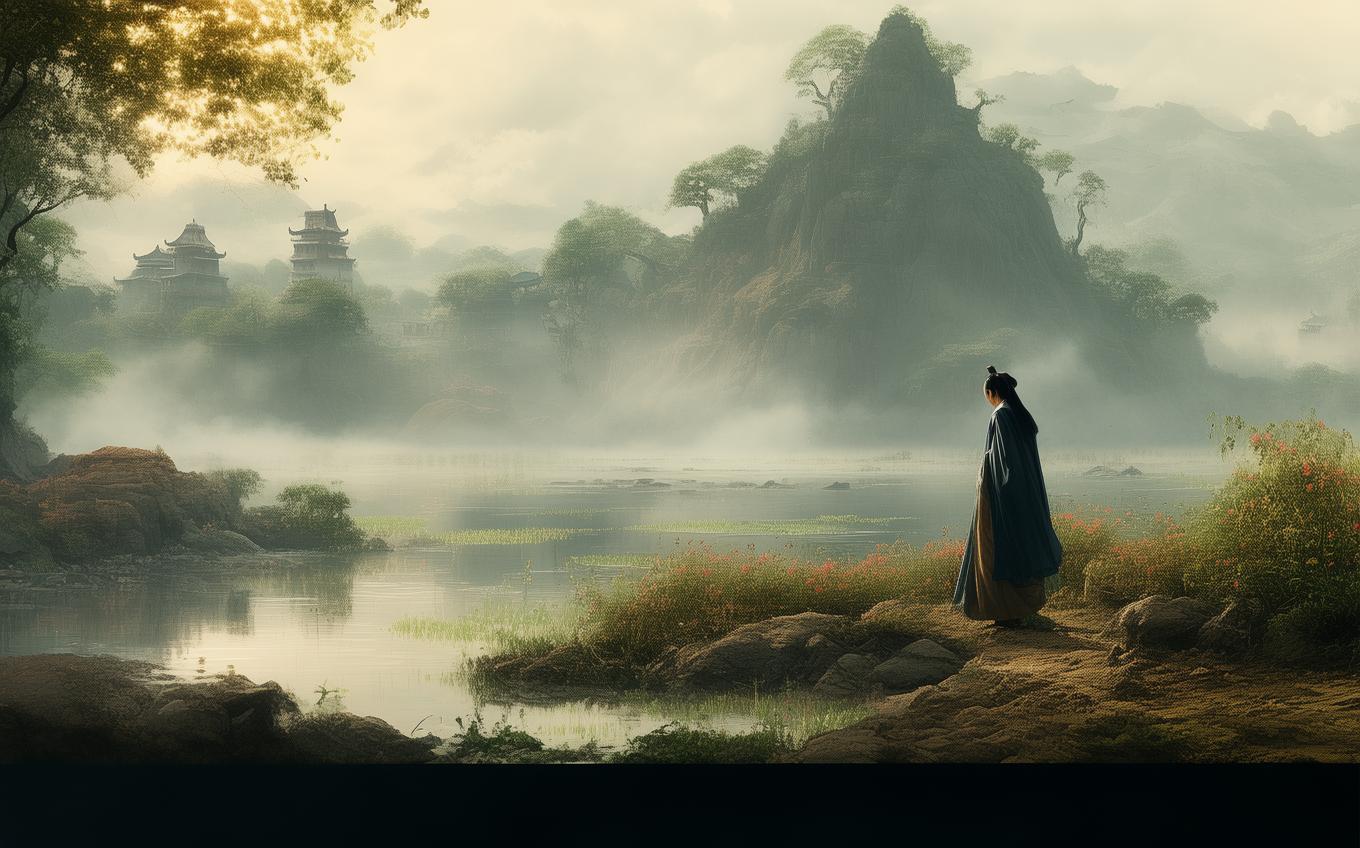
Among the many sorrowful voices in Chinese poetry, few are as haunting as that of Li Yu (李煜), the last ruler of the Southern Tang dynasty. Known posthumously as the "Poet Emperor," Li Yu is celebrated more for his lyrical ci than for his political achievements, which ended in disaster when his kingdom fell to the Song dynasty in 975 AD. The poem "渡中江望石城泣下" (Dù Zhōng Jiāng Wàng Shí Chéng Qì Xià – "Crossing the Middle River, Gazing at Stone City, Tears Fall") was written during his forced journey north as a captive, as he looked back upon Jinling (modern Nanjing), the "Stone City" that was once his imperial home. In this heart‑rending poem, Li Yu pours out his grief over a lost kingdom, a shattered family, and a life that suddenly feels like a vanished dream.
The Poem: Full Text and Translation
江南江北旧家乡,
Jiāng nán jiāng běi jiù jiā xiāng,
South of the river, north of the river – both were once my homeland.
三十年来梦一场。
Sān shí nián lái mèng yī chǎng.
These thirty years now seem no more than a dream.
吴苑宫闱今冷落,
Wú yuàn gōng wéi jīn lěng luò,
The palace halls of Wu now stand desolate and cold,
广陵台殿已荒凉。
Guǎng líng tái diàn yǐ huāng liáng.
The terraces and halls of Guangling lie in ruins and neglect.
云笼远岫愁千片,
Yún lóng yuǎn xiù chóu qiān piàn,
Clouds shroud the distant peaks – a thousand shreds of sorrow;
雨打归舟泪万行。
Yǔ dǎ guī zhōu lèi wàn háng.
Rain beats upon my home‑bound boat – ten thousand lines of tears.
兄弟四人三百口,
Xiōng dì sì rén sān bǎi kǒu,
We were four brothers with three hundred in our household,
不堪闲坐细思量。
Bù kān xián zuò xì sī liang.
I cannot bear to sit idle and ponder all this in detail.
Line-by-Line Analysis
江南江北旧家乡,三十年来梦一场。
The opening couplet immediately establishes the vast, sweeping loss. "South of the river, north of the river" refers to the lands on both sides of the Yangtze, once fully under his rule. By calling them "old home" (jiù jiā xiāng), Li Yu frames the loss not merely as a political defeat but as an intimate, personal exile. The second line, with its blunt metaphor "a dream of thirty years," suggests his entire life as emperor now feels unreal – a fragile illusion that has suddenly shattered. The number thirty is not accidental; it approximates his age at the time and the duration of his reign, turning a precise timeframe into a symbol of a lifetime obliterated overnight.
吴苑宫闱今冷落,广陵台殿已荒凉。
Here the poet draws on two historical place names – Wu (the region around Suzhou) and Guangling (modern Yangzhou) – to stand for the glories of his palace and its suburban pleasure grounds. The words lěng luò (desolate, neglected) and huāng liáng (barren, desolate) are paired strategically. They paint a picture of empty courtyards, silent corridors, and weed‑choked terraces. The contrast between past splendor and present ruin is not described directly but implied through these chilling epithets. This couplet gives a visual, architectural dimension to his loss: the very stone of his former world has turned cold.
云笼远岫愁千片,雨打归舟泪万行。
This is the poem’s most famous and poignant couplet. The landscape itself seems to weep with the poet. Clouds envelop distant mountain ranges, and he sees them not as billowing white shapes but as "a thousand shreds of sorrow" (chóu qiān piàn). The rain lashing his boat becomes a torrent of his own tears, "ten thousand lines" dripping into the river. The hyperbole – thousand pieces, ten thousand lines – is typical of Chinese lyric excess, but here it feels utterly sincere: the grief is so immense that the natural world is saturated with it. Moreover, the term guī zhōu (home‑bound boat) is painfully ironic. He is sailing north, away from his true home; the boat moves into captivity, not toward safety. The rain, the clouds, the river – all become accomplices in his lament.
兄弟四人三百口,不堪闲坐细思量。
The closing couplet shifts from landscape to family. Li Yu recalls his three brothers and the entire clan of three hundred souls – the extended imperial household. Now they are scattered, some dead, some captives. The final line is an act of emotional self‑defense: "I cannot bear to sit idle and ponder this in detail." The word kān (bear, endure) is a dagger. It implies that if he allowed his mind to dwell on each name, each face, the pain would destroy him. This deliberate mental avoidance becomes the poem’s ultimate expression of despair – silence after the scream.
Themes and Symbolism
Loss and exile. The poem is soaked in the grief of a fallen monarch who has lost not just power but identity. His homeland now exists only in memory; the present is an alien, hostile space.
The dream metaphor. Dream (mèng) is a recurring device in Li Yu’s poetry. Here, life’s thirty years are a dream from which he has woken to nightmare. The metaphor underscores the transience of glory and the illusory nature of worldly success.
Nature as mirror of emotion. Clouds, rain, peaks, and river do not form a pleasant backdrop but become extensions of the poet’s inner state. The pathetic fallacy is employed so intensely that it transcends technique and becomes a worldview: the cosmos shares his sorrow.
The ruined palace. The cold halls (lěng luò) and barren terraces (huāng liáng) evoke the classical Chinese motif of huái gǔ (怀古, "meditation on the past"). Ruins are not just material decay but the traces of vanished human warmth and purpose.
The clan. The mention of four brothers and three hundred household members universalizes the tragedy. This is not a single man’s misfortune but the collapse of an entire lineage – a deep wound in a culture that values family continuity above all.
Cultural Context
Li Yu (937–978) reigned over the Southern Tang from 961 until his capture. Despite his political ineptitude, he was a brilliantly gifted poet, calligrapher, and musician. His passionate ci lyrics, often about love and loss, are considered foundational in that genre. This poem, however, is a shi (regular‑pattern verse), not a ci, and its more restrained form magnifies the dignity of his sorrow.
When the Song armies conquered Jinling in 975, Li Yu was taken north to Bianjing (today’s Kaifeng) as a prisoner with the humiliating title "Marquis of Disobedience." On the journey, he crossed the Yangtze and looked back at Stone City (Jinling). According to historical anecdotes, he wept and composed this poem. It thus belongs to a pivotal moment in both his personal life and Chinese literary history: the voice of a vanquished king who would, within a few years, be poisoned by the Song emperor.
The poem is deeply informed by Chinese aesthetics of lament (aì yuàn, 哀怨) and the Confucian‑influenced idea that a ruler should mourn his kingdom’s fall as he would a parent’s death. The reference to "Stone City" (Shí Chéng) evokes the ancient fortifications of Nanjing, a symbol of enduring political power. To see it from the river, disappearing into mist, was to witness the death of his dynasty in visual, spatial terms.
Conclusion
"渡中江望石城泣下" endures because it transforms political catastrophe into universal human emotion. Li Yu’s personal collapse, rendered in precise, haunting imagery, speaks to anyone who has felt the sudden vanishing of a world. The poem’s beauty arises from its restraint: the tears are not merely stated but shown through rain‑lashed boat, cloud‑shrouded peaks, and a memory he dares not revisit. For the English‑speaking reader, this poem offers a direct window into the Chinese tragic sensibility – where the outer landscape mirrors the inner, and where a fallen king becomes a poet of the truest grief. As we read his words today, more than a millennium later, the river still flows, and the sorrow remains startlingly vivid.

Comments (0)
No comments yet. Be the first to comment!