Introduction
Su Shi (苏东坡, 1037–1101), one of the most celebrated literary figures of the Song Dynasty (960–1279), poured his heart into a poem that has become the quintessential 悼诗 (elegy) in the Chinese classical tradition. His cí (song lyric) “江城子·乙卯正月二十日夜记梦” (Jiang Cheng Zi: Dreaming of My Deceased Wife on the Night of the 20th Day of the First Month, Year Yimao) was written in 1075, exactly ten years after the death of his first wife, Wang Fu (王弗). Though only a teenager when they married, Wang Fu was a gentle and capable partner, and her sudden loss at the age of twenty-seven left a hollow space in the poet’s life. A decade later, now far from her burial place and worn by political exile, Su Shi woke from a dream of her and immortalized his grief in this compact, devastating work. In Chinese literature, it stands as the gold standard of marital mourning, admired equally for its raw sincerity and its distilled imagery.
The Poem: Full Text and Translation
十年生死两茫茫,
Shí nián shēngsǐ liǎng mángmáng,
For ten long years the living and the dead are lost in endless haze.不思量,自难忘。
Bù sīliang, zì nánwàng.
I try not to dwell, yet how can I forget?千里孤坟,无处话凄凉。
Qiān lǐ gū fén, wú chù huà qīliáng.
Her lonely grave a thousand miles away — nowhere can I speak of this desolation.纵使相逢应不识,尘满面,鬓如霜。
Zòng shǐ xiāng féng yīng bù shí, chén mǎn miàn, bìn rú shuāng.
Even if we met again, she would not know me: my face covered with dust, my temples white as frost.夜来幽梦忽还乡,小轩窗,正梳妆。
Yè lái yōu mèng hū huán xiāng, xiǎo xuān chuāng, zhèng shūzhuāng.
Last night a deep dream suddenly took me home — by the little latticed window, she was combing her hair.相顾无言,惟有泪千行。
Xiāng gù wú yán, wéi yǒu lèi qiān háng.
We gazed at each other speechless, only a thousand lines of tears.料得年年肠断处,明月夜,短松冈。
Liào dé nián nián cháng duàn chù, míng yuè yè, duǎn sōng gāng.
I know the place where year after year my heart will break: under the bright moon, on the low pine-covered hill.
Line-by-Line Analysis
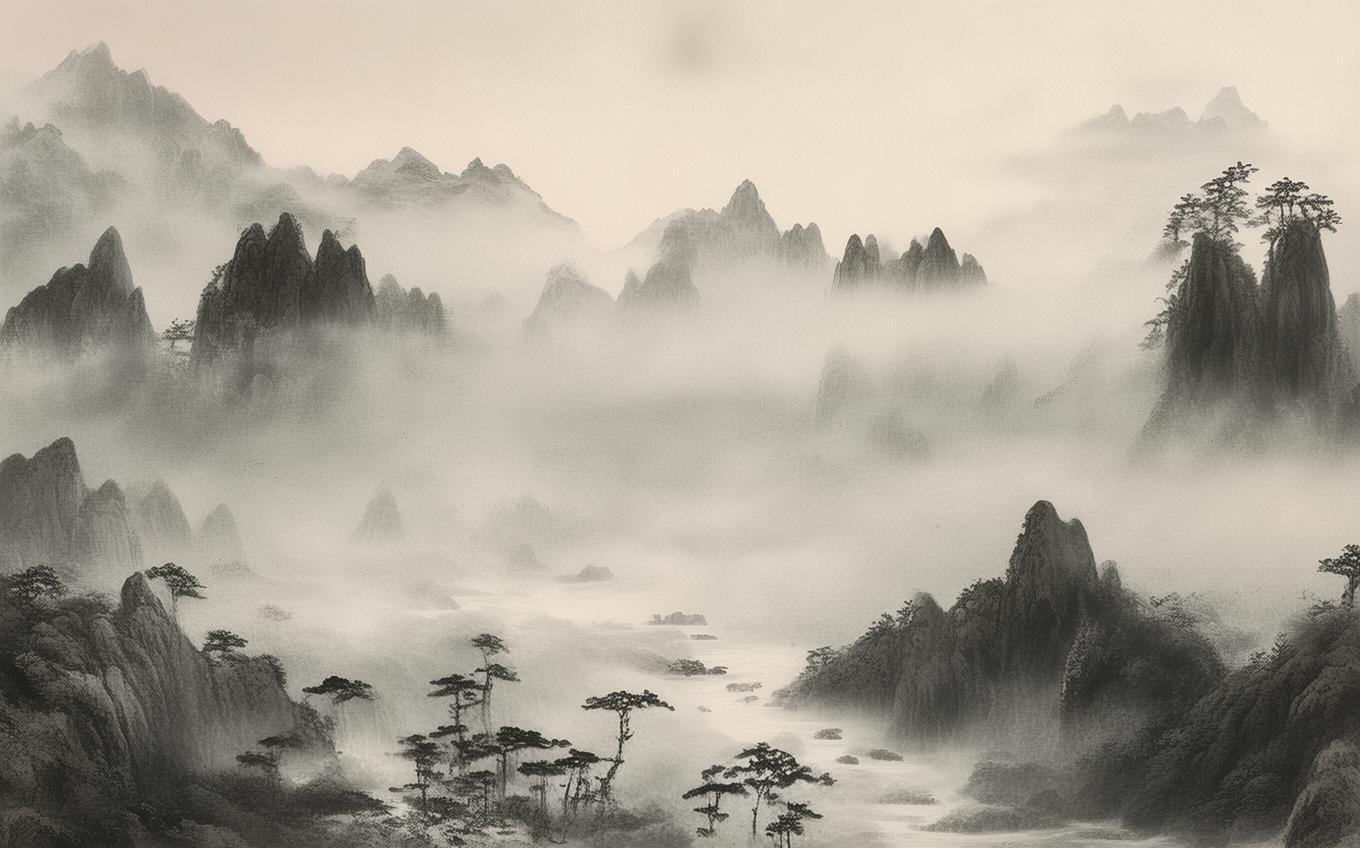
The cí opens with a devastating temporal and spatial chasm: “十年生死两茫茫” — ten years cleave the living from the dead, and both realms appear indistinct, almost swallowed by an existential fog (茫茫, mángmáng). The reduplicated adjective suggests not only physical distance but a blurring of boundaries between memory and reality. Su Shi immediately follows with one of Chinese poetry’s most human paradoxes: “不思量,自难忘.” The very attempt not to think of her is proof that forgetting is impossible. The line is deceptively plain, yet it carries the weight of unstoppable grief: love, once real, cannot be willed away.
“千里孤坟” moves from time to space. Her grave (孤坟, gū fén, a solitary tomb) lies a thousand li away, separated not just by miles but by the poet’s political banishment to Shandong, while she rests in their native Sichuan. The word “凄凉” (qīliáng, desolate, bleak) intensifies the loneliness — there is no shared ground for his sorrow, no one with whom to “speak” this chill.
Then comes a moment of brutal self-awareness: “纵使相逢应不识,尘满面,鬓如霜.” If by some miracle they could meet, Wang Fu would not recognize the man before her. “Dust on the face” (尘满面) evokes the toil of a lifetime on the road, of disgrace and hardship; “temples like frost” (鬓如霜) paints the premature aging of a poet in his late thirties, already marked by sorrow. The juxtaposition of the imagined reunion and its impossibility injects a piercing realism — time has altered him beyond recognition, deepening the tragedy of separation.
The second stanza shifts into dreamscape: “夜来幽梦忽还乡.” The adjective “幽” (yōu, deep, hidden, otherworldly) signals a dream that crosses the border between worlds. Suddenly he is “home” — a place that exists now only in sleep. The scene is domestic and heartrendingly ordinary: “小轩窗,正梳妆.” She is at a small latticed window, combing her hair, frozen in the eternal youth of memory. The detail is supreme in its quietness; the poem does not need grand gestures. This image, mundane yet sacred, encapsulates all that was lost.
The reunion is wordless: “相顾无言,惟有泪千行.” Gazing at each other, they find no language adequate to bridge death. The hyperbole “a thousand lines of tears” turns the silence into a torrent of shared emotion — grief so profound it can only pour out physically. This moment, poised between dream and waking, captures the core of elegy: the living and the dead can meet only in tears.
The final couplet breaks the dream. Awake, the poet projects his sorrow forward: “料得年年肠断处,明月夜,短松冈.” He knows exactly where his heart will “break its intestines” (肠断, cháng duàn, the classical idiom for utter heartbreak) every year henceforth. The setting is chillingly precise: a moonlit night over the low pines on the hill where she lies buried. The “short pines” (短松) suggest recently planted trees, a grave still relatively new even after a decade. The moonlight, a perennial image of reunion and longing in Chinese poetry, here becomes a cold witness to eternal separation. The temporal cycle (“年 年,” year after year) locks grief into permanence — the place of mourning never changes, and neither does the pain.
Themes and Symbolism
The dominant theme is the persistence of love beyond death — a love so deep that it invades dreams and redefines the landscape of memory. Grief here is not cathartic but cyclical; each year brings the same heartbreak under the same moon. The poem also explores the cruelty of time: the poet’s physical decay and scattered life stand in stark contrast to the eternal youth of his departed wife, frozen in combing her hair.
Several symbols reinforce the emotional weight:
- The lonely grave (孤坟) represents isolation — both the physical separation of death and the poet’s own alienation in a hostile political world.
- The dream (幽梦) and window (轩窗) function as thresholds between realms; the window frames the beloved both literally and as a portal to the past.
- Moonlight (明月) is the classic Chinese symbol for longing and shared gaze across distance; here it becomes the cruel light that illuminates the unbridgeable gap between the living and the dead.
- Pine trees (松) are emblems of constancy and mourning, often planted near graves. Their “shortness” hints at the freshness of grief, as if even the land refuses to heal.
Cultural Context
In the Chinese literary tradition, a poem written explicitly to mourn a deceased spouse is called 悼亡 (dào wáng, “mourning the departed”), and Su Shi’s Jiang Cheng Zi is its crown jewel. The term originally referred to poems by the Jin Dynasty poet Pan Yue (潘岳), but by the Song Dynasty it had become a poetic subgenre. Su Shi’s innovation was to write in the cí form, which allowed a more personal, colloquial tone than the stately shi (诗) verse. This blending of high emotion with a musical, almost conversational register made the poem feel immediate and unfiltered — as if the reader were overhearing a private grief.
The poem also reflects central values of Chinese culture: 情 (qíng, sincere feeling) prized above ritual form, and the Confucian ideal of a harmonious, faithful marriage. In a society where love was often expressed indirectly, Su Shi’s open display of lifelong devotion was both revolutionary and deeply moving. Furthermore, the dream motif echoes the Daoist and Buddhist fascination with the illusory nature of reality — is the reunion more real than waking loneliness? The answer remains heartbreakingly ambiguous.
Conclusion
Su Shi’s Jiang Cheng Zi remains one of the most beloved elegies in world literature because it speaks a universal language of loss without artifice. The scene at the latticed window, the thousand lines of silent tears, and the bright moon over the pine-shaded mound distill grief into images that transcend time and culture. By anchoring his personal sorrow in the concrete — dust on a face, a comb in hand, a lonely hill — Su Shi gives shape to the shapeless ache of missing someone who can never return. For the English-speaking reader newly arriving in the world of Chinese poetry, this poem offers a luminous entry: a masterclass in how a handful of simple words can house the infinite. In every generation, wherever loved ones are remembered, the moon rises again over the short pines, and the heart breaks anew — and each time, with this poem, it finds a voice.

Comments (0)
No comments yet. Be the first to comment!