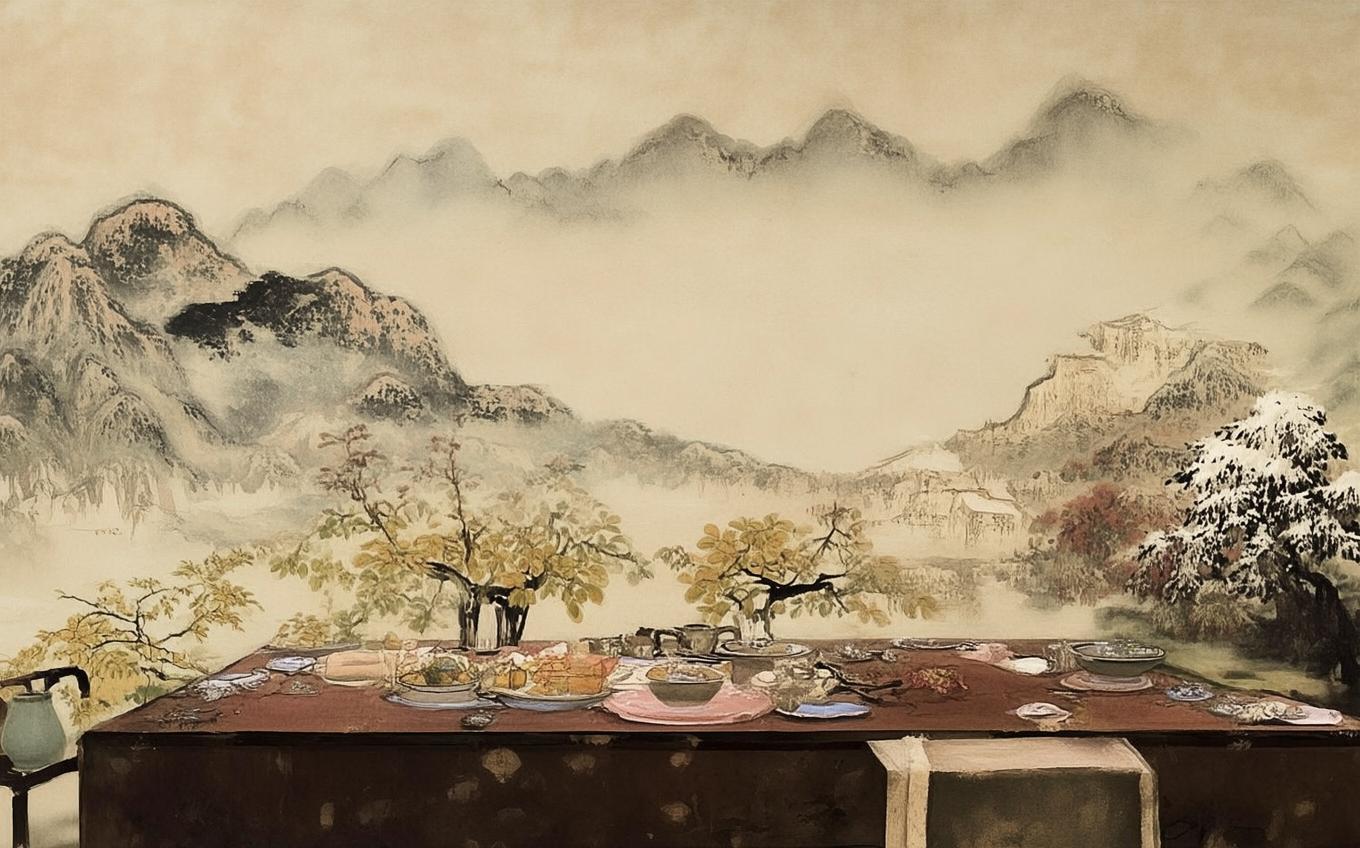
Analysis of "书灵筵手巾" - Classical Chinese Poetry
Introduction
Li Yu (937–978), the last ruler of the Southern Tang dynasty, is celebrated as one of China’s most poignant poets. Though fated to lose his kingdom and die in captivity, his true empire lay in the realm of words. Far less known than his later, heartbroken ci lyrics is a short, devastating poem he wrote in his twenties, titled “书灵筵手巾” (“Written on a Handkerchief at the Spirit Table”). The piece commemorates his first wife, Empress Zhou the Great, who died suddenly in 964. In five-character quatrain form, Li Yu turns a small, intimate object—a handkerchief left behind by his beloved—into a vessel of memory and sorrow. The poem stands as a timeless elegy in Chinese literature, marrying the fragility of mortal love with the enduring power of sensory remembrance.
The Poem: Full Text and Translation
浮生共憔悴
Fú shēng gòng qiáo cuì
In this floating life we shared emaciation;
壮岁失婵娟
Zhuàng suì shī chán juān
In my prime I lost the lovely one;
汗手遗香渍
Hàn shǒu yí xiāng zì
Fragrant stains left by her sweating hands;
痕眉染黛烟
Hén méi rǎn dài yān
Brow-tracings dyed with dark pigment’s haze.
Line-by-Line Analysis
The opening line, “浮生共憔悴”, sets the philosophical tone immediately. “Floating life” (浮生) is a Daoist and Buddhist concept denoting the transient, rootless nature of human existence—a shared earthly journey inevitably marked by suffering and decay. Li Yu inserts himself and his wife into this universal condition: they grew thin and haggard together. The word “共” (together) cements a union not only of joy but of mutual vulnerability, suggesting a deep, compassionate bond that life’s hardships could not sever.
With “壮岁失婵娟”, the poet confronts the sudden rupture. “壮岁” (prime of life) intensifies the shock—she died young, robbing him of her beauty (“婵娟”, chán juān) at an age when life should be flourishing. “婵娟” carries strong feminine grace, often used to describe the moon or an elegant woman. Losing her in his prime makes the grief doubly bitter: love’s peak was also its end.
The third line, “汗手遗香渍”, descends into a powerfully intimate, physical detail. The handkerchief still bears the traces of sweat from her hands—perhaps from a recent summer day, or from the gentle work of her daily life. The stains are not described as soiled or repulsive; they are “fragrant stains” (香渍), preserving the warmth and scent of her living body. This line brings her back to life through the sense of smell, a fleeting, ghostly presence that memories alone could not convey so viscerally.
The poem closes with “痕眉染黛烟”. Ancient Chinese women decorated their eyebrows with “黛” (dài), a dark pigment made from crushed minerals. The handkerchief has captured the imprint of her brows, now dyed with a smoky, ink-like smudge. “痕” (trace) and “染” (dyed) suggest something that has seeped into the fabric, an indelible mark rather than a surface stain. The word “烟” (smoke, haze) dissolves the sharpness of the image, melting the traces into something half-remembered, half-dreamed. The brow lines become a lingering gesture, a quiet signature of her gaze.
Themes and Symbolism
The poem’s central theme is bereavement through the sanctity of everyday objects. The handkerchief, an unassuming personal item, transforms into a relic—a tangible link between the living and the dead. Its stains are not imperfections; they are proof of life. Li Yu explores how memory attaches to the senses, particularly smell and sight, resisting the abstraction of sorrow.
A second theme is the transience of human beauty and happiness (“浮生”). By setting the scene within a floating world, the poet elevates personal loss into a meditation on mortality itself. The “fragrant stains” and “brow traces” are fleeting forms of permanence, bound to fade yet fiercely clutched in the poem.
Symbolically, the handkerchief serves as a microcosm of the beloved. The sweat is her labour, her movement, her summer; the brow pigment is her carefully crafted beauty, her daily act of self-expression. Together they form a portrait without a face—a presence woven from absence.
Cultural Context
Li Yu (李煜) ruled the Southern Tang, a sophisticated but politically fragile kingdom during the Five Dynasties and Ten Kingdoms period. He was a refined patron of the arts, deeply in love with poetry, music, and his wife Zhou Ehuang. Her sudden death shattered him, prefiguring the deeper sorrows he would later pen after losing his throne. The poem “书灵筵手巾” was written on a handkerchief placed at her spirit tablet altar, a setting where offerings and mementos kept the departed close.
In Chinese tradition, personal items of the deceased could become “遗物” (yíwù), cherished relics that channel the spirit’s lingering aura. Poetry itself often served as a form of spiritual communication—writing a poem on that very handkerchief was an act of intimate conversation with the soul of the departed. The piece epitomizes the Chinese artistic ideal of “寄托” (jìtuō), lodging profound emotion in a concrete, sensory vessel.
Conclusion
Li Yu’s miniature elegy holds its power through restraint. In just twenty characters, he conveys a lifetime of shared frailty, the blow of irrevocable loss, and the stubborn afterlife of love in the smallest traces—a sweat stain, a faded brow line, a wisp of fragrance. The poem speaks across centuries because it touches something universal: the way the dead remain with us in the most ordinary things. For today’s reader, “书灵筵手巾” reminds us that grief is not only a grand narrative but a quiet inventory of what was held, worn, and touched. Ultimately, the handkerchief becomes a mirror reflecting both the beloved’s vanished face and the poet’s enduring, tear-stained humanity.
Comments (0)
No comments yet. Be the first to comment!