Introduction
Wang Yucheng (王禹偁, 954–1001) was a distinguished scholar‑official of the early Northern Song Dynasty, admired for his plain, straightforward style and his unwavering moral integrity. Though his literary output spanned many genres, his short poems often crystallize a timeless truth in a handful of lines. “书琵琶背” (“Writing on the Back of a Pipa”) is one such gem. At first glance it might seem like a casual inscription, but it quietly challenges the reader to weigh the value of worldly ambition against the quiet persistence of human affection. For English‑speaking readers interested in Chinese culture, this poem offers a perfect window into the way classical Chinese verse uses allusion, contrast, and a single concrete image to express an entire philosophy of life.
The Poem: Full Text and Translation
书琵琶背
Shū Pí Pá Bèi
Writing on the Back of a Pipa金张三万轴
Jīn zhāng sān wàn zhóu
Gold and Zhang own thirty thousand scrolls,不称女儿情
Bù chèn nǚ’er qíng
Yet they cannot match a daughter’s feeling.唯有琵琶背
Wéi yǒu pí pá bèi
Only the back of this pipa长留旧姓名
Cháng liú jiù xìng míng
Forever preserves her old name.
Line-by-Line Analysis
金张三万轴 – The opening line hurls us into the laps of immense luxury. “金” (Jīn) and “张” (Zhāng) do not refer to money and a surname here, but are a compressed classical allusion to two fabulously powerful Han‑dynasty clans: the Jīn family of Jin Midi (a Xiongnu prince turned high minister) and the Zhāng family of Zhang Anshi (a trusted general and regent). Together they represented the pinnacle of hereditary wealth and influence. “三万轴” literally means “thirty thousand scroll‑rollers” – a conventional hyperbole for an enormous library. In an age when books were precious and a sign of cultural capital, hoarding scrolls spoke of both material opulence and elite status. Right away Wang Yucheng sets up a towering symbol of visible, measurable success.
不称女儿情 – Then comes the sharp twist. “不称” means “not equal to” or “unworthy of comparison with.” The single word “情” (feeling, emotion, love, affection) is the heart of the line. “女儿情” can be read as “a daughter’s love,” “a girl’s tender feelings,” or more broadly the kind of personal, heartfelt passion that belongs to a woman – perhaps a courtesan, a musician, or a beloved figure from youth. The poet makes a bold claim: all those glittering scrolls, all that ancestral glory, are still not the equal of one genuine, intimate human emotion. The line strips away the façade of status and asks what really matters.
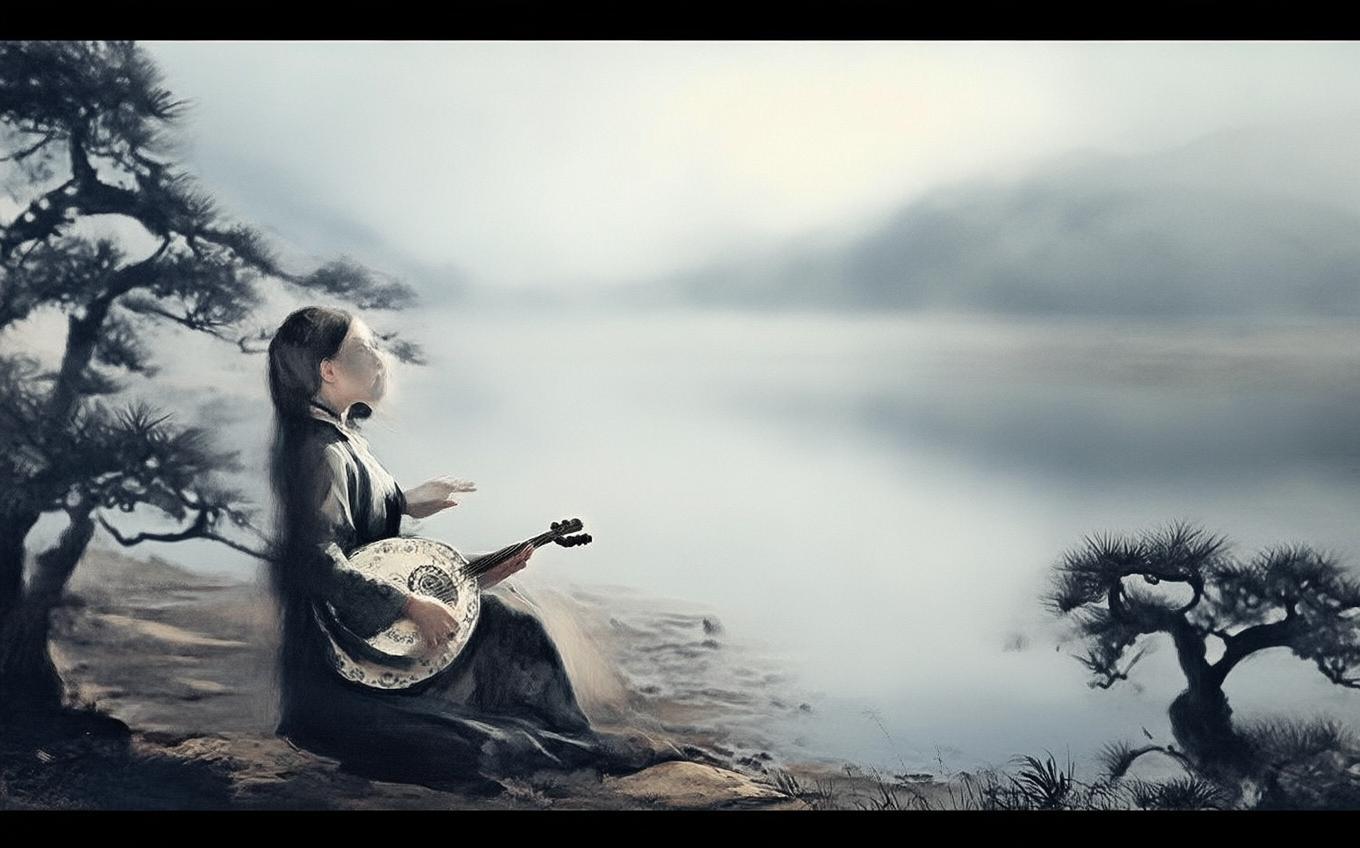
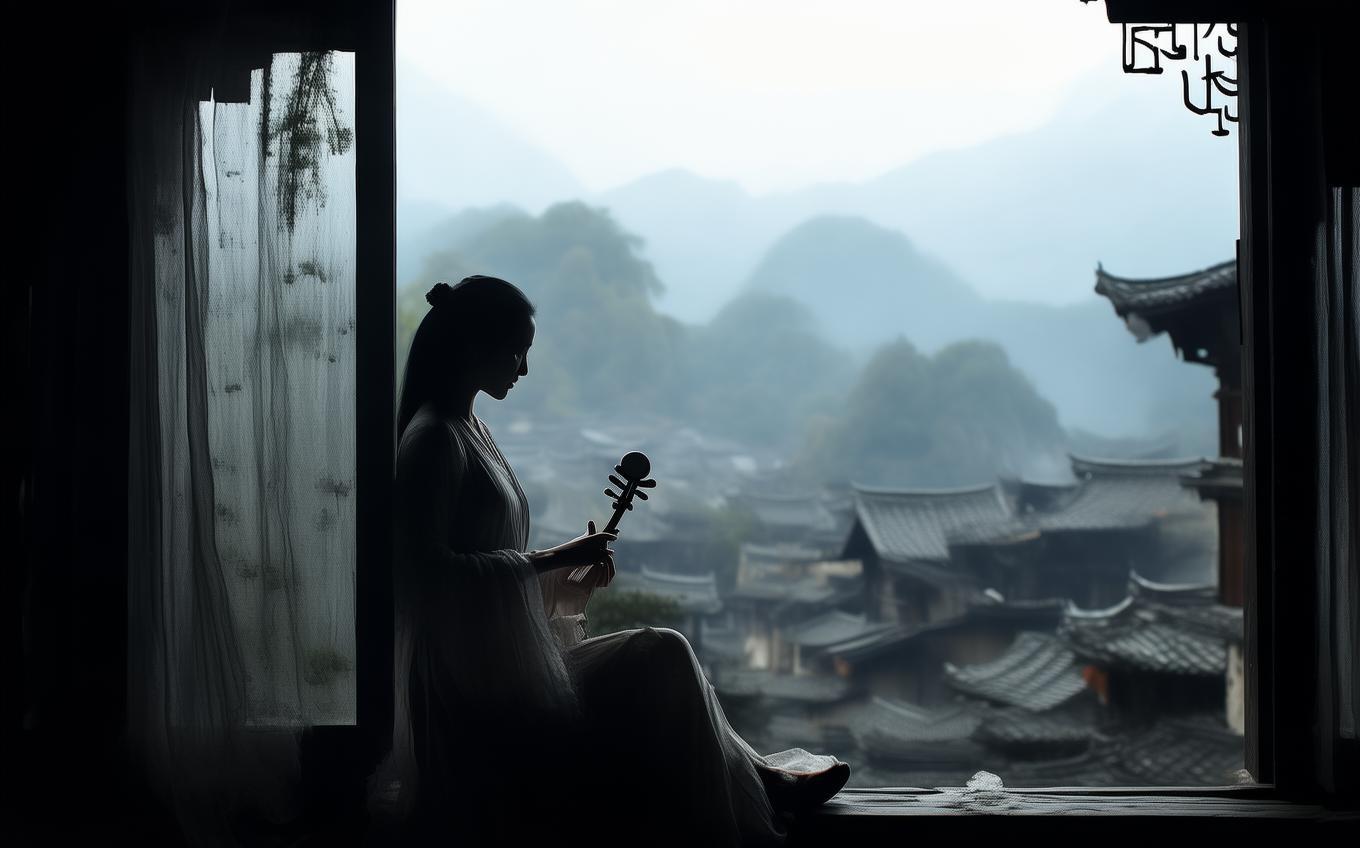
唯有琵琶背 – With the value judgement already delivered, the poem swings its spotlight onto a single, small object: the unadorned back of a pipa. The pipa is a pear‑shaped lute that in Chinese culture is overwhelmingly associated with female entertainers, romance, and poignant personal stories (think of Bai Juyi’s long narrative poem Pipa xing). The “back” is the part usually held against the body, the part one would not normally notice – a secret, private surface. By choosing this humble, hidden place, the poet suggests that what truly endures is often invisible to the public eye.
长留旧姓名 – The final line reveals what is inscribed on that wooden back: an “old name” (旧姓名). This is the name of a woman, perhaps a lover, a beloved courtesan, or even the poet’s own daughter, etched there long ago. The verb “长留” (forever preserves) is beautifully restrained; it does not shout of immortality, but simply notes that as long as the instrument exists, her name will outlive all the gold‑and‑scrolls that the Jin and Zhang families could ever amass. The pipa – a fragile, perishable thing – becomes, in the poet’s logic, a stronger vehicle of memory than mountains of treasure.
Themes and Symbolism
- Transience of worldly wealth: The poem explicitly contrasts material abundance (the thirty thousand scrolls) with something much smaller yet more durable. Wealth and fame, it implies, are ultimately hollow compared with the truth of feeling.
- The power of personal memory: An old name, kept in a private space, holds a power that vast libraries cannot. Memory and affection become a kind of quiet victory over time.
- The dignity of the ordinary object: The pipa is not a royal scepter or a bronze ritual vessel, but a modest, everyday tool of music and courtship. Its “back” symbolizes the hidden side of life where true feelings are stored, unobserved by society.
- Feminine emotion as a counterweight to masculine ambition: In the patriarchal world of classical China, a “daughter’s feeling” would have been considered a private, domestic matter. Wang Yucheng elevates it above the most prestigious achievements of officialdom, a gently subversive gesture.
Cultural Context
Wang Yucheng wrote during the early Song Dynasty, a time when the ruling elite consciously revived Han‑ and Tang‑era models of governance, literature, and moral philosophy. By referencing the famous Jin and Zhang clans, he draws on a shared historical memory that every literate reader would recognize: these families had been envied for centuries, yet eventually their glory evaporated. The pipa, meanwhile, had been a central instrument in Chinese music and poetry since the Han Dynasty, and by the Tang it was inextricably linked with the world of entertainment quarters and the poignant stories of women who lived there. Inscribing a name on a pipa was a real practice – a token of remembrance, often done by a lover or a friend. Thus the poem straddles the high‑minded world of classical allusions and the earthy, emotional realm of personal keepsakes, uniting them in a single, deceptively simple moment. It reflects a persistent theme in Chinese aesthetics: the belief that the monumental can be surpassed by the intimate, and that what is “left behind” by sincere human connection has its own kind of eternal life.
Conclusion
“书琵琶背” achieves its lasting appeal through absolute economy. In just twenty Chinese characters, Wang Yucheng builds a monument out of a few strokes of ink on wood and then, with devastating gentleness, declares that this tiny monument is more durable than palaces full of scrolls. The poem speaks to anyone who has ever treasured a handwritten name, a keepsake, or a memory over the trappings of public success. For English‑speaking readers, it is a lesson in how classical Chinese poetry often finds profound philosophy not in grand pronouncements, but in the quiet corners of everyday life. More than a thousand years later, the inscription on that pipa may be lost, but the poem keeps the “old name” – and the feeling behind it – alive.
Comments (0)
No comments yet. Be the first to comment!