Introduction
“病中书事” (Bìng Zhōng Shū Shì, “Writing of Things While Ill”) is a poem traditionally attributed to Li Yu (李煜, 937–978), the last ruler of the Southern Tang kingdom during the Five Dynasties and Ten Kingdoms period. Li Yu is best known in Chinese literary history not as a successful monarch, but as one of the greatest lyric poets of sorrow, loss, and inward reflection.
Although Li Yu’s most famous works are cí lyrics written after the fall of his kingdom, “病中书事” belongs to the broader tradition of Chinese poems written during illness. In classical Chinese literature, illness often becomes more than a physical condition: it becomes a moment of self-examination, spiritual retreat, and philosophical insight.
This poem is significant because it shows a quieter side of Li Yu’s emotional world. Instead of grand political grief or romantic longing, the poem presents a sick man in seclusion, surrounded by medicine, silence, and Buddhist thought. Through simple domestic details, it reveals the poet’s search for inner peace amid bodily weakness and mental anxiety.
The Poem: Full Text and Translation
病身坚固道情深
Bìng shēn jiān gù dào qíng shēn
Though my body is ill, my devotion to the Way grows firm and deep.
宴坐清香思自任
Yàn zuò qīng xiāng sī zì rèn
Sitting quietly amid pure fragrance, I let my thoughts settle by themselves.
月照静居唯捣药
Yuè zhào jìng jū wéi dǎo yào
Moonlight shines on my silent dwelling; only the pounding of medicine is heard.
门扃幽院只来禽
Mén jiōng yōu yuàn zhǐ lái qín
The gate is shut in the secluded courtyard; only birds come and go.
庸医懒听词何取
Yōng yī lǎn tīng cí hé qǔ
I am too weary to listen to mediocre doctors—what value are their words?
小婢将行力未禁
Xiǎo bì jiāng xíng lì wèi jīn
A young maid tries to help me walk, but my strength cannot sustain it.
赖问空门知气味
Lài wèn kōng mén zhī qì wèi
Fortunately, by seeking the Buddhist path, I have come to know its true flavor.
不然烦恼万涂侵
Bù rán fán nǎo wàn tú qīn
Otherwise, countless troubles would invade me from every direction.
Line-by-Line Analysis
The opening line, “病身坚固道情深” (Though my body is ill, my devotion to the Way grows firm and deep), immediately sets up a contrast between physical weakness and spiritual strength. The phrase “病身” means “sick body,” emphasizing human fragility. Yet “坚固” suggests firmness and stability. The more the body suffers, the more deeply the poet turns toward “道” (dào), the Way. Here, “the Way” may refer broadly to spiritual cultivation, especially Buddhist and Daoist ideas of detachment.
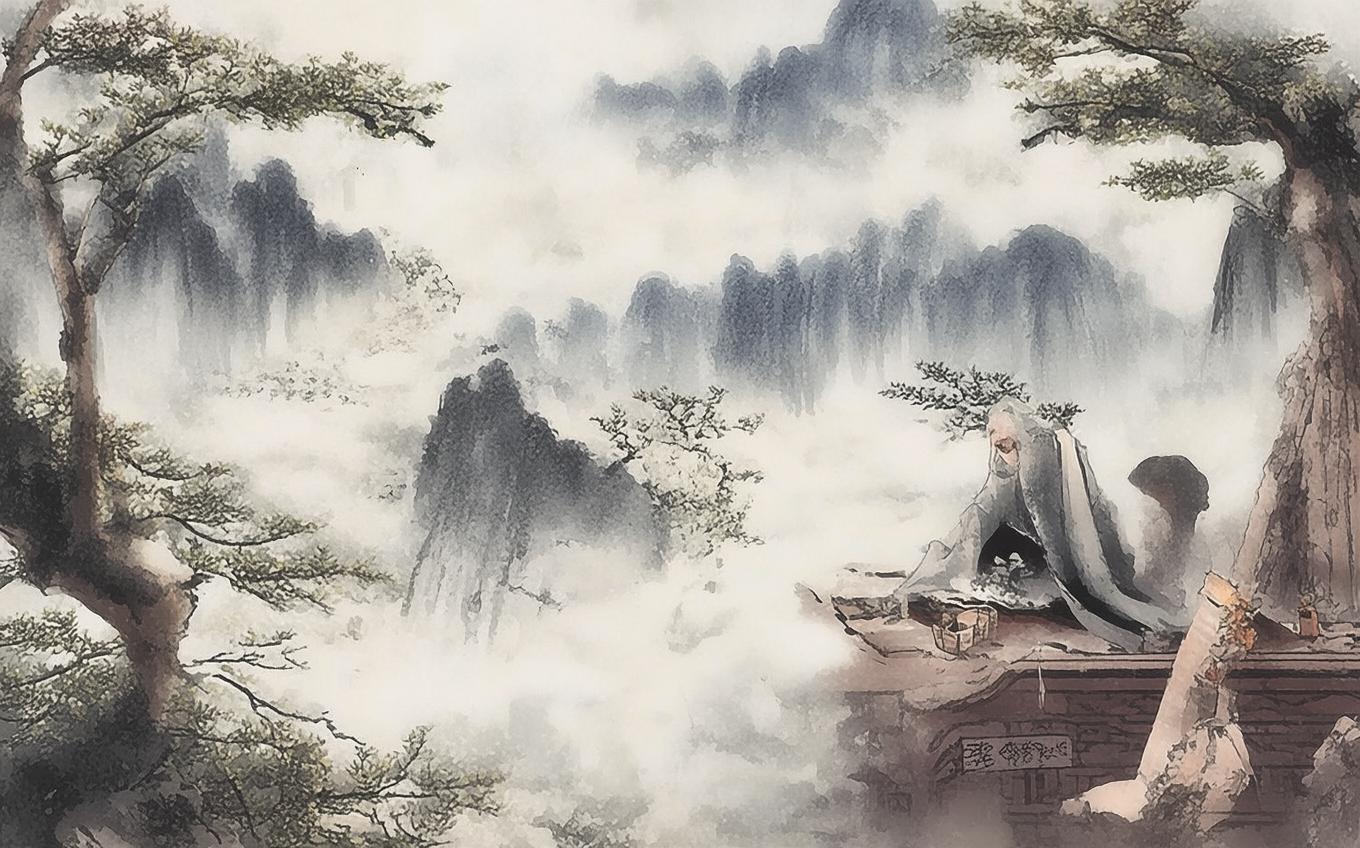
In “宴坐清香思自任” (Sitting quietly amid pure fragrance, I let my thoughts settle by themselves), the poet presents an image of meditation. “宴坐” does not mean feasting here; it means sitting calmly and peacefully. “清香,” or pure fragrance, may suggest incense burned during Buddhist practice. The line evokes a room of stillness, where the poet is not forcing his mind into order but allowing thoughts to “take care of themselves.” This reflects a deeply Chinese spiritual ideal: peace arises not through struggle, but through quiet acceptance.
The third line, “月照静居唯捣药” (Moonlight shines on my silent dwelling; only the pounding of medicine is heard), is rich in sound and atmosphere. The moon is a classic symbol in Chinese poetry, often associated with solitude, longing, purity, and reflection. Here, moonlight falls on a “静居,” a quiet residence. The only sound is “捣药,” the pounding of medicine. This small domestic sound makes the stillness even deeper. It reminds us that the poet is not living in heroic isolation, but in the ordinary reality of sickness.
“门扃幽院只来禽” (The gate is shut in the secluded courtyard; only birds come and go) continues the atmosphere of withdrawal. “门扃” means the gate is closed or locked. The world of human affairs has been shut out. The courtyard is “幽,” secluded and quiet. Only birds visit. In Chinese poetry, birds often suggest freedom, nature, and a life beyond worldly concerns. Their presence contrasts with the poet’s immobility. He cannot move freely, but birds still pass through the quiet space around him.
The fifth line, “庸医懒听词何取” (I am too weary to listen to mediocre doctors—what value are their words?), introduces a sharper tone. “庸医” means an ordinary or incompetent doctor. The poet is tired not only from illness, but also from useless advice. This line may be read literally: he distrusts the doctors treating him. But it may also have a broader meaning. In Chinese literature, ineffective doctors can symbolize shallow worldly solutions to deep human suffering. The poet’s illness is not only medical; it is existential.
In “小婢将行力未禁” (A young maid tries to help me walk, but my strength cannot sustain it), the poem becomes physically intimate. A young servant girl supports him as he attempts to walk, but his body is too weak. The line is simple and touching. It shows the poet’s dependence on others and the humiliation of illness. Classical Chinese poetry often communicates powerful emotion through restraint. There is no dramatic complaint here, only a small gesture that reveals the depth of his condition.
The seventh line, “赖问空门知气味” (Fortunately, by seeking the Buddhist path, I have come to know its true flavor), turns from the physical world to spiritual insight. “空门” literally means “the gate of emptiness,” a common term for Buddhism. In Buddhist thought, “emptiness” does not mean nothingness, but the absence of fixed, independent existence. To understand emptiness is to loosen attachment to the self, to pain, and to worldly anxieties. The phrase “知气味,” “to know its flavor,” suggests that this is not merely intellectual knowledge. The poet has tasted, through experience, the comfort of Buddhist wisdom.
The final line, “不然烦恼万涂侵” (Otherwise, countless troubles would invade me from every direction), completes the poem’s emotional movement. “烦恼” is an important Buddhist term meaning afflictions, worries, or mental disturbances. “万涂” suggests countless paths or directions. Without spiritual refuge, the poet says, troubles would overwhelm him from all sides. The poem ends not in complete joy, but in a fragile form of relief. Illness remains, but Buddhism offers a way to endure it.
Themes and Symbolism
One of the central themes of “病中书事” is the relationship between bodily suffering and spiritual awakening. The poet’s body is weak, but his inner life becomes more focused. This reflects a common idea in Chinese religious and literary traditions: adversity can become a path toward self-knowledge.
Another major theme is seclusion. The closed gate, quiet courtyard, moonlit room, and visiting birds all create a world separated from public life. For Li Yu, who lived through political instability and personal tragedy, withdrawal from the world may have represented both loss and liberation. In illness, he is forced into solitude, but solitude also opens the possibility of contemplation.
The poem also explores the limits of worldly remedies. Doctors and medicine appear in the poem, but they do not fully solve the poet’s suffering. The pounding of medicine reminds us of physical treatment, while the reference to Buddhism suggests a deeper cure for mental anguish. The poem does not reject medicine completely, but it implies that human suffering needs more than practical treatment.
Key symbols include the moon, medicine, birds, and the closed gate. The moon symbolizes stillness, purity, and reflective solitude. Medicine symbolizes the reality of illness and the attempt to heal the body. Birds represent the natural world and a freedom beyond human troubles. The closed gate marks the poet’s separation from society and his movement toward inner life.
Most importantly, “空门” (kōng mén, the Buddhist gate of emptiness) symbolizes spiritual refuge. It is a doorway out of ordinary anxiety, not by escaping life, but by seeing life differently.
Cultural Context
Li Yu lived during the Five Dynasties and Ten Kingdoms period, a time of political division and frequent warfare after the fall of the Tang dynasty. He ruled the Southern Tang, a small kingdom known for its refined culture but vulnerable political position. In 975, the Song dynasty conquered Southern Tang, and Li Yu was taken captive. His later writings are filled with memories of lost palaces, vanished pleasures, and the pain of helplessness.
Even if “病中书事” is read outside the exact details of Li Yu’s biography, it belongs to a long Chinese tradition of illness poetry. Many Chinese poets wrote about sickness not simply to describe pain, but to explore the meaning of life. Illness stripped away ambition, social performance, and worldly desire. It forced the poet to confront the self.
The poem also reflects the strong influence of Buddhism on Chinese literati culture. By Li Yu’s time, Buddhism had become deeply integrated into Chinese intellectual and artistic life. Concepts such as “emptiness,” “affliction,” and detachment were widely used by poets, even those who were not monks. For educated readers, the phrase “空门” would immediately evoke Buddhist practice and the hope of release from suffering.
At the same time, the poem reflects Chinese values of quietness, restraint, and harmony with nature. Instead of describing illness in dramatic or confessional language, the poet uses images: moonlight, a shut gate, a secluded courtyard, birds, medicine, and incense. This indirectness is a hallmark of classical Chinese poetry. Emotion is not shouted; it is placed carefully within a scene.
Conclusion
“病中书事” is a quiet but deeply moving poem about illness, solitude, and spiritual endurance. Its beauty lies in its restraint. The poet does not present himself as a heroic sufferer. Instead, he gives us a room lit by moonlight, the sound of medicine being prepared, a closed courtyard, and the small presence of birds.
Through these images, the poem shows how physical weakness can lead to inward strength. The poet cannot control his body, doctors, or circumstances, but he can turn toward a deeper understanding of suffering. Buddhism offers him not a magical cure, but a way to keep “countless troubles” from overwhelming the heart.
For modern readers, “病中书事” remains relevant because it speaks to experiences that are universal: illness, anxiety, isolation, and the search for peace. Its message is gentle but powerful: when the outer world narrows, the inner world may still open.

Comments (0)
No comments yet. Be the first to comment!