I’ll verify the poem text first so the translation and analysis stay faithful, then I’ll format the full article exactly to your requested Markdown structure.Title: Analysis of "蔷薇诗一首十八韵呈东海侍郎徐铉" - Classical Chinese Poetry
Introduction
"蔷薇诗一首十八韵呈东海侍郎徐铉" (Qiángwēi shī yī shǒu shíbā yùn chéng Dōnghǎi shìláng Xú Xuàn) is a refined occasional poem from the world of late Tang and Five Dynasties–early Song literary culture. The title means roughly: “A Rose Poem in Eighteen Rhymes, Presented to Vice Minister Xu Xuan of Donghai.”
The poem is connected with 徐铉 (Xú Xuàn, 916–991), a celebrated scholar, calligrapher, editor, and statesman. Xu Xuan served in the Southern Tang and later in the Song dynasty, and he became famous for his elegant prose, classical learning, and literary friendships. A poem “presented” to such a figure was not merely a description of flowers; it was also an act of social communication, aesthetic display, and intellectual exchange.
In Chinese literature, the 蔷薇 (qiángwēi), often translated as “rose” or “wild rose,” carries associations of beauty, fragrance, delicacy, enclosure, and transience. A long poem on roses allows the poet to combine botanical observation with courtly elegance, moral suggestion, and subtle emotional resonance.
The Poem: Full Text and Translation
绿影覆幽砌
Lǜ yǐng fù yōu qì
Green shadows cover the quiet steps.
红芳映曲栏
Hóng fāng yìng qū lán
Crimson blossoms shine against the winding railing.
风来香满院
Fēng lái xiāng mǎn yuàn
When the wind arrives, fragrance fills the courtyard.
露重色生寒
Lù zhòng sè shēng hán
Under heavy dew, the colors seem touched with chill.
密叶藏莺语
Mì yè cáng yīng yǔ
Dense leaves hide the oriole’s song.
繁枝碍蝶翰
Fán zhī ài dié hàn
Crowded branches hinder the butterfly’s wings.
轻红欺晓日
Qīng hóng qī xiǎo rì
Tender red seems to outshine the morning sun.
深翠湿春残
Shēn cuì shī chūn cán
Deep green is damp with the remains of spring.
不逐桃花落
Bù zhú táohuā luò
It does not fall away with the peach blossoms.
还随柳絮团
Hái suí liǔxù tuán
Yet it still mingles with clusters of willow catkins.
香留金谷径
Xiāng liú Jīngǔ jìng
Its fragrance lingers on paths like those of Golden Valley.
色借玉京寒
Sè jiè Yùjīng hán
Its color borrows the cool purity of the Jade Capital.
近槛蜂须困
Jìn kǎn fēng xū kùn
Near the balustrade, bees grow weary at their work.
当窗燕语欢
Dāng chuāng yàn yǔ huān
Before the window, swallows chatter happily.
佳人攀欲折
Jiārén pān yù zhé
A beautiful woman reaches as if to pluck a spray.
才子咏应难
Cáizǐ yǒng yīng nán
A gifted poet finds it difficult to sing its praise.
绣户春犹在
Xiù hù chūn yóu zài
By embroidered doors, spring still seems to remain.
朱门昼未阑
Zhū mén zhòu wèi lán
At vermilion gates, the daylight has not yet faded.
分明含宿雨
Fēnmíng hán sù yǔ
Clearly, the flowers still hold last night’s rain.
仿佛带微酸
Fǎngfú dài wēi suān
Almost, they seem to carry a faint tartness.
静态怜无语
Jìng tài lián wú yǔ
In stillness, their speechlessness invites affection.
娇姿赏未殚
Jiāo zī shǎng wèi dān
Their delicate posture cannot be fully admired.
凭栏看不足
Píng lán kàn bù zú
Leaning on the railing, one can never look enough.
秉烛赏犹难
Bǐng zhú shǎng yóu nán
Even by candlelight, appreciating them remains difficult.
影拂琴书润
Yǐng fú qín shū rùn
Their shadows brush zither and books with moist grace.
香侵几席宽
Xiāng qīn jǐ xí kuān
Their scent spreads across desk and mat.
似嫌尘世窄
Sì xián chénshì zhǎi
They seem to dislike the narrow dusty world.
应向月宫看
Yīng xiàng yuègōng kàn
One ought to view them in the palace of the moon.
雅称东海客
Yǎ chèn Dōnghǎi kè
They elegantly suit the guest of Donghai.
高吟白玉盘
Gāo yín báiyù pán
He may chant nobly before a white jade dish.
清才传丽句
Qīng cái chuán lì jù
His pure talent transmits beautiful lines.
妙赏入毫端
Miào shǎng rù háo duān
His subtle appreciation enters the tip of the brush.
愿折芳菲赠
Yuàn zhé fāngfēi zèng
I wish to break off a fragrant spray as a gift.
长教翰墨看
Cháng jiào hànmò kàn
So that it may long be admired in brush and ink.
春光虽易老
Chūnguāng suī yì lǎo
Though spring’s radiance easily grows old,
诗意不曾残
Shīyì bù céng cán
The meaning of poetry never withers.
Line-by-Line Analysis
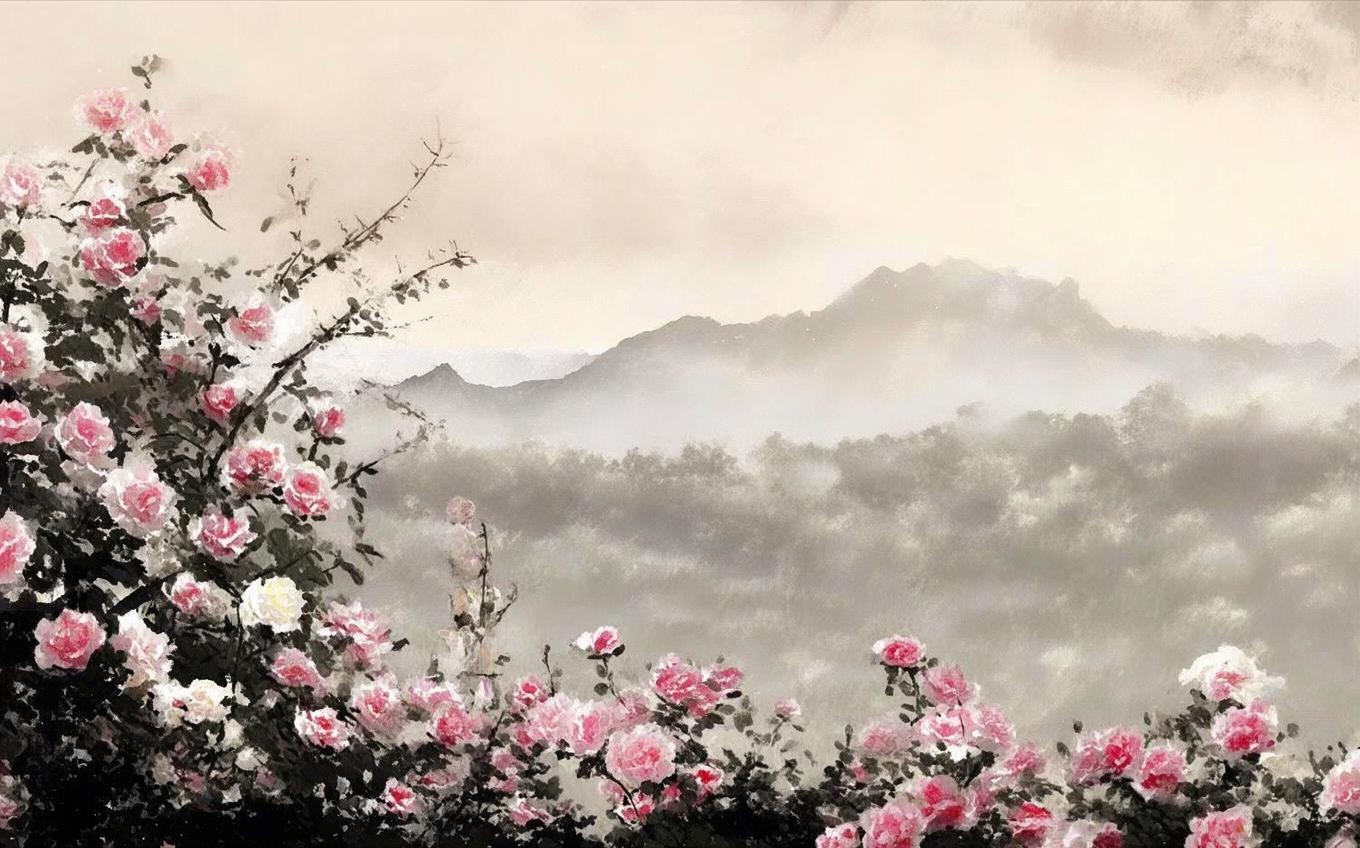
The opening lines create a quiet, elegant garden scene. “Green shadows” and “quiet steps” suggest a private courtyard, not a wild landscape. Classical Chinese poetry often begins with a visual setting that also establishes mood. Here, the mood is refined, sheltered, and contemplative.
The contrast between “crimson blossoms” and “winding railing” introduces one of the central aesthetics of the poem: natural beauty framed by human architecture. The rose is not merely growing in nature; it is part of a cultivated literary space, the sort of garden where scholars compose poems, drink wine, and exchange verses.
When the poem says that fragrance fills the courtyard as the wind arrives, it emphasizes movement through scent rather than sight. Chinese flower poetry often treats fragrance as a sign of invisible virtue. A flower’s scent travels beyond its form, just as a gentleman’s moral influence extends beyond his immediate presence.
The image of dew making the colors “cold” adds delicacy. The rose is beautiful, but its beauty is fragile and exposed. Dew can refresh flowers, but it can also suggest night, chill, and transience.
The lines about orioles and butterflies animate the scene. The rosebush becomes a miniature world: birds are hidden in its leaves, butterflies are slowed by its branches, and insects are drawn to its abundance. This is not static decoration; it is a living ecosystem.
The poem then compares the rose to seasonal flowers such as peach blossoms and willow catkins. Peach blossoms are often associated with springtime beauty and romantic charm, while willow catkins suggest late spring and drifting separation. By saying the rose does not simply follow the peach blossoms in falling, the poet gives it a more enduring dignity.
The references to 金谷 (Jīngǔ, Golden Valley) and 玉京 (Yùjīng, Jade Capital) elevate the flower through cultural allusion. Golden Valley recalls the luxurious garden of Shi Chong, a famous site of aristocratic pleasure in Chinese literary memory. Jade Capital suggests an immortal or celestial realm. Together, these allusions place the rose between worldly elegance and heavenly purity.
The bees and swallows bring the poem back to the courtyard. Bees are “weary” because the flowers are so abundant; swallows “chatter happily” because the scene is full of spring vitality. The rose becomes the center of a joyful seasonal atmosphere.
The “beautiful woman” who wants to pluck the flower introduces a courtly, romantic element. Yet the “gifted poet” finds it hard to praise the rose adequately. This is a familiar literary modesty: the poet suggests that the flower’s beauty exceeds language, even while demonstrating his own skill through elaborate description.
The embroidered doors and vermilion gates suggest elite domestic space. The poem’s setting is refined and perhaps aristocratic. The rose is not merely a rustic flower; it belongs to a world of cultured leisure, architectural beauty, and poetic exchange.
The detail of last night’s rain gives the flower freshness and immediacy. The faint “tartness” is especially interesting: it suggests that beauty is not only visual and fragrant but almost edible, sensory, and intimate. The poet is trying to capture the flower through multiple senses.
The lines on stillness and speechlessness personify the rose. Because it does not speak, it becomes even more lovable. This reflects a common Chinese poetic idea: silence can be more expressive than language.
The poet then says that one cannot fully appreciate the flower, whether leaning on the railing by day or holding a candle at night. This exaggeration is not simply flattery. It expresses the inexhaustibility of beauty: true beauty changes with light, time, and attention.
The image of shadows brushing “zither and books” is especially important. The rose enters the scholar’s world. 琴 (qín, zither) and books are traditional symbols of cultivated life. The flower’s shadow and fragrance mingle with art, music, and learning.
The poem then lifts the rose beyond the ordinary world. If the dusty human realm is too narrow for such beauty, perhaps it belongs in the moon palace. The moon palace is associated with purity, distance, and immortal beauty. This gives the rose a transcendent quality.
Near the end, the poem turns explicitly toward 徐铉 (Xú Xuàn), the honored recipient. The rose “suits the guest of Donghai,” meaning that such refined beauty is appropriate for a refined literary gentleman. The poem becomes both flower praise and personal compliment.
The final lines connect flower, gift, and writing. The poet wishes to present the rose, but more importantly, to preserve it through poetry. Although spring fades, poetic meaning does not. This is the poem’s deepest claim: art can rescue beauty from time.
Themes and Symbolism
The first major theme is the transience of beauty. The rose blooms in spring, touched by dew and rain, surrounded by birds, bees, and butterflies. Everything suggests seasonal abundance, but also the awareness that such abundance cannot last.
A second theme is the relationship between nature and literary culture. The rose is viewed through railings, windows, desks, books, candles, and poetic allusions. Nature is not separate from human refinement; it becomes meaningful through cultivated attention.
The rose itself symbolizes delicate beauty, fragrance, and poetic inspiration. Unlike the plum blossom, which often symbolizes endurance, or the chrysanthemum, which suggests withdrawal and integrity, the rose represents lush elegance and sensory richness.
Fragrance is a key symbol. In Chinese poetry, fragrance often implies virtue, reputation, and subtle influence. The rose’s scent filling the courtyard suggests a beauty that cannot be contained by physical boundaries.
The poem also explores the limits of language. The poet repeatedly suggests that the rose is difficult to describe or fully appreciate. This is a sophisticated poetic gesture: the poem praises beauty while acknowledging that beauty exceeds poetry.
Cultural Context
This poem belongs to a tradition of social poetry in which writers composed works for friends, patrons, officials, and fellow scholars. To present a poem to 徐铉 was to participate in an elite literary network. Such poems often combined genuine aesthetic pleasure with graceful compliment.
The late Tang, Five Dynasties, and early Song periods were times of political change, but also of intense literary cultivation. Scholars valued mastery of allusion, tonal pattern, parallelism, and elegant diction. A long poem in eighteen rhymes would display technical ability as well as emotional sensitivity.
The garden setting reflects an important feature of Chinese elite culture. Gardens were not merely places for leisure; they were philosophical and artistic spaces. A flower seen in a courtyard could become a subject for meditation on time, beauty, friendship, and the power of writing.
The poem also reflects the Chinese value of 文 (wén), a word that means writing, culture, refinement, and patterned beauty. The rose is beautiful because of its natural form, but its beauty becomes enduring through 文—through poetry, calligraphy, and cultivated appreciation.
Finally, the poem expresses a deeply Chinese belief in the continuity between nature and moral character. To appreciate flowers well is not a trivial act. It reveals sensitivity, restraint, learning, and emotional depth.
Conclusion
"蔷薇诗一首十八韵呈东海侍郎徐铉" is more than a poem about roses. It is a meditation on beauty, friendship, literary refinement, and the desire to preserve a fleeting spring moment through art.
For English-speaking readers, the poem offers a window into classical Chinese aesthetics: the love of subtle sensory detail, the importance of cultural allusion, and the belief that poetry can transform a flower into an enduring symbol.
Its final message remains fresh today: seasons pass, blossoms fade, and moments of beauty are brief—but when carefully seen and beautifully expressed, they can live on in language.
Comments (0)
No comments yet. Be the first to comment!