Introduction
- The poem “幸秦川上梓潼山” (Xìng Qínchuān Shàng Zǐtóng Shān) is traditionally attributed to Emperor Xuanzong of Tang (唐玄宗, Táng Xuánzōng, 685–762), one of the most famous rulers of the Tang dynasty.
- Emperor Xuanzong’s reign is remembered both for cultural brilliance and political tragedy. The early part of his rule marked the height of Tang prosperity, while the later years were shaken by the An Lushan Rebellion (安史之乱, Ān Shǐ zhī Luàn), a devastating conflict that changed the course of Chinese history.
- The title may be translated as “Imperial Visit to Mount Zitong in the Qin Plain.” The word 幸 (xìng) has a special imperial meaning: it refers to an emperor’s visit or journey.
- This poem is significant because it combines landscape description with imperial self-reflection. It is not merely a nature poem; it presents the ruler’s journey as an act connected to responsibility, anxiety, and statecraft.
The Poem: Full Text and Translation
乔岩簇冷烟
Qiáo yán cù lěng yān
Tall cliffs gather in cold mist.
幽径上寒天
Yōu jìng shàng hán tiān
A secluded path rises into the chilly sky.
下瞰峨眉岭
Xià kàn Éméi lǐng
Looking down, one sees the ridges of Emei.
上窥华岳巅
Shàng kuī Huà Yuè diān
Looking upward, one glimpses the summit of Mount Hua.
驱驰非取乐
Qū chí fēi qǔ lè
This journey is not made in pursuit of pleasure.
按幸为忧边
Àn xìng wèi yōu biān
The imperial visit is undertaken out of concern for the frontier.
此去如登陟
Cǐ qù rú dēng zhì
This journey onward is like a difficult ascent.
歌声入九天
Gē shēng rù jiǔ tiān
Songs rise into the highest heavens.
Line-by-Line Analysis
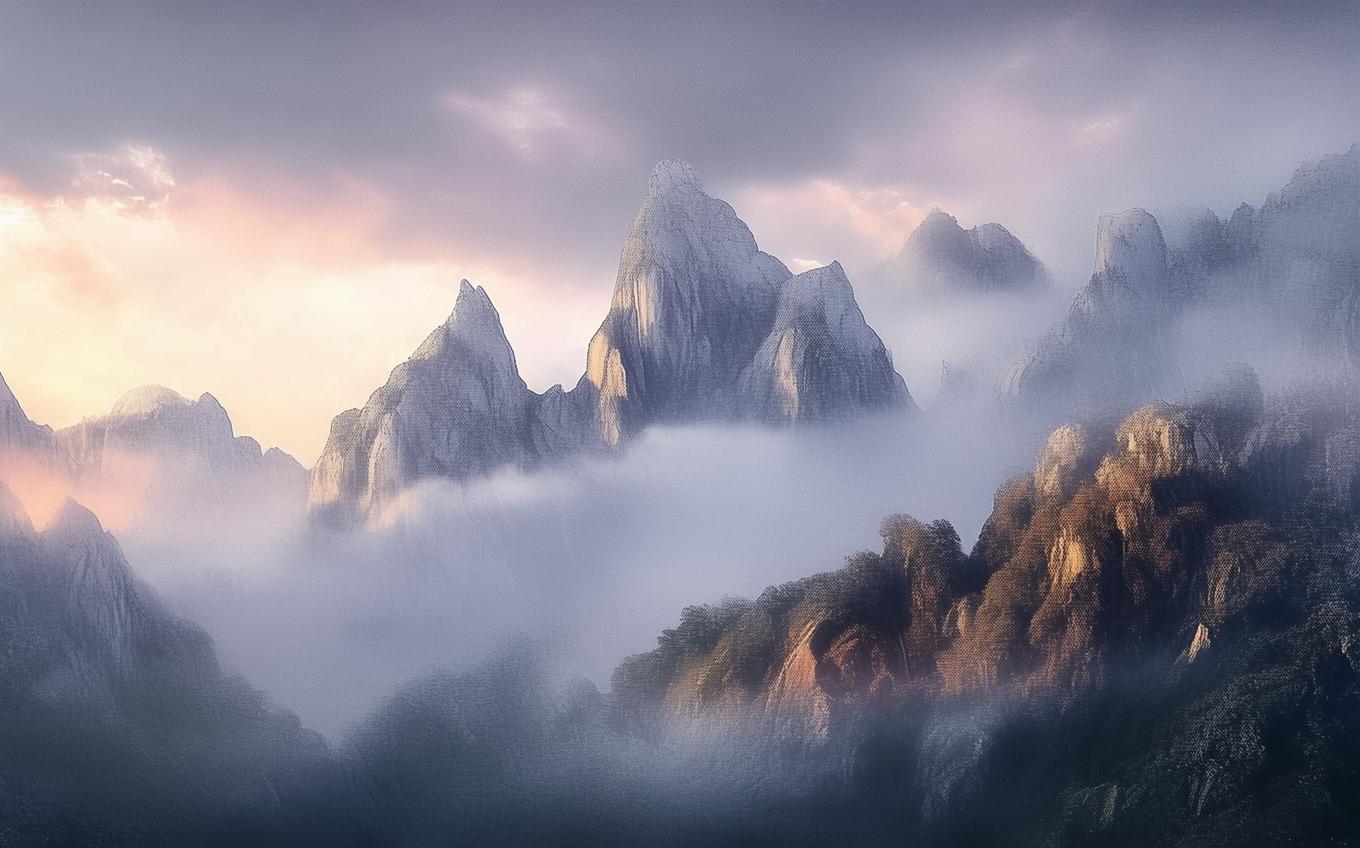
- “乔岩簇冷烟” opens with a dramatic mountain scene. The phrase 乔岩 suggests high, steep rocks, while 冷烟 evokes cold mist or vapor. The landscape feels remote, solemn, and elevated. For English readers, it may help to imagine a ruler moving through a mountain pass where nature appears both magnificent and severe.
- “幽径上寒天” continues the upward movement. The “secluded path” is not a broad royal road but a narrow route climbing toward a cold sky. This creates a sense of physical hardship and spiritual seriousness. The emperor is not placed in a comfortable palace but in a harsh landscape.
- “下瞰峨眉岭” introduces Mount Emei (峨眉山, Éméi Shān), one of China’s sacred mountains, later especially associated with Buddhism. By looking down toward Emei’s ridges, the poem expands the scene beyond one mountain to a grand geographical imagination.
- “上窥华岳巅” refers to Mount Hua (华山, Huà Shān), one of the Five Great Mountains of China. Mount Hua is famous for its steepness and sacred status. The contrast between Emei and Hua suggests the vastness of the empire and the poet’s elevated viewpoint.
- “驱驰非取乐” shifts from scenery to intention. The emperor insists that his travel is not for entertainment. In classical Chinese poetry, imperial journeys could be criticized as extravagant, so this line functions as a moral clarification.
- “按幸为忧边” explains the purpose of the journey: concern for the borderlands. The word 边 often refers to frontier regions, where military defense and political stability were major concerns. The emperor presents himself as a ruler who travels because he worries about the security of the realm.
- “此去如登陟” compares the journey to climbing. Literally, it describes physical ascent, but symbolically it also suggests the difficulty of governance. Ruling an empire is like climbing a dangerous mountain: one must endure hardship and keep moving upward.
- “歌声入九天” ends with a grand, almost ceremonial image. 九天 means “the nine heavens,” a traditional expression for the highest celestial realm. The rising song may suggest imperial majesty, public celebration, or the harmony between ruler, people, and Heaven.
Themes and Symbolism
- Nature and authority: The mountains are not just scenery. They frame the emperor’s power within the larger order of Heaven and Earth.
- Duty over pleasure: The poem explicitly denies that the journey is for amusement. This reflects the Confucian ideal that a ruler should place responsibility above personal enjoyment.
- Elevation and difficulty: The upward path symbolizes moral and political effort. Climbing becomes a metaphor for the burden of leadership.
- Sacred geography: References to Emei and Mount Hua connect the poem to China’s religious and cultural landscape, where mountains often represent spiritual power, imperial legitimacy, and cosmic order.
- Harmony with Heaven: The final image of song entering the heavens suggests an ideal relationship between human rule and celestial approval.
Cultural Context
- In imperial China, poetry was not only a literary art but also a medium of political expression. Emperors, officials, monks, and scholars all used poetry to reflect on public duty, personal emotion, and the natural world.
- The Tang dynasty was a golden age of Chinese poetry. Even emperors participated in poetic culture, and imperial poems often combined landscape description with political symbolism.
- The word 幸 is culturally important. In ordinary Chinese, it can mean “fortunate,” but in classical court language it often means an emperor’s visit. A title beginning with 幸 immediately signals an imperial perspective.
- The poem reflects Confucian political values: a ruler should be vigilant, morally serious, and concerned with the people and the frontier. At the same time, it reflects Daoist and Buddhist associations with mountains as places of transcendence and sacred power.
- For readers unfamiliar with Chinese literary tradition, the poem shows how landscape poetry can also be political poetry. Mountains, mist, roads, and songs are not neutral images; they carry meanings about virtue, empire, hardship, and cosmic order.
Conclusion
- “幸秦川上梓潼山” is a compact but powerful poem. In only eight lines, it moves from cold cliffs and hidden paths to sacred mountains, political duty, and songs rising into heaven.
- Its beauty lies in the union of landscape and responsibility. The emperor’s climb through the mountains becomes an image of rulership itself: difficult, elevated, and morally demanding.
- Today, the poem remains meaningful because it reminds us that power should be accompanied by responsibility. The highest journey is not the pursuit of pleasure, but the difficult ascent toward duty, awareness, and harmony with the world.
Comments (0)
No comments yet. Be the first to comment!