Introduction
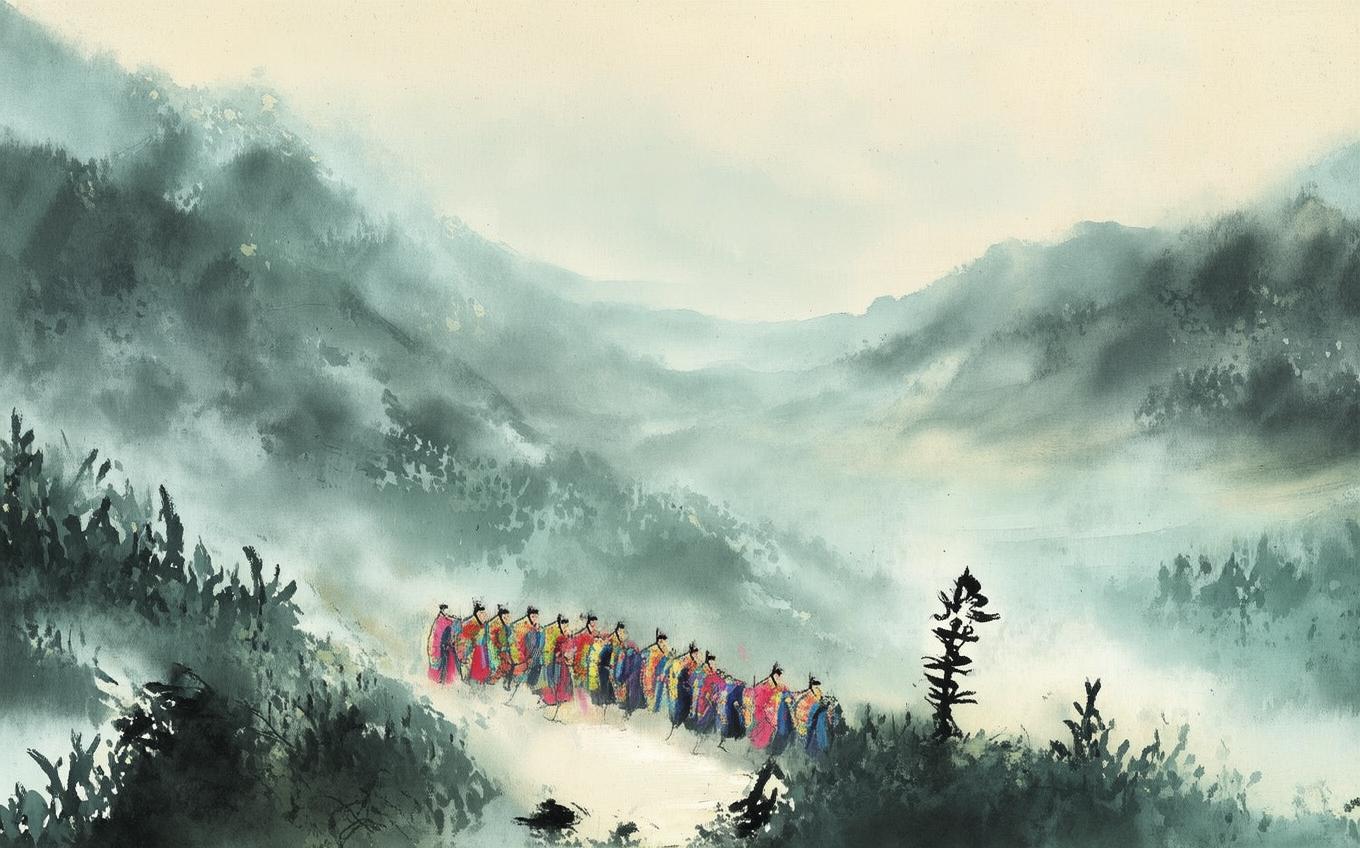
Amid the turbulence of the Five Dynasties and Ten Kingdoms period (907–979 CE), when China fractured into competing states, a remarkable figure emerged from humble origins to found the Wuyue Kingdom. Qian Liu (钱镠, 852–932 CE) rose from being a salt smuggler to a celebrated military governor and eventually the king of a prosperous coastal realm. He is remembered not only for his shrewd statecraft and engineering projects but also for a singularly personal poem he wrote in 906 CE: “巡衣锦军制还乡歌” (roughly, “A Song of Returning Home as Commander of the Brocade Army Patrol”). The title itself encapsulates an age-old Chinese dream—returning to one’s native village in dazzling success. This poem, composed when Qian Liu was fifty-five and at the height of his power, stands as a rare, authentic voice of a ruler who never forgot his roots, blending regal splendor with deep nostalgia.
The Poem: Full Text and Translation
The poem adopts the “Gē” (song) form, marked by the classical exclamatory particle “兮” (xī) that evokes the ancient Chu Ci (Songs of the South) tradition, lending it a lyrical, almost shamanistic rhythm.
三节还乡兮挂锦衣,
Sān jié huán xiāng xī guà jǐn yī,
With threefold honor I return home, wearing brocade robes;
碧天朗朗兮爱日晖。
Bì tiān lǎng lǎng xī ài rì huī,
The azure sky shines bright—how I cherish the sunlight’s warmth.
功臣道上兮列旌旗,
Gōng chén dào shàng xī liè jīng qí,
On the Meritorious Official Road, banners and flags are arrayed;
父老远来兮相追随。
Fù lǎo yuǎn lái xī xiāng zhuī suí,
Village elders come from afar, following me closely.
家山乡眷兮会时稀,
Jiā shān xiāng juàn xī huì shí xī,
Loved ones from the hometown hills—gatherings like this are rare;
今朝设宴兮觥散飞。
Jīn zhāo shè yàn xī gōng sàn fēi,
Today I host a feast, toasting vessels scatter like birds in flight.
斗牛无孛兮民无欺,
Dǒu niú wú bó xī mín wú qī,
No baleful stars in the Dipper and Ox constellations, and the people suffer no oppression;
吴越一王兮驷马归。
Wú Yuè yī wáng xī sì mǎ guī,
The one king of Wuyue returns, drawn by a four-horse team.
Line-by-Line Analysis
Line 1: The poem opens with a triumphant declaration. “三节” (sān jié) refers to the three tallies of authority granted by the emperor, symbolizing supreme military command. “挂锦衣” (guà jǐn yī) literally means “donning brocade clothes,” a direct nod to the idiom “衣锦还乡” (yī jǐn huán xiāng — returning home in brocade), i.e., returning in glory after achieving high rank. Qian Liu immediately establishes his hard-won status while grounding it in the intimate act of coming home.
Line 2: A sudden shift from personal pride to natural beauty. The bright sky and sun’s warmth suggest a cosmic blessing on his return. The verb “爱” (ài, love/cherish) reveals Qian Liu’s emotional vulnerability—he is not just a warrior but a man savoring a perfect moment.
Line 3: The “功臣道” (Meritorious Official Road) likely refers to a road built in his honor, lined with ceremonial flags. This is a visual spectacle of power, but also a public celebration linking his personal success to the collective memory of his hometown.
Line 4: “父老” (fù lǎo) — the elders — symbolize his roots. They “come from afar” and “follow” him, reversing the usual dynamic of a young man leaving home; now the home comes to him, acknowledging his elevation while retaining a tender, familial bond.
Line 5: Here, the tone grows reflective. “家山” (jiā shān, home hills) is a deeply emotive term in Chinese poetry, evoking shared childhood landscapes. The phrase “会时稀” (such gatherings are rare) hints at the transience of life and the cost of ambition—he has been away too long.
Line 6: A scene of lavish hospitality. “觥散飞” (gōng sàn fēi) describes drinking vessels clinking and emptying with abandon, like flying birds. The image conveys both joy and a fleeting, almost elegiac quality, as if the revelry might never come again.
Line 7: Qian Liu inserts a political statement. “斗牛” (the Dipper and Ox lunar mansions) were considered astrological omens for the Wuyue region. “无孛” (no broom-shaped comet, a bad omen) means the kingdom is at peace. He links cosmic order to just rule: “民无欺” — the people are not cheated. It is a ruler’s vow of benevolent governance.
Line 8: The grand finale. “吴越一王” (one king of Wuyue) asserts his unique status—he is not a distant emperor but a local son made good. “驷马归” (returning with four-horse carriage) echoes a phrase from Sima Qian’s Records of the Grand Historian, where the ambitious young Xiang Yu declared he would return home in a grand carriage. Qian Liu’s version is fulfilled, not a boast, and brings the poem full circle to the theme of triumphant homecoming.
Themes and Symbolism
Homecoming and Identity: The poem is a celebration of “衣锦还乡,” one of the most enduring motifs in Chinese culture. Qian Liu’s return is not merely a physical journey but a ritual of identity reaffirmation. His brocade robes and four-horse team are external symbols of an internal truth: he has remained loyal to his origins.
Power and Humility: Despite the display of military insignia and royal authority, the poem radiates warmth. The king values sunlight, elders, and rare family reunions over ruthless conquest. This reflects the Confucian ideal of a ruler who governs with benevolence and remains connected to his subjects.
Cosmic Harmony: By linking astrological signs to just rule, the poem draws on the ancient Chinese concept of “天人合一” (tiān rén hé yī, harmony between heaven and humanity). Qian Liu presents his kingship as part of a natural and celestial order, legitimizing his rule in an era of chaos.
Transience and Celebration: The image of flying wine cups and rare gatherings underscores a melancholy awareness that time is fleeting. The poem is as much about savoring the present as about recording a triumph.
Cultural Context
Qian Liu’s Wuyue Kingdom (907–978 CE) was centered in modern-day Zhejiang and prospered through trade and wise governance. He famously built seawalls to protect farmland and fostered economic stability. The poem was composed in 906, when he visited his hometown of Lin’an (near today’s Hangzhou) after being granted the honorific title “衣锦军” (Brocade-Clad Army) by the Tang court. The occasion was a grand imperial-style tour of inspection, but the song he sang—preserved in historical records—was deeply personal.
The phrase “巡衣锦军制” in the title refers to his role as commander of the Yijin (Brocade) army, patrolling his homeland. By writing in the Chu Ci song style, Qian Liu tapped into a rich poetic tradition that conveyed intense emotion through rhythmic exclamations, normally reserved for laments or spiritual quests. His adaptation for a festive homecoming was innovative and would have resonated with an audience familiar with such ancient verses.
The concept of yijin huanxiang (returning home in glory) pervades Chinese literature. From Xiang Yu’s tragic failure to achieve it to countless opera characters who long for it, the motif encapsulates the tension between worldly ambition and the pull of one’s roots. Qian Liu’s poem is a rare historical instance where the dream was realized, set to a king’s own words.
Conclusion
“巡衣锦军制还乡歌” is a gem of early medieval Chinese poetry that fuses the pageantry of a king with the heartfelt nostalgia of a villager. Its vivid imagery—brocade robes, bright skies, cheering elders, and flying wine cups—paints a picture of a perfect, if momentary, homecoming. For English-speaking readers, the poem offers a window into a uniquely Chinese ideal: that a successful life culminates not in distant luxury but in a return to one’s origins, surrounded by those who knew you before fame. Nearly eleven centuries later, Qian Liu’s song still resonates, reminding us that the truest validation of our achievements may lie in the smiles of aging neighbors and the warmth of a hometown sun.

Comments (0)
No comments yet. Be the first to comment!