Analysis of "宫中作" - Classical Chinese Poetry
Introduction
Li Yi (李益, c. 746–829) was a renowned poet of the mid‑Tang dynasty, celebrated for his frontier ballads, romantic verses, and poignant palace poems. He lived through the turbulent aftermath of the An Lushan Rebellion, a period that sharpened the Tang literati’s sensitivity to transience, imperial excess, and the silent suffering within the court. “宫中作” (Gōng zhōng zuò, literally “Written in the Palace”) is a masterpiece of understated lament. In just four lines, Li Yi captures the bitter solitude of a neglected palace lady by contrasting her isolation with the distant sounds of imperial revelry. The poem appears under several titles (such as “宫怨” – Palace Grievance), but its core remains timeless: a meditation on love, power, and the cruelty of waiting. For English readers, this quatrain opens a window into the hidden world of the Tang harem and the exquisite economy of Classical Chinese poetry.
The Poem: Full Text and Translation
露湿晴花春殿香,
Lù shī qíng huā chūn diàn xiāng,
Dew moistens the sun-bright flowers; the spring palace is fragrant.
月明歌吹在昭阳。
Yuè míng gē chuī zài Zhāoyáng.
Moonlit, sounds of song and flute drift from Zhaoyang Hall.
似将海水添宫漏,
Sì jiāng hǎi shuǐ tiān gōng lòu,
As if they had taken sea water to fill the palace water‑clock,
共滴长门一夜长。
Gòng dī Chángmén yī yè cháng.
So that every drop makes the night at Changmen longer than the night itself.
Line‑by‑Line Analysis
Line 1: Dew moistens the sun‑bright flowers; the spring palace is fragrant.
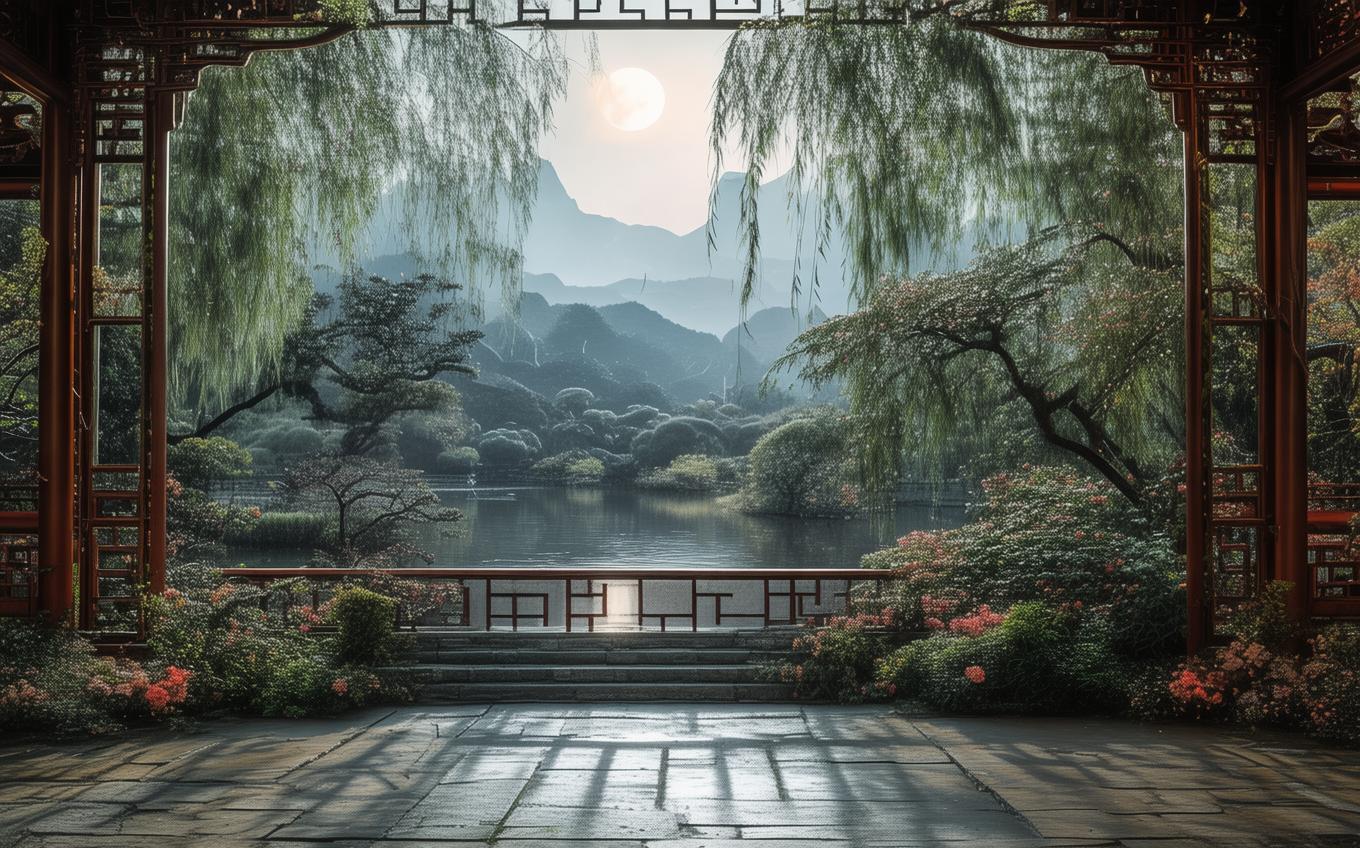
The poem opens on a sensuous, almost cinematic image. The morning dew still clings to blossoms that have opened in fair weather, releasing a delicate perfume through the palace compound. The phrase “晴花” (clear‑weather flowers) suggests a day full of promise, warmth, and vitality — precisely the kind of spring moment that ought to bring joy. Yet the very beauty of this scene will soon be turned into a cruel contrast. The fragrance is a public, outward sign of the palace’s luxury; the lonely speaker perceives it from the shadows, excluded from its sweetness.
Line 2: Moonlit, sounds of song and flute drift from Zhaoyang Hall.
Zhaoyang Hall (昭阳殿) was a famous residence of imperial favourites during the Han dynasty, notably occupied by the dazzling Empress Zhao Feiyan. In Tang poetry, mentioning Zhaoyang was a coded way to denote the current emperor’s most beloved consort. Here, moonlight mingles with the sound of 歌吹 (singing and wind instruments) — a synecdoche for a lavish nocturnal entertainment. The verb “在” (zài) simply states presence, but the juxtaposition makes it painfully clear: the music is there, in the favoured hall, while the speaker is here, in her own cold quarters. The line is a masterclass in implied narrative through spatial and sensory contrast.
Line 3: As if they had taken sea water to fill the palace water‑clock.
This line introduces a startling hyperbole that transforms the poem’s quiet grief into cosmic complaint. The “宫漏” (gōng lòu) refers to a clepsydra, the water‑drip clock used in ancient China to mark the watches of the night. Normally its reservoir holds a finite amount of water; the night passes after a predictable number of drips. But here the poet imagines someone — perhaps the indifferent emperor, or fate itself — having poured in the entire ocean. The image suggests endless, maddening time, as if the very mechanism designed to measure the hours has been sabotaged to prolong the sufferer’s vigil. The sea (海水) is a vast, untameable expanse, emblematic of the lady’s boundless sorrow.
Line 4: So that every drop makes the night at Changmen longer than the night itself.
The final line delivers the devastating punch. Changmen Palace (长门宫) is another Han dynasty allusion: it was the secluded residence where Emperor Wu’s empress, Chen Jiao, was confined after falling from favour. By choosing “Changmen,” Li Yi explicitly identifies his speaker with the archetypal abandoned consort. “一夜长” (one night long) undergoes a semantic stretch — the night is not merely subjectively endless; the drops create a night that surpasses the length of any ordinary night, an eternity compressed into a few hours. The word “共” (together, shared) implies that each drop participates in building this infinite darkness. There is a bitter irony: others hear the music of Zhaoyang; she hears only the drip of the water‑clock that will not let dawn come.
Themes and Symbolism
The harem as a microcosm of power and neglect
The poem operates within the classical convention of palace lament (宫怨), but Li Yi transforms it into a psychological study. He never mentions the lady directly; instead, we feel her presence through what she perceives — the fragrance she cannot own, the music she cannot share, the clock she cannot escape. This indirection gives the poem an almost modern sense of interiority.
Time as torture
The water‑clock (宫漏) is the central symbol. Structurally, it bridges the natural world of dew and flowers and the human world of halls and intrigues. When its water is imagined as the sea, time loses its boundaries. The poet hints that for the powerless, time is not a healer but a punisher — each drop falling with the weight of an ocean.
Historical allusion as political mask
The Han‑dynasty settings (Zhaoyang, Changmen) allowed Tang poets to criticise contemporary court life without open offence. By pointing to the past, Li Yi signals that such cruelty is perennial. The contrast between the glittering Zhaoyang and the dark Changmen has become a topos in Chinese literature, yet Li Yi’s handling feels fresh because of the sensory immediacy.
Cultural Context
The Tang imperial harem could number thousands of women, many of whom would never be visited by the emperor. Once a consort lost favour, she was often relocated to remote palaces, condemned to a life of material comfort but total emotional desolation. The “water‑clock” was a real feature of palace life, marking the night watches with a steady drip that easily became a metaphor for tedium and despair. By the mid‑Tang period, poets increasingly turned their gaze to these marginalised figures, influenced by both the Confucian ideal of compassion and the new interiority encouraged by Chan Buddhism. Li Yi, who spent years as a government official in the capital, would have been intimately familiar with the whispered stories of the palace.
Moreover, using a woman’s voice to express political exile or personal disappointment was a standard allegorical device following the tradition of Qu Yuan’s “Li Sao.”

Comments (0)
No comments yet. Be the first to comment!