Analysis of "题金华宫" - Classical Chinese Poetry
Introduction
"题金华宫" is traditionally attributed to 宋之问 (Sòng Zhīwèn), a prominent poet of the early Tang dynasty. The Tang period (618–907) is often regarded as the golden age of Chinese poetry, and poets of this era developed an elegant, refined style that deeply influenced later literature. Song Zhiwen is especially known for regulated verse and for poems that combine courtly polish with a strong sensitivity to landscape and atmosphere.
This poem belongs to the tradition of "题" (tí) poems, meaning verses written "on" or "inscribed at" a particular site. Such poems are never just descriptions of scenery; they also record a mood, a cultural memory, and a way of seeing the world. "题金华宫" is significant because it shows how Tang poets transformed a physical place into a spiritual and emotional landscape.
The Poem: Full Text and Translation
轩骑出东阁
Xuān qí chū dōng gé
Carriages and mounted attendants emerge from the eastern pavilion.
都门信宿过
Dū mén xìn sù guò
After only a short stay, they have already passed beyond the capital gate.
磬声流远涧
Qìng shēng liú yuǎn jiàn
The sound of stone chimes drifts along the distant mountain ravine.
钟韵下层萝
Zhōng yùn xià céng luó
The resonance of bells descends through layers of hanging vines.
日色翻池上
Rì sè fān chí shàng
Sunlight flickers and turns upon the surface of the pond.
云光隔殿多
Yún guāng gé diàn duō
Cloud-glow spreads between the palace halls in shifting abundance.
终疑神女至
Zhōng yí shén nǚ zhì
One almost suspects that a heavenly goddess has arrived.
更觉翠微阿
Gèng jué cuì wēi ē
And feels all the more the green, mist-veiled slope enfolding the place.
Line-by-Line Analysis
The opening couplet immediately creates movement and ceremonial dignity:
轩骑出东阁
都门信宿过
The first line presents a courtly scene: "轩骑" suggests noble carriages and horsemen, while "东阁" evokes an architectural setting associated with rank and refinement. The second line shifts the scene outward, beyond the city gate. Even in these opening lines, the poem moves from human order to a larger world outside political space. This movement is important in Tang poetry: leaving the city often means entering a zone of reflection, nature, and spiritual release.
The middle couplet deepens the atmosphere through sound:
磬声流远涧
钟韵下层萝
This is one of the poem's most beautiful passages. A 磬 (qìng) is a ritual stone chime used in Buddhist or ceremonial contexts, and 钟 (zhōng) refers to a bell. These are not merely heard; their sounds seem to move physically through the landscape. The chime "flows" through the ravine, and the bell-tone "descends" through layered vines. The poet turns sound into motion and gives the mountain temple environment an almost living resonance. For English readers, it may help to imagine a monastery hidden in hills, where each note expands through rock, mist, and vegetation.
The next couplet shifts from sound to light:
日色翻池上
云光隔殿多
The verb "翻" is especially vivid. It suggests not static sunshine but light that glitters, trembles, and seems to flip across the water's surface. The second line adds depth and architecture: clouds and light interact among the halls of the palace or temple complex. Human construction remains present, but it is softened and partially veiled by natural radiance. The effect is painterly. Tang poets often wrote in ways that resemble landscape painting, and this couplet is a fine example of that visual sensibility.
The closing couplet lifts the poem into suggestion and wonder:
终疑神女至
更觉翠微阿
The phrase "神女" means "goddess" or "divine lady," often recalling classical Chinese legends in which a supernatural feminine presence appears in a mountain setting. The poet does not literally claim a goddess has arrived; rather, the beauty of the scene is so refined, mysterious, and ethereal that it creates that impression. "翠微" refers to green mountain mist or the dim, beautiful shade of distant hills. The final line does not close with argument or statement, but with heightened perception. The place feels more secluded, more numinous, more charged with spiritual presence.
Themes and Symbolism
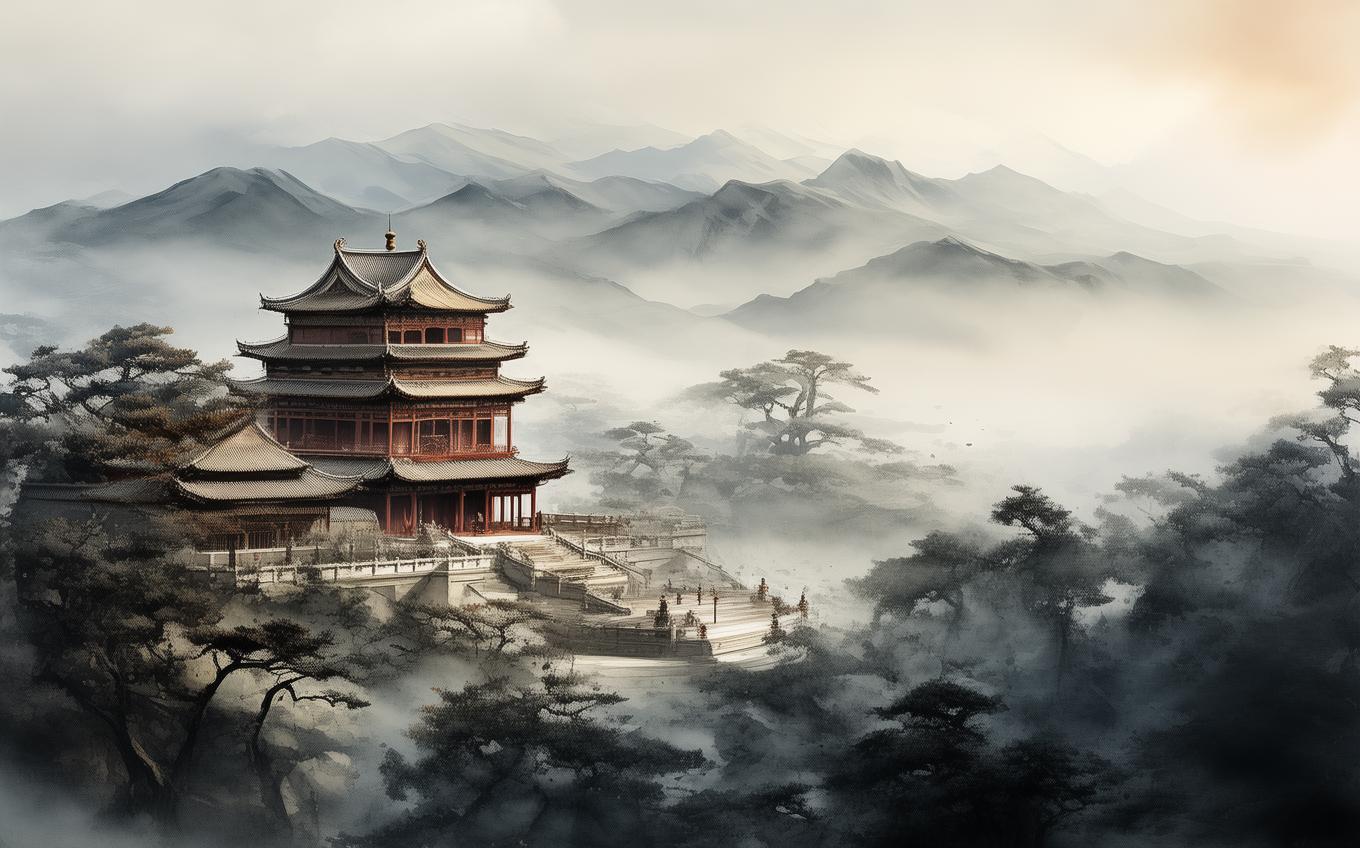
One major theme of the poem is the fusion of architecture, ritual, and nature. The site is not described as a dead monument. Instead, it vibrates with bell-tones, light, water, vines, clouds, and mountain color. Human culture and the natural world are not opposites here; they complete one another.
Another important theme is transcendence. The poem begins with worldly movement—carriages, gates, travel—but gradually enters a realm of meditative stillness. Sound becomes sacred, light becomes fluid, and the landscape suggests divine visitation. This movement reflects a recurring ideal in Chinese poetry: leaving ordinary life behind to encounter something purer and deeper.
In symbolic terms, the bell and chime suggest religious seriousness, inner awakening, and the ordering of space through sound. Clouds, water, and mountain green symbolize transience, spiritual depth, and the subtle beauty of nature. The goddess is a symbol of the barely graspable—beauty so intense that it seems supernatural.
Cultural Context
To appreciate this poem fully, it helps to understand the Tang dynasty's cultural world. Elite writers often traveled to scenic or sacred sites and composed poetry there. Temples, palaces, and mountain retreats were not just tourist destinations; they were places where politics, religion, art, and personal reflection met.
The imagery of bells and chimes points toward a Buddhist or quasi-religious atmosphere, which was common in Tang literary culture. At the same time, the poem reflects broader Chinese aesthetic values: harmony between humanity and nature, sensitivity to seasonal and atmospheric change, and respect for what is suggestive rather than explicit. Chinese poetry frequently values the mood a scene creates more than a direct statement of emotion. In this poem, the reader feels awe and serenity not because the poet names them directly, but because the landscape itself generates them.
The poem also reflects a classical Chinese habit of associating mountains with spiritual elevation. Mountains are places of distance from worldly life, but also of closeness to the sacred. That is why the final image of green, mist-covered slopes feels more than descriptive: it suggests a state of mind.
Conclusion
"题金华宫" is a graceful and evocative example of Tang poetry's ability to transform place into experience. In just a few lines, it moves from ceremonial departure to sacred sound, shimmering light, and finally a mood of near-mythic wonder.
Its enduring appeal lies in this subtle transformation. The poem invites readers to slow down, listen, and see more deeply. Even today, its message remains fresh: when we step away from noise and ambition, the world may reveal a beauty that feels almost divine.

Comments (0)
No comments yet. Be the first to comment!