Title: Analysis of "丹景山至德寺" - Classical Chinese Poetry
Introduction
The poem "丹景山至德寺" is attributed to 宋祁 (Sòng Qí, 998–1061), a prominent writer and statesman of the Northern Song dynasty. Song poetry often combines refined observation of landscape with subtle emotional reflection, and this poem is a fine example of that tradition. Rather than presenting dramatic action, it invites the reader into a quiet Buddhist mountain setting, where scenery, architecture, and inward feeling merge.
Although this poem is not as internationally famous as some Tang masterpieces, it is valuable for understanding how Song poets approached nature, religion, and cultivated solitude. In Chinese literary history, such poems show how a visit to a temple could become not only a travel record, but also a meditation on perception, serenity, and the human place within the natural world.
The Poem: Full Text and Translation
丹景山頭宿梵宮
Dān jǐng shān tóu sù fàn gōng
I lodge for the night in the Buddhist temple atop Danjing Mountain.
天邊鐘梵下方中
Tiān biān zhōng fàn xià fāng zhōng
From the edge of the sky, bell tones and Buddhist chants drift down into the world below.
松聲夜半和秋籟
Sōng shēng yè bàn hé qiū lài
At midnight, the sound of pines blends with the autumn wind’s music.
月色雲間見佛宮
Yuè sè yún jiān jiàn fó gōng
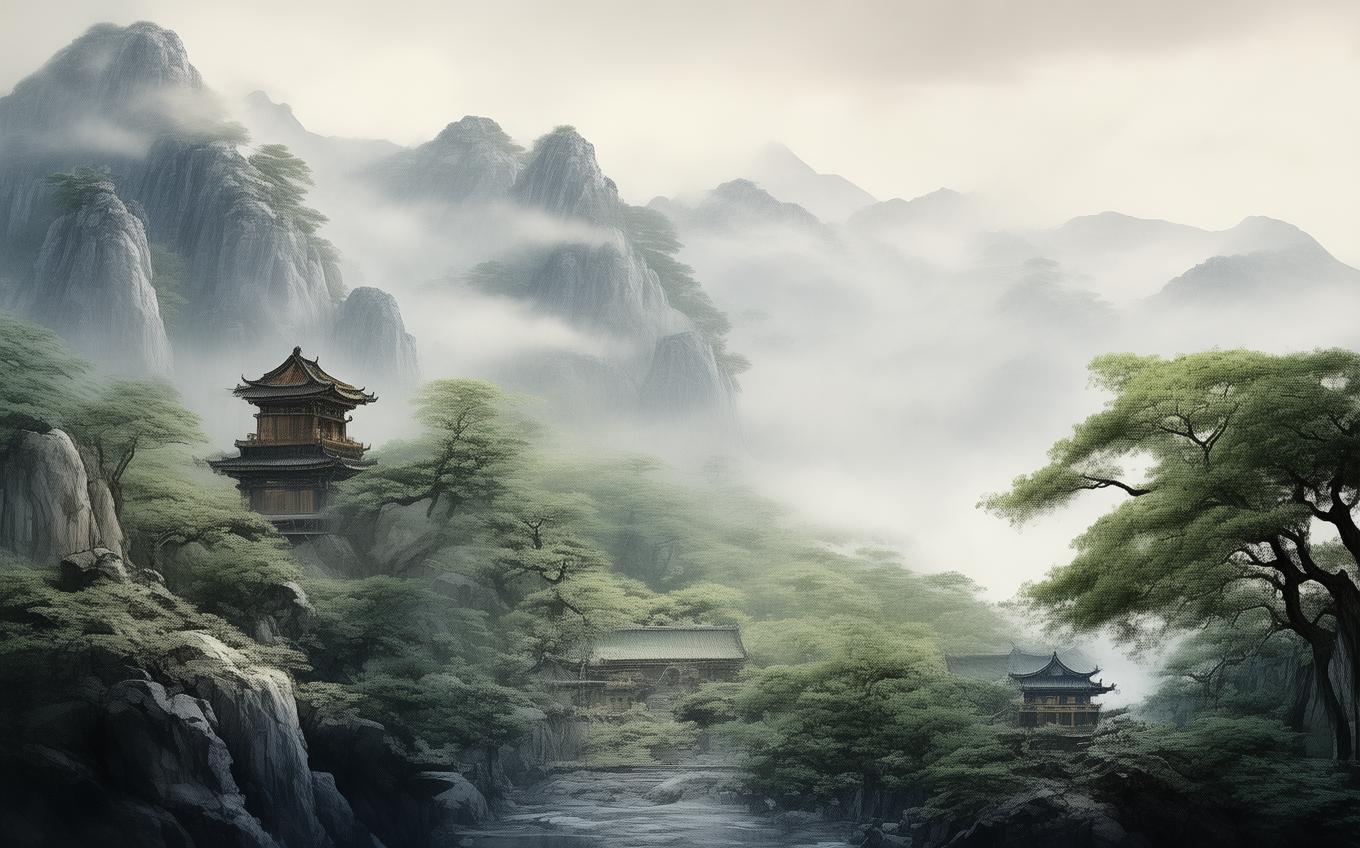
In the moonlight among the clouds, the Buddha’s halls come faintly into view.
Line-by-Line Analysis
The first line, “丹景山頭宿梵宮”, establishes both place and mood immediately. 丹景山 (Dānjǐng Shān) is the mountain setting, while 梵宮 (fàn gōng) refers to a Buddhist temple, literally a “Brahma palace” or sacred Buddhist hall. The verb 宿 means “to stay the night,” giving the scene an intimate perspective: this is not a passing glance, but an overnight experience in a secluded religious space. The line creates elevation in both the physical and spiritual sense—the poet is high on the mountain, removed from ordinary life.
The second line, “天邊鐘梵下方中”, expands the poem’s atmosphere through sound. 鐘梵 refers to bells and Buddhist chanting, two classic sounds of temple life. The phrase 天邊, “at heaven’s edge” or “on the rim of the sky,” exaggerates the temple’s lofty position. The sounds seem to descend from above into 下方, the lower world below. This vertical imagery is important: the temple is not just geographically elevated, but symbolically closer to the sacred. The world beneath feels distant, almost mundane, while the temple belongs to a more purified realm.
The third line, “松聲夜半和秋籟”, is especially elegant in its soundscape. 松聲 means the sound of pine trees, and 秋籟 refers to the natural music of autumn wind. Chinese poets often treat wind in the pines as a kind of heavenly or cosmic music. The word 和 means “to harmonize with,” suggesting that nature itself is participating in a quiet performance. This is not noisy or overwhelming; it is balanced, spare, and contemplative. The midnight setting deepens the stillness, allowing the smallest natural sounds to feel profound.
The fourth line, “月色雲間見佛宮”, brings the poem to a visual close. After sound has dominated the middle lines, moonlight now reveals the temple through drifting clouds. The phrase 雲間 places the building in an almost otherworldly realm, as if it were suspended between earth and heaven. 見佛宮 does not suggest a blunt, clear sight; rather, the temple appears gradually, partially, almost mysteriously. The final effect is one of revelation without full possession. The sacred cannot be entirely grasped; it is glimpsed.
Taken together, the poem moves from lodging, to hearing, to harmonizing with nature, to seeing by moonlight. This progression mirrors a contemplative experience: one enters the temple, listens, grows inwardly still, and finally perceives the world in a transformed way.
Themes and Symbolism
One major theme of the poem is spiritual elevation through landscape. The mountain is not merely a scenic backdrop; it lifts the temple above the everyday world and suggests a movement toward transcendence. In Chinese poetry, mountains often symbolize withdrawal from official life, closeness to nature, and the search for higher truth.
A second theme is the unity of religion and nature. The bells, chants, wind, pines, clouds, and moonlight are not sharply separated. The temple does not dominate the landscape; it joins it. This reflects an important feature of Chinese aesthetics, in which human culture at its highest level harmonizes with the natural world rather than conquering it.
The poem also explores silence and perception. Sound is central here, but it is delicate sound: bells, chanting, wind in pines. Such sounds sharpen awareness rather than distract from it. The moonlit glimpse of the temple at the end suggests that truth or beauty often appears indirectly, in moments of calm attention.
Several symbols stand out:
- Mountain: spiritual height, retreat, and perspective
- Temple: sacred order, Buddhist contemplation, refuge from worldly concerns
- Pine trees: endurance, purity, and constancy in Chinese tradition
- Autumn wind: clarity, melancholy, and the voice of the natural world
- Moonlight: illumination, serenity, and fleeting insight
- Clouds: mystery, distance, and the boundary between visible and invisible realms
Cultural Context
This poem reflects the literary culture of the Northern Song dynasty, a period known for intellectual sophistication, landscape appreciation, and the growing influence of Neo-Confucian, Buddhist, and Daoist thought. Song poets often wrote with less of the grand emotional sweep found in some Tang poetry, but with greater subtlety of observation and inwardness. A mountain temple poem like this one fits that Song sensibility perfectly.
Buddhism had long been deeply integrated into Chinese culture by the Song period. Temples were not only religious centers but also destinations for travel, reflection, and literary composition. For educated officials such as Song Qi, visiting a temple could become a moment of temporary withdrawal from political life and social obligations.
The poem also reflects a broader Chinese value: the ideal of harmony between the human spirit and the cosmos. Nature is not treated as dead matter or mere scenery. Instead, sounds and sights become part of an ethical and spiritual experience. The poet’s sensitivity to bells, wind, moonlight, and clouds expresses a cultivated attentiveness that was admired in classical Chinese culture.
For English-speaking readers, it may help to think of this poem as combining elements of landscape painting, religious meditation, and lyrical travel writing. It is brief, but its world is spacious. Much of its power lies in suggestion rather than explanation.
Conclusion
"丹景山至德寺" is a small but beautiful example of classical Chinese poetry’s ability to unite place, mood, and philosophy in just a few lines. Through mountain height, temple bells, pine wind, clouds, and moonlight, the poem creates a world of stillness that feels both earthly and transcendent.
Its enduring appeal lies in its quietness. It does not argue or declare; it lets the reader listen and look. Even today, the poem speaks to a modern desire for calm, perspective, and moments of genuine attention. In that sense, its message remains timeless: sometimes the deepest insight comes not from striving, but from dwelling quietly in the presence of nature and the sacred.

Comments (0)
No comments yet. Be the first to comment!