Title: Analysis of "题天回驿" - Classical Chinese Poetry
Introduction
"题天回驿" is a poem by Wen Tong (文同, Wén Tóng), a Northern Song dynasty writer, painter, and poet best known for his bamboo paintings and for a literary style that combines clarity with quiet emotional depth. The Song dynasty was a period of extraordinary cultural refinement, when poetry often turned away from grand heroic gestures and instead found meaning in travel, memory, solitude, and the moral life of the individual. A poem written at a postal station or relay inn may seem modest in subject, but such places were important nodes in official travel and often became settings for reflection, homesickness, and historical feeling.
This poem is significant because it shows how a brief travel poem can open onto larger emotional and cultural horizons. Like many classical Chinese poems, it uses a small scene—an inn, a landscape, a passing moment—to suggest feelings that are not fully stated. For English-speaking readers, "题天回驿" offers an excellent example of how Chinese poetry condenses mood, place, and thought into a few restrained lines.
The Poem: Full Text and Translation
岧峣宫殿拥山椒,
Tiáo yáo gōng diàn yǒng shān jiāo,
Lofty palace buildings cluster around the mountain ridge.
天回驿路转迢迢。
Tiān huí yì lù zhuǎn tiáo tiáo.
The road by Tianhui Posthouse bends onward, long and far.
云埋古堞藏秋色,
Yún mái gǔ dié cáng qiū sè,
Clouds bury ancient battlements, concealing the colors of autumn.
水绕寒城起暮潮。
Shuǐ rào hán chéng qǐ mù cháo.
Water circles the chilly city as the evening tide begins to rise.
客思已随征雁远,
Kè sī yǐ suí zhēng yàn yuǎn,
A traveler’s thoughts have already followed the journeying wild geese into the distance.
乡心空共暮烟遥。
Xiāng xīn kōng gòng mù yān yáo.
My homesick heart lingers vainly with the far-off evening haze.
明发孤舟又前去,
Míng fā gū zhōu yòu qián qù,
At dawn, my solitary boat will set out forward once again.
不堪回首望西桥。
Bù kān huí shǒu wàng xī qiáo.
I cannot bear to turn my head and gaze back toward the western bridge.
Line-by-Line Analysis
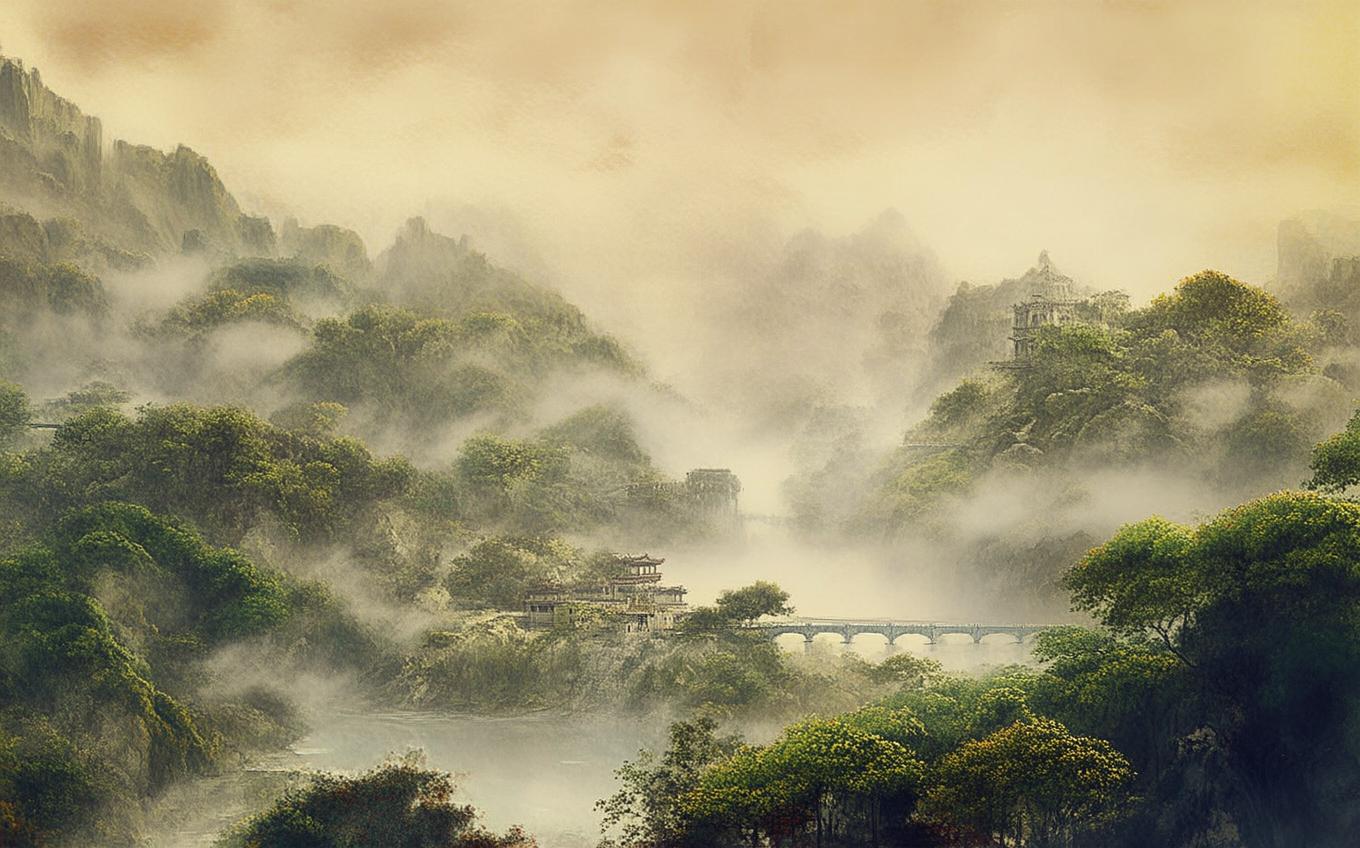
The first line, “岧峣宫殿拥山椒”, opens with height and grandeur. The word “岧峣” suggests something towering and steep, immediately lifting the reader’s eyes upward. The image of palace buildings pressing around a mountain ridge creates a sense of human power embedded within nature. Yet in classical Chinese poetry, such grandeur is rarely just decorative. It often hints at history, authority, and the passing of dynasties. The scene is visually impressive, but it also carries a subtle feeling of distance: the traveler sees these structures from outside, as an observer rather than a participant.
The second line, “天回驿路转迢迢”, shifts from architecture to movement. The road near Tianhui Posthouse winds away into remoteness. The repetition-like sound of “迢迢” gives the line a drawn-out feeling, as if the road keeps extending beyond sight. In Chinese poetry, roads often symbolize both official duty and emotional separation. A traveler on the road is rarely just traveling physically; he is also moving through states of longing, uncertainty, and reflection.
The third line, “云埋古堞藏秋色”, introduces one of the poem’s most evocative images. Ancient battlements suggest military history and the remains of earlier ages. Clouds burying them do two things at once: they create a beautiful landscape effect, and they partially erase the visible traces of the past. The phrase “藏秋色”—“hiding the colors of autumn”—is especially rich. Autumn in Chinese poetry often carries associations of decline, melancholy, clarity, and mature beauty. Here the season is present, yet veiled. Emotion is not directly confessed; instead, it is filtered through weather and ruin.
The fourth line, “水绕寒城起暮潮”, deepens the atmosphere. The city is “寒”, cold—not necessarily in a literal meteorological sense alone, but emotionally cold, austere, and lonely. Water circling the city gives the landscape a kind of enclosed motion, while the rising evening tide introduces time: day is turning to dusk. Evening in Chinese poetry is a classic moment of homesickness. As daylight fades, the mind turns inward. The external scene becomes an emotional echo chamber.
The fifth line, “客思已随征雁远”, makes the human feeling more explicit. The speaker’s thoughts as a traveler have gone off with the wild geese. In Chinese poetic tradition, geese are among the most important symbols of distance and longing. Because they migrate seasonally and travel in formation across vast spaces, they often represent messages, exile, separation, and homesickness. The poet does not say merely “I miss home”; instead, his thoughts seem to depart with the geese themselves. This is more vivid and more moving.
The sixth line, “乡心空共暮烟遥”, continues the homesick mood but with greater subtlety. The “heart of home” or homesick feeling is said to remain only with the distant evening mist. The word “空” is crucial: it can suggest “in vain,” “emptily,” or “only.” It gives the line a helpless emotional tone. The speaker’s longing has no practical outlet; it drifts outward into haze. This is characteristic of classical Chinese restraint: the emotion is intense, but it is expressed through atmosphere rather than dramatic declaration.
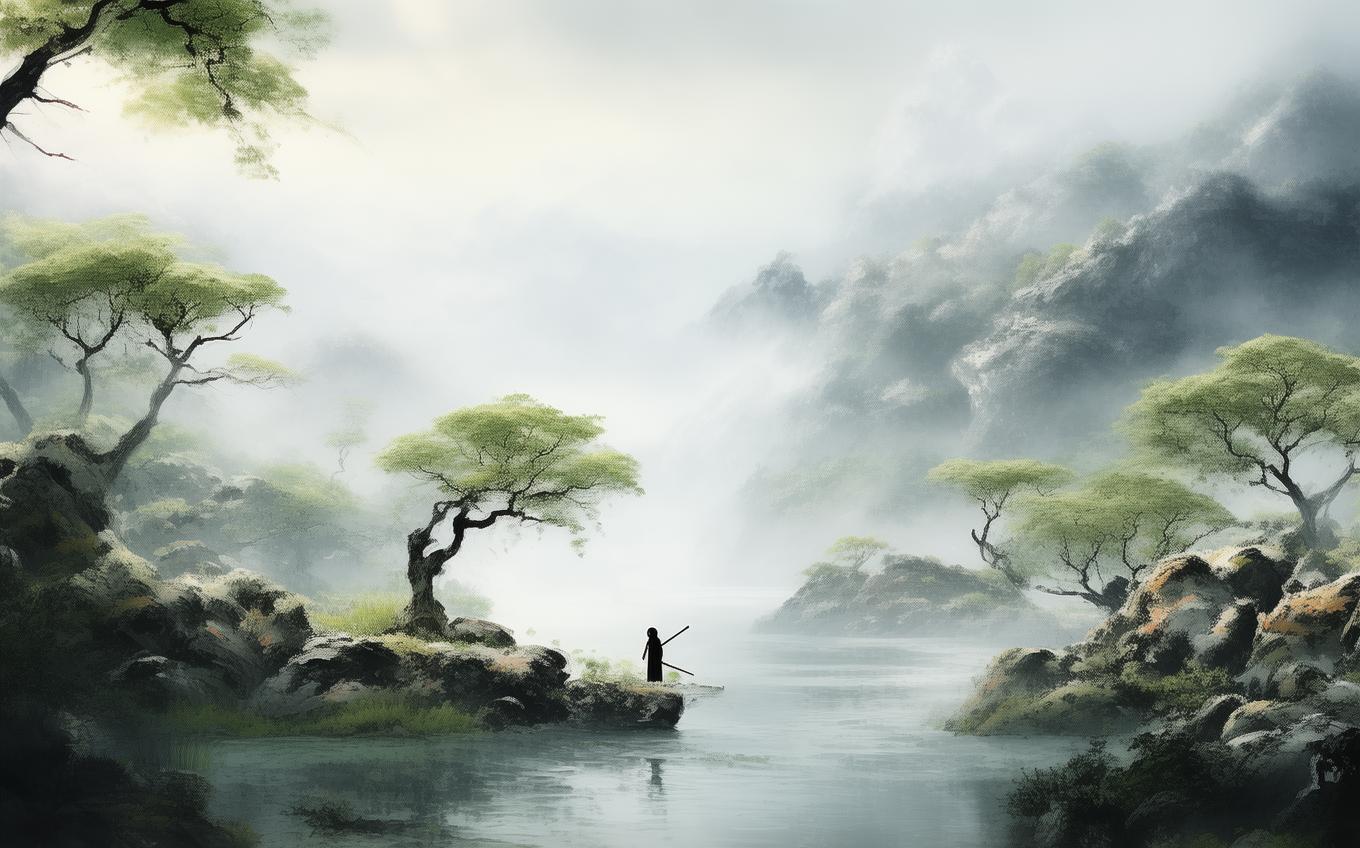
The seventh line, “ 明发孤舟又前去”, looks ahead to the next morning. Travel will continue. The phrase “孤舟”, “solitary boat,” is a deeply resonant image in Chinese literature. It suggests isolation, fragility, and the smallness of the individual against the wide world. The word “又”—“again”—is equally important. This is not a unique departure but part of an ongoing pattern of movement. The traveler’s life is one of repeated leave-taking.
The final line, “不堪回首望西桥”, brings the emotional force of the poem into focus. The speaker cannot bear to turn back and look toward the western bridge. In many Chinese poems, the backward glance is powerful because it marks the moment when departure becomes emotionally real. Bridges are threshold spaces: they connect places, but they also mark separation. To look back is to acknowledge loss. The poet stops at the edge of that gesture, and precisely this restraint gives the line its poignancy.
Themes and Symbolism
One major theme of the poem is travel and displacement. The setting at a postal station emphasizes transience. The speaker is not settled; he is passing through, and that passing-through becomes a metaphor for human life itself.
A second major theme is homesickness. This is one of the most enduring subjects in Chinese poetry, especially in poems written by officials, scholars, or exiles traveling far from home. Yet homesickness here is not sentimental in a simple way. It is mediated through landscape: geese, evening mist, distant roads, and the final backward glance all carry the feeling.
A third theme is the relationship between history and the present moment. The ancient battlements suggest that the traveler’s personal loneliness exists within a much larger historical landscape. Human beings come and go, but old walls, rivers, roads, and bridges remain. This contrast gives the poem depth and seriousness.
Several symbols are especially important:
- Wild geese symbolize distance, migration, and longing for news or home.
- Autumn symbolizes melancholy, maturity, decline, and reflective beauty.
- Evening mist and dusk symbolize emotional uncertainty and inwardness.
- The solitary boat symbolizes the isolated self in motion through the world.
- The bridge symbolizes transition, separation, and the pain of departure.
Cultural Context
To understand this poem, it helps to know the importance of relay stations and inns in premodern China. Official roads connected cities through post stations where travelers, messengers, and government officials rested or changed horses. These sites became natural places for poetry because they concentrated movement, separation, and the emotional strain of travel.
The poem also reflects a distinctly Chinese literary habit: using landscape as emotional language. In much classical Chinese poetry, nature is not just background. Clouds, rivers, autumn colors, geese, and dusk all participate in meaning. Rather than explaining feelings abstractly, the poet presents a scene in which the reader experiences the feeling through image and rhythm.
From a philosophical perspective, the poem also reflects the Song dynasty taste for quiet inwardness. Song poetry often values understatement, suggestiveness, and reflective observation. The poet does not dramatize himself as a tragic hero. Instead, he notices the world carefully, and his emotions emerge through that attentiveness. This restraint is one reason the poem remains powerful: it trusts the reader to feel what is left unsaid.
The poem further reflects Chinese values surrounding attachment to home and the emotional cost of official duty or long-distance travel. In traditional Chinese culture, home was not merely a private residence; it was tied to family lineage, memory, moral belonging, and social identity. To be far from home was therefore both a physical and existential condition.
Conclusion
"题天回驿" is a beautiful example of how classical Chinese poetry transforms a brief travel scene into a meditation on distance, memory, and longing. Its imagery is graceful and compressed: high palaces, winding roads, buried battlements, evening tide, migrating geese, and a solitary boat all combine to create a deeply resonant emotional landscape.
For modern readers, especially those coming to Chinese poetry in English, the poem offers an important lesson: its power lies not in explicit statement but in suggestion. It shows how a restrained voice can carry profound feeling, and how the outer world of roads, clouds, water, and dusk can become the truest language of the heart. Even today, anyone who has traveled far from home or felt the pain of moving onward without wanting to look back can recognize the poem’s quiet truth.

Comments (0)
No comments yet. Be the first to comment!