Introduction
- “和题丹景山至德寺” (Hè Tí Dānjǐng Shān Zhìdé Sì) is a Tang-style poem traditionally attributed to Xú Shì(徐氏), a woman poet connected with the courtly and religious culture of the late Tang and Five Dynasties period.
- The title means roughly “Written in Response to a Poem on Zhide Temple at Danjing Mountain.” The word 和 (hè) indicates that the poem responds to or harmonizes with another poem, a common literary practice among educated Chinese poets.
- The poem combines Buddhist temple imagery, mountain scenery, and imperial symbolism, making it a fascinating example of how classical Chinese poetry could unite spirituality, politics, and landscape.
- Its significance lies not only in its refined imagery but also in its rare courtly female voice, showing how women poets could participate in sophisticated literary and religious expression.
The Poem: Full Text and Translation
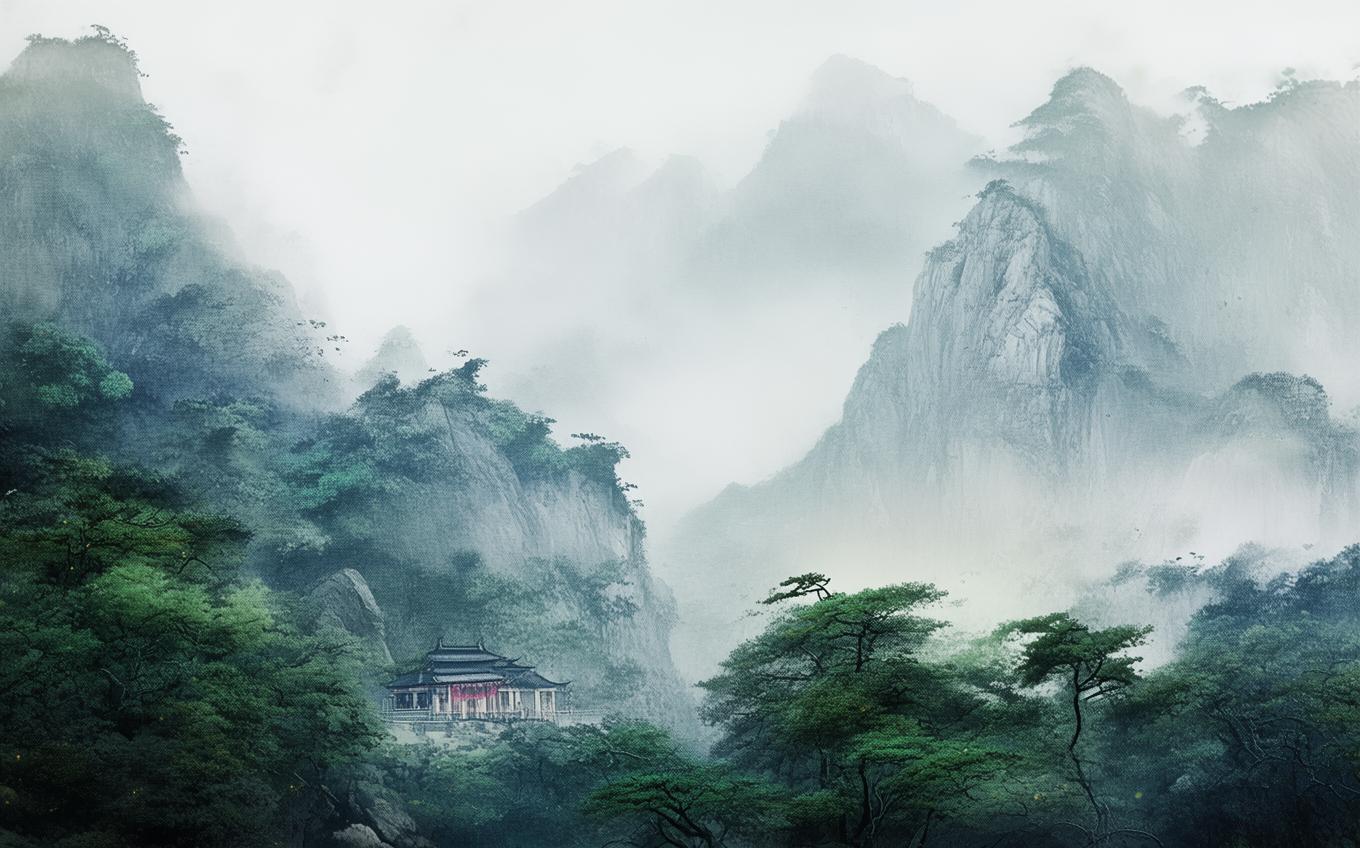
丹景山头宿梵宫
Dānjǐng shān tóu sù fàn gōng
At the summit of Danjing Mountain, we lodge in a Buddhist palace.
玉轮金辂驻虚空
Yù lún jīn lù zhù xū kōng
Jade wheels and golden carriages seem to pause in the empty sky.
军持无水注寒碧
Jūn chí wú shuǐ zhù hán bì
The monk’s water vessel holds no water to pour into the cold green depths.
兰若有花开晚红
Lán rě yǒu huā kāi wǎn hóng
In the monastery, flowers still bloom with late crimson color.
武士尽排青嶂下
Wǔ shì jìn pái qīng zhàng xià
Armed guards are arrayed below the blue-green cliffs.
内人皆在讲筵中
Nèi rén jiē zài jiǎng yán zhōng
Palace women are all gathered at the Buddhist lecture seat.
我家帝子传王业
Wǒ jiā dì zǐ chuán wáng yè
The imperial sons of my house inherit the royal enterprise.
积善终期四海同
Jī shàn zhōng qī sì hǎi tóng
By accumulating goodness, we finally hope to unite all under heaven.
Line-by-Line Analysis
丹景山头宿梵宫
Dānjǐng shān tóu sù fàn gōng
At the summit of Danjing Mountain, we lodge in a Buddhist palace.
The poem opens with a strong sense of height and sacred space. Danjing Mountain(丹景山)is not merely a scenic location; in classical Chinese poetry, mountains often suggest closeness to immortals, monks, and the world beyond ordinary human affairs.
The phrase 梵宫 (fàn gōng, “Buddhist palace” or “temple”) gives the temple grandeur. It is not described as a humble monastery but as a palace of Buddhist holiness. This already blends two worlds: the religious and the imperial.
玉轮金辂驻虚空
Yù lún jīn lù zhù xū kōng
Jade wheels and golden carriages seem to pause in the empty sky.
This line introduces dazzling courtly imagery. 玉轮 (“jade wheels”) and 金辂 (“golden carriages”) evoke royal vehicles, luxury, and celestial splendor. Because the temple is high on the mountain, the carriages seem suspended in 虚空 (xū kōng), the “empty sky” or “void.”
The word 虚空 also has Buddhist resonance. In Buddhism, emptiness is not simply nothingness; it points to the insubstantial nature of worldly things. Thus, the imperial procession appears magnificent, yet it is placed against the vast Buddhist “void,” subtly reminding readers that worldly glory is temporary.
军持无水注寒碧
Jūn chí wú shuǐ zhù hán bì
The monk’s water vessel holds no water to pour into the cold green depths.
军持 (jūn chí) refers to a Buddhist water vessel, often associated with monks and ritual purity. The image of an empty vessel may suggest restraint, stillness, or spiritual detachment.
The phrase 寒碧 (“cold green” or “chilly emerald-blue”) likely refers to the color of mountain water, a pool, or deep natural scenery. The line feels quiet and austere after the splendor of jade wheels and golden carriages. The poem shifts from imperial brightness to monastic simplicity.
This contrast is important: worldly power is ornate and public; Buddhist practice is sparse, inward, and silent.
兰若有花开晚红
Lán rě yǒu huā kāi wǎn hóng
In the monastery, flowers still bloom with late crimson color.
兰若 (lán rě) is a Buddhist term meaning monastery or quiet religious retreat. The flowers blooming 晚红 (“late red”) suggest beauty at evening, late season, or perhaps late in life.
This line softens the previous austerity. Even in a place of Buddhist discipline, beauty remains. The red flowers may symbolize lingering vitality, spiritual warmth, or the compassionate beauty of the Buddhist world.
There is also a delicate emotional undertone: the flowers bloom late, but they bloom nonetheless. Classical Chinese poetry often values such restrained, late-blooming beauty because it suggests endurance and quiet dignity.
武士尽排青嶂下
Wǔ shì jìn pái qīng zhàng xià
Armed guards are arrayed below the blue-green cliffs.
The poem now returns to the imperial setting. 武士 (“warriors” or “armed guards”) stand beneath 青嶂 (“blue-green cliffs”). Their presence indicates that this is not an ordinary pilgrimage but a courtly or royal visit.
The vertical arrangement is meaningful: the guards remain below the cliffs, while the temple and Buddhist teaching occupy the higher space. This may imply that military power supports the state, but spiritual cultivation belongs to a higher order.
The line also creates a visual contrast: human order and discipline are placed against the vast natural form of the mountain.
内人皆在讲筵中
Nèi rén jiē zài jiǎng yán zhōng
Palace women are all gathered at the Buddhist lecture seat.
内人 refers to women of the inner palace. Their presence at a 讲筵 (jiǎng yán), a seat or gathering for Buddhist teaching, shows the importance of Buddhism in court life.
This line is especially interesting because the poem itself is traditionally associated with a woman poet. It gives us a glimpse into female religious participation in elite Chinese culture. Palace women were not only decorative figures in court life; they could be listeners, patrons, and sometimes writers within religious and literary communities.
The line suggests collective devotion. The inner palace turns toward Buddhist instruction, seeking moral and spiritual guidance.
我家帝子传王业
Wǒ jiā dì zǐ chuán wáng yè
The imperial sons of my house inherit the royal enterprise.
Here the poem becomes openly political. 帝子 (“sons of the emperor” or “imperial sons”) and 王业 (“royal enterprise,” “dynastic mission”) refer to the continuation of rulership.
The speaker connects her family with dynastic legitimacy. This line shows that the poem is not only about scenery or Buddhist devotion; it is also about the hopes of a ruling house.
In classical Chinese thought, political authority was not supposed to rest only on force. A dynasty needed moral virtue, cosmic approval, and the welfare of the people. The next line makes this idea explicit.
积善终期四海同
Jī shàn zhōng qī sì hǎi tóng
By accumulating goodness, we finally hope to unite all under heaven.
The final line brings together Buddhism, Confucian politics, and imperial aspiration. 积善 means “to accumulate goodness” or “to build up virtue through good deeds.” This idea appears in both Buddhist and Confucian moral traditions.
四海 (“the Four Seas”) is a classical Chinese expression meaning the entire world, or all lands under heaven. 四海同 suggests unity, harmony, and peace across the realm.
The poem ends not with personal emotion but with a public wish: that moral cultivation will lead to political unity. The speaker imagines good government as the result of accumulated virtue.
Themes and Symbolism
- Sacred Landscape: Danjing Mountain is more than a location; it is a symbolic height where the human world approaches the spiritual realm.
- Buddhist Emptiness and Courtly Splendor: The golden carriages in the empty sky suggest the tension between worldly magnificence and Buddhist awareness of impermanence.
- Women and Religious Culture: The palace women listening to Buddhist teachings reveal the important role of elite women in religious life.
- Virtue and Rule: The poem connects political legitimacy with moral goodness, reflecting the Chinese belief that rulers must cultivate virtue.
- Late-Blooming Beauty: The “late red” flowers symbolize resilience, quiet grace, and beauty that remains even in a setting of religious discipline.
Cultural Context
This poem reflects a world in which Buddhism, monarchy, and poetry were deeply connected. In medieval China, emperors and aristocratic families often supported temples, attended Buddhist lectures, and used religious language to express hopes for peace and legitimacy.
The poem also reflects the traditional Chinese idea that political order depends on moral order. A ruler’s success was not understood merely as military strength or inherited power. It required 德 (dé), virtue. This is especially meaningful because the temple is named 至德寺 (Zhìdé Sì), “Temple of Supreme Virtue.”
The poem’s final message—“accumulating goodness” to bring unity to the world—echoes both Buddhist karmic thinking and Confucian statecraft. Good deeds create spiritual merit, but they also support social harmony.
For English-speaking readers, one of the most striking features of the poem is its layering. A simple temple visit becomes a meditation on power, faith, gender, beauty, and the moral responsibilities of rule.
Conclusion
“和题丹景山至德寺” is a compact but richly layered poem. It begins with a royal visit to a mountain temple, moves through Buddhist images of emptiness and purity, and ends with a hope for virtuous rule and universal harmony.
Its beauty lies in its balance: splendid yet restrained, political yet spiritual, public yet quietly emotional. The poem reminds us that in classical Chinese culture, poetry was not only a personal art form. It was also a way to think about how human beings should live, how rulers should govern, and how worldly power might be guided by moral and spiritual insight.
Today, the poem remains relevant because it asks a timeless question: can power be made meaningful through goodness? Its answer is gentle but profound—true unity begins with the accumulation of virtue.
Comments (0)
No comments yet. Be the first to comment!