Introduction
- “鼓吹曲辞·朱鹭” (Gǔchuī Qǔcí · Zhū Lù) is an ancient Chinese poem preserved in the Yuefu tradition, especially associated with the Han dynasty musical repertoire.
- The title can be translated as “Drum-and-Wind Song Lyrics: The Scarlet Egret.” “鼓吹” refers to ceremonial music performed with drums and wind instruments, often used in military, court, or ritual settings.
- The poem is anonymous, like many early Yuefu songs. Its language is archaic, compressed, and difficult, making it one of those early Chinese poems whose meaning is partly mysterious.
- Its significance lies not only in its imagery but also in its role as a surviving fragment of early Chinese musical-poetic culture, where poetry, ritual, politics, and performance were deeply connected.
The Poem: Full Text and Translation
朱鹭,鱼以乌。
Zhū lù, yú yǐ wū.
Scarlet egret—fish become dark.
路訾邪,鹭何食?
Lù zī yé, lù hé shí?
By the roadside marsh, what does the egret eat?
食茄下。
Shí jiā xià.
It feeds beneath the lotus stems.
不之食,不以吐。
Bù zhī shí, bù yǐ tǔ.
If it does not eat them, it does not spit them out.
将以问诛者。
Jiāng yǐ wèn zhū zhě.
I shall ask the one who punishes.
Line-by-Line Analysis
-
“朱鹭,鱼以乌。”
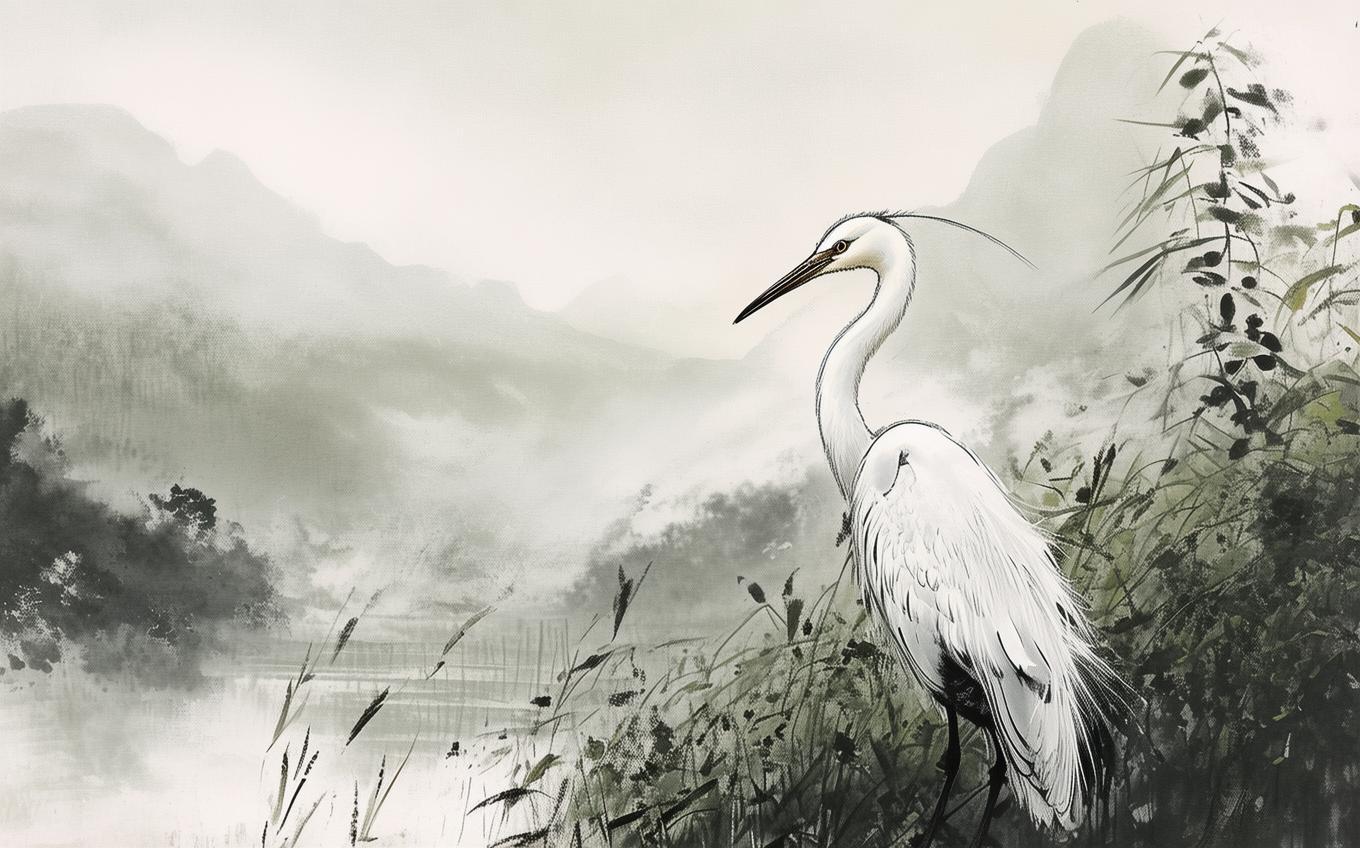
The poem begins with a striking image: the 朱鹭 (zhū lù), often understood as a red or scarlet egret. In Chinese literary symbolism, birds are frequently more than animals; they may suggest omens, officials, noble figures, or displaced souls. The phrase “fish become dark” is strange and difficult. It may describe the contrast between the bright bird and the dark fish beneath the water, or it may hint at transformation, disorder, or moral confusion. -
“路訾邪,鹭何食?”
This line asks what the egret eats. The phrase 路訾邪 is obscure and has been interpreted in different ways. It may refer to a marshy or watery place near a road, or it may preserve an ancient sound from a song whose original meaning was already unclear to later readers. The question gives the poem a riddle-like quality. The speaker observes nature, but the question feels symbolic rather than merely zoological. -
“食茄下。”
The egret feeds beneath 茄 (jiā), often interpreted as a water plant or lotus-related vegetation. In classical Chinese poetry, water plants often suggest purity, hidden life, or the boundary between the visible and invisible. The egret stands between air and water, brightness and shadow, surface and depth. This makes it a powerful figure for ambiguity. -
“不之食,不以吐。”
This line is syntactically difficult, but it seems to describe refusal or restraint: if the egret does not eat something, it does not spit it out either. The line may point toward the moral problem of accusation and evidence. Something has been taken in, or perhaps not taken in; something has not been confessed, rejected, or revealed. The language feels like a legal or ethical puzzle. -
“将以问诛者。”
The final line suddenly introduces punishment: 诛者 (zhū zhě), “the one who executes” or “the one who punishes.” This changes the tone of the poem. What seemed like a bird scene becomes connected to judgment, guilt, and authority. The speaker says, in effect, “I will ask the punisher.” The natural image may therefore conceal a political or moral allegory.
Themes and Symbolism
-
Nature as Allegory
The egret, fish, water plants, and marshland form a natural scene, but the poem does not behave like simple nature poetry. The images seem to point toward human concerns: accusation, guilt, survival, and punishment. -
Ambiguity and Hidden Meaning
The poem’s obscurity is part of its power. Early Yuefu poems often preserve fragments of older songs, rituals, or oral traditions. Their meaning may not be fully recoverable, but their emotional atmosphere remains vivid. -
Judgment and Power
The sudden mention of punishment suggests a world where authority is present even in symbolic form. The poem may reflect anxieties about political violence, legal judgment, or the danger of being misunderstood. -
The Scarlet Egret
The 朱鹭 is the central symbol. Its redness may suggest beauty, nobility, blood, ritual color, or ominous brightness. As a bird that feeds in water, it belongs to two realms: the open sky and the hidden depths. This makes it an ideal symbol for uncertain truth.
Cultural Context
-
Yuefu Poetry and Han Musical Culture
The poem belongs to the Yuefu tradition. The term Yuefu originally referred to the Han dynasty Music Bureau, which collected songs from different regions and created music for court and ritual use. Over time, “Yuefu” came to describe a poetic genre marked by musical origins, folk echoes, and vivid imagery. -
“鼓吹曲辞” as Ceremonial Song
“鼓吹曲辞” means lyrics for drum-and-wind music. Such music was often associated with military processions, imperial ceremonies, and public displays of power. This background helps explain why a short poem about a bird might carry a darker undertone of authority and punishment. -
Ancient Chinese Indirect Expression
Chinese poetry often communicates through suggestion rather than direct statement. Especially in early poetry, animals and plants can act as symbolic mirrors of political and moral life. A bird’s feeding habits may become a way to speak about corruption, innocence, accusation, or the danger of imperial justice. -
The Value of Obscure Poetry
For English-speaking readers, this poem may feel unusually cryptic. But in Chinese literary history, such obscurity is not merely a flaw. It reminds us that ancient poems were once songs, performances, and cultural events. Some of their meanings depended on melodies, rituals, and historical memories now lost.
Conclusion
- “鼓吹曲辞·朱鹭” is brief, mysterious, and haunting. Its imagery of the scarlet egret, dark fish, marsh plants, and punishment creates a world where nature and human judgment overlap.
- The poem’s beauty lies in its suggestiveness. It does not explain itself fully; instead, it invites readers to listen for echoes of ritual music, political anxiety, and symbolic thought.
- For modern readers, the poem remains relevant because it captures a timeless human concern: how truth can become hidden, how judgment can be dangerous, and how even a simple scene in nature may carry the weight of power, fear, and moral uncertainty.

Comments (0)
No comments yet. Be the first to comment!