Introduction
Li Bai (701–762), one of the most celebrated poets of the Tang Dynasty, is often called the “Immortal of Poetry.” His work ranges from dreamy celebrations of wine and moonlight to sharp-edged social commentary disguised in musical verse. The poem “上之回” (Shàng zhī huí), drawn from the yuefu category “鼓吹曲辞” (Drum and Wind Songs), belongs to that critical side of Li Bai. The title “上之回” literally means “The Emperor’s Return” and originally referred to Han Dynasty ceremonial songs that praised imperial hunts and the submission of foreign tribes. Li Bai borrows this archaic form not to flatter power, but to expose the moral blindness that can accompany it. In this poem, dazzling spectacle and restless pleasure mask a deeper loneliness and a kingdom sliding toward neglect. For English readers encountering Chinese literature, this poem offers a sharp window into how a great poet uses traditional ritual language to hold a mirror to his own age.
The Poem: Full Text and Translation
三十六离宫,
Sān shí liù lí gōng,
Thirty-six detached palaces,
楼台与天通。
Lóu tái yǔ tiān tōng.
Towers and pavilions connect with the sky.
阁道步行月,
Gé dào bù xíng yuè,
Along the gallery paths, one walks under the moving moon,
美人愁烟空。
Měi rén chóu yān kōng.
Beautiful women grieve in the misty emptiness.
恩疏宠不及,
Ēn shū chǒng bù jí,
Imperial favor thins, affection does not reach them,
桃李伤春风。
Táo lǐ shāng chūn fēng.
Peach and plum blossoms are wounded by the spring wind.
淫乐意何极,
Yín lè yì hé jí,
This boundless pleasure — where will it end?
金舆向回中。
Jīn yú xiàng huí zhōng.
The golden chariot heads toward Huizhong Palace.
万乘出黄道,
Wàn shèng chū huáng dào,
The imperial procession sets out on the Yellow Path,
千旗扬彩虹。
Qiān qí yáng cǎi hóng.
A thousand banners lift like a rainbow.
前军细柳北,
Qián jūn xì liǔ běi,
The vanguard troops camp north of Xiliu,
后骑甘泉东。
Hòu jì gān quán dōng.
The rear riders halt east of Sweet Spring Palace.
岂问渭川老,
Qǐ wèn wèi chuān lǎo,
Does he ever ask for the old man by the Wei River?
宁邀襄野童。
Nìng yāo xiāng yě tóng.
How would he invite the boy from the wilds of Xiangye?
但慕瑶池宴,
Dàn mù yáo chí yàn,
He only longs for the feast at the Jasper Lake,
归来乐未穷。
Guī lái lè wèi qióng.
Returning, the joy will never end — so he believes.
Line-by-Line Analysis
三十六离宫,楼台与天通。
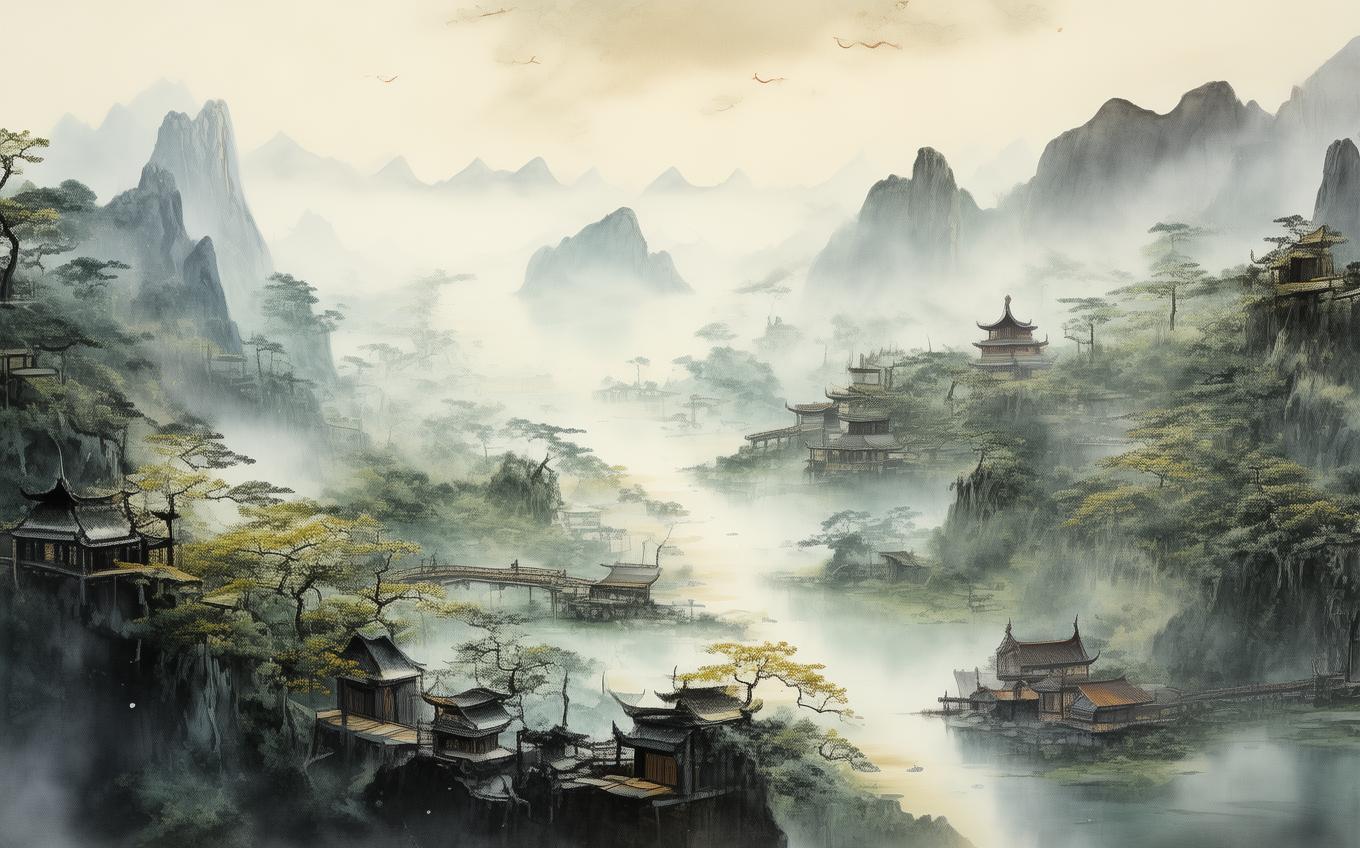
The poem opens with an overwhelming image of architectural excess. “Thirty-six detached palaces” is not a precise number but a trope signifying countless imperial retreats scattered across the landscape. The towers “connect with the sky,” suggesting that the ruler has built a world so high it blurs the boundary between the human and the divine. Yet this vertical reach is ominous — it isolates the emperor from ordinary life. The scene is magnificent but remote, a heaven that remains empty.
阁道步行月,美人愁烟空。
The covered galleries (gé dào) allow the emperor to move unseen between palaces. Li Bai imagines walking there under the moon, a romantic detail that immediately curdles. The beautiful women are not shown in joyful company but “grieve in the misty emptiness.” Their sorrow is formless as fog. These neglected palace ladies are a conventional motif, but here they become the human cost of the emperor’s insatiable building and collecting. The moon walks with no companion; the beauties ache in a void.
恩疏宠不及,桃李伤春风。
Favor (ēn) has grown distant, affection no longer reaches them. The poet turns to nature: peach and plum trees are damaged by the very spring wind that should make them bloom. In Chinese poetry, peach and plum blossoms often symbolize youthful beauty and transient glory. The wind, usually life-giving, becomes destructive when favor is fickle. The emperor’s love is like an unreliable season — it blows past the deserving and leaves them bruised.
淫乐意何极,金舆向回中。
A rhetorical question breaks the descriptive flow: “This boundless pleasure — where will it end?” The word yín carries a heavy moral charge; it implies excess, self-indulgence, a pleasure that drowns reason. At the very moment of asking, the golden chariot is already moving “toward Huizhong Palace,” a historical hunting lodge associated with Han Emperor Wu’s extravagant journeys. The emperor is not pausing to reflect; he is already chasing the next thrill.
万乘出黄道,千旗扬彩虹。
Now the full imperial hunt is depicted with cinematic grandeur. “Ten-thousand chariots” (wàn shèng) is the classic title for the Son of Heaven. The “Yellow Path” is the central road reserved for the emperor, a cosmic line aligning earth with heaven. A thousand banners ripple into a rainbow — visually stunning, yet the rainbow is an insubstantial bridge of light. The poem suggests that this mighty display, for all its color, is built on illusion and destined to vanish.
前军细柳北,后骑甘泉东。
The poet uses two place names heavy with historical meaning. Xiliu (Fine Willow) Camp was where the Han general Zhou Yafu maintained such strict military discipline that even the emperor had to respect his rules. Sweet Spring Palace (Gānquán) was another Han pleasure palace, a site of ritual and luxurious retreat. By placing the “vanguard” at the disciplined Xiliu and the “rear riders” at the hedonistic Sweet Spring, Li Bai juxtaposes military duty with self-indulgence. The hunt has a martial facade, but it is all display, no substance.
岂问渭川老,宁邀襄野童。
Two biting allusions follow. “The old man by the Wei River” is Jiang Ziya, the impoverished sage who fished with a straight hook, waiting for a wise king to employ him. King Wen of the Zhou Dynasty sought him out and gained a strategist who helped found a dynasty. “The boy from the wilds of Xiangye” refers to the legendary boy guide who appeared to the wandering Yellow Emperor and led him to enlightenment. Li Bai asks: would the present emperor ever humble himself to ask for such wisdom? The rhetorical answer is a bitter no. The emperor hunts for animals, not for sages.
但慕瑶池宴,归来乐未穷。
The final couplet drives the satire home. Jasper Lake (Yáochí) is the paradise of the Queen Mother of the West, where peaches of immortality grow. The emperor “only longs for” that divine feast; he imitates the obsession of past rulers who sought immortality through alchemy and transcendent banquets. The phrase “the joy will never end” is dripping with irony. From the poet’s perspective, this endless pleasure is precisely what will bring ruin. The return is not to duty but to an echo chamber of delight while the empire’s foundations crack.
Themes and Symbolism
Excess and the Abuse of Power
The poem is a study in imperial overreach. Li Bai presents the hunt and the palaces not as signs of strength, but as symptoms of a ruler who has lost all measure. The “boundless pleasure” (yín lè) is a negative infinity — the more the emperor consumes, the emptier he becomes.
Neglect and Abandonment
Two kinds of neglect intertwine: the romantic neglect of palace ladies weeping into mist, and the political neglect of worthy advisors. The emperor surrounds himself with rainbows but overlooks the crying women and the waiting sages. Li Bai implies that a ruler who ignores the human heart cannot possibly govern well.
The Contrast Between Empty Spectacle and True Worth
The rainbow banners and golden chariots are visually arresting but hollow. Against them stand the “old man by the Wei River” and the “boy of Xiangye,” figures of genuine wisdom who remain uninvited. The poem’s symbolic geography — the disciplined Xiliu versus the luxurious Sweet Spring — reinforces this tension between the substance the empire needs and the glitter it clings to.
Immortality as Self-Delusion
The closing image of the Jasper Lake feast ties earthly pleasure to the dangerous fantasy of living forever. Past Chinese emperors, including the one Li Bai obliquely criticizes, were notorious for seeking elixirs of immortality. The poet suggests that such yearning is the ultimate escape from moral responsibility.
Cultural Context
Li Bai composed “上之回” as part of the yuefu revival, a Tang dynasty movement that breathed new life into ancient Han music bureau titles. The original Han “上之回” was a drum-and-wind song celebrating the emperor’s return from a hunt and the submission of distant tribes — a straightforward piece of court pageantry. Li Bai turns the form on its head: the return is not triumphant but dissolute, and the foreigners are conspicuously absent. He directs the ancient ritual language against the very court it once glorified.
The poem is often read as a veiled critique of Emperor Xuanzong’s later reign (circa 740s–750s
Comments (0)
No comments yet. Be the first to comment!