Analysis of "鼓吹曲辞巫山高" - Classical Chinese Poetry
Introduction
Among the earliest treasures of Chinese poetry are the yuefu (乐府) — songs collected or composed for the imperial music bureau during the Han dynasty (206 BCE – 220 CE). One particularly evocative piece is “巫山高” (Wū Shān Gāo, “Wu Mountain Is High”), which belongs to the guchui quci (鼓吹曲辞), or “drum and wind songs.” Originally part of the eighteen naoge (铙歌) performed with military bands, these poems often voice the unadorned emotions of soldiers, travelers, and common folk. “巫山高” is no exception. With its stark natural imagery and raw, plaintive tone, the poem captures the ache of a wanderer separated from home by towering peaks and deep rivers. This analysis will guide you through the poem’s text, imagery, and cultural resonance, revealing why it has haunted Chinese readers for over two millennia.
The Poem: Full Text and Translation
The original Han-dynasty yuefu “巫山高” is brief but immensely powerful. Below, each line is given in Chinese characters, pinyin, and English translation. Since the text contains ancient corruptions, I have followed the most widely accepted readings.
巫山高,高以大;
Wū shān gāo, gāo yǐ dà;
Wu Mountain is high — so high and vast;
淮水深,难以逝。
Huái shuǐ shēn, nán yǐ shì.
The Huai River is deep — hard to cross.
我欲东归,害梁不为?
Wǒ yù dōng guī, hé liáng bù wéi?
I wish to go back east — why is the bridge not built?
我集无高曳,水何汤汤回回。
Wǒ jí wú gāo yè, shuǐ hé shāng shāng huí huí.
I halt, without oar or rudder; the water, how it surges and whirls!
临水远望,泣下沾衣。
Lín shuǐ yuǎn wàng, qì xià zhān yī.
By the water I gaze into the distance; tears fall and soak my robe.
远道之人心思归,谓之何!
Yuǎn dào zhī rén xīn sī guī, wèi zhī hé!
A man on a far journey, his heart longing for home — what can be said!
(Notes: “害” is read hé, an archaic word for “why.” “高曳” is probably a scribal error for “篙枻” gāo yè, “oar and rudder.” “汤汤” is read shāng shāng, describing vast, rushing water.)
Line-by-Line Analysis
“巫山高,高以大”
The poem opens with a blunt, almost childish declaration. Wu Mountain (in present-day Chongqing, along the Yangtze River) is not merely tall — it is “high and vast,” an immensity that blocks the way. In early Chinese poetry, landscape is never just scenery; it embodies the emotional state. Here the mountain’s sheer scale becomes the physical manifestation of the traveler’s obstacle: something monumental and impossible to ignore.
“淮水深,难以逝”
Next, the gaze drops from peak to river. The Huai River, which flows through central China, is deep and treacherous. To “逝” (shì, pass through) means to cross successfully. The word carries a hint of finality, as if crossing is not just a physical act but a passage that cannot be undone. Together, the mountain and the river form a vertical prison — heaven-high and abyss-deep — trapping the speaker between two extremes.
“我欲东归,害梁不为?”
Suddenly, the personal pronoun “我” (I) jolts us out of pure description. The traveler yearns to “return east.” In a Han military context, “east” often meant home for conscripts from the central plains. The rhetorical question — “why is the bridge not built?” — is a cry of frustration. It is not a reasoned complaint but a childlike, desperate plea against the negligence of the world. The missing bridge symbolizes all the broken connections in a life uprooted by war or forced service.
“我集无高曳,水何汤汤回回”
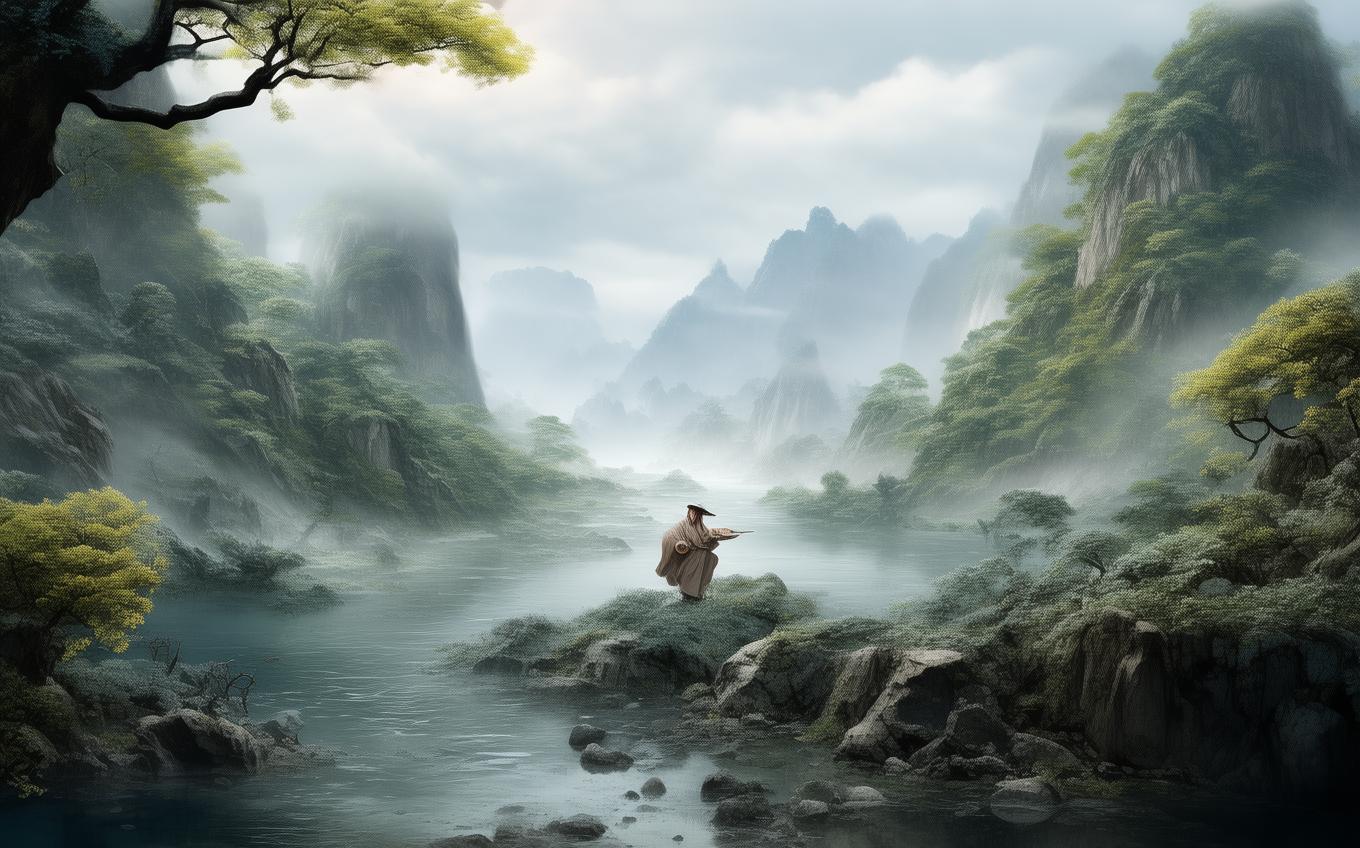
“I halt” — the traveler stops, helpless. Without oar or rudder, he cannot attempt the crossing. The archaic word “高曳” (oar and rudder) may have been obscure even to Han audiences, adding a rough, unpolished texture. Then, the focus shifts entirely to the river: the reduplicated “汤汤” and “回回” mimic the sound and motion of surging, swirling water. It is a cinematic moment: a lone figure, still, facing the immense, indifferent power of nature.
“临水远望,泣下沾衣”
Now the action becomes entirely emotional. Standing by the water, the speaker looks into the distance — toward the home he cannot reach. Silent weeping stains his clothes. There is no self-pity, only a physical overflow of sorrow. “沾衣” (zhān yī, soak the garment) is a detail that later Chinese poets will use again and again to convey wordless grief.
“远道之人心思归,谓之何!”
The final line steps back and turns the personal into the universal. “A man on a far journey” — it could be anyone. The heart “longs for home,” a deep-seated impulse that words cannot pacify. “谓之何” — literally “call it what?” — is a shrug of the soul. How can you name this feeling? The poem ends not with resolution but with an open-mouthed sigh that still hangs in the air after two thousand years.
Themes and Symbolism
Homesickness and Displacement
The dominant theme is the agony of being severed from home. Wu Mountain and the Huai River function as both real geography and metaphors for insurmountable separation. In Han China, conscripts, merchants, and officials often traveled thousands of miles, and the longing to “return east” became a staple poetic motif.
The Power of Nature vs. Human Frailty
Nature in this poem is not a gentle companion but a towering, swirling adversary. The mountain’s “vastness” and the river’s “surging and whirling” dwarf human effort. Yet the speaker’s tears are equally real — a tiny, tender thread of humanity against an epic backdrop. This tension between immensity and intimacy gives the poem its enduring emotional kick.
The Unsolvable Question
The rhetorical questions (“why is the bridge not built?” and “what can be said?”) frame the entire poem as a cry without an answer. There is no philosophical consolation, no moral resolution. This raw, existential openness was characteristic of early folk-style yuefu and stands in stark contrast to later, more polished classical verse.
Cultural Context
“巫山高” belongs to the Han dynasty’s naoge, pieces originally performed with drums, bells, and wind instruments during court ceremonies and military gatherings. The Wu Mountain itself was not just a landmark but a myth-laden site: according to legend, a goddess of Wu Mountain appeared to King Huai of Chu in a dream, and the mountain became a symbol of unattainable love and distance. While our poem does not explicitly invoke the goddess, the mere mention of 巫山 would have triggered associations with longing and unbridgeable gaps.
The Han yuefu tradition valued authenticity over refinement. Many pieces were collected from ordinary people, preserving their dialect, irregular meters, and raw sentiment. “巫山高” exemplifies this with its uneven line lengths, colloquial exclamations, and the almost awkward repetition of “I.” In contrast to the Confucian ideal of emotional restraint, this poem wears its heart on its sleeve — and was treasured precisely for that honesty.
Conclusion
“巫山高” is a small poem with a giant heart. In just six ragged lines, it conjures a landscape that is both geographical and psychological, a traveler frozen between mountain and river, and a grief so pure that it needs no explanation. For modern readers, separated by time and language, the poem works like a snapshot of human vulnerability: the mountain still rises, the river still churns, and somewhere, someone still stares across the water, weeping for a home they cannot reach. That is the timeless power of classical Chinese poetry — it refuses to console us, and in that refusal, makes us feel profoundly less alone.
Comments (0)
No comments yet. Be the first to comment!