Introduction
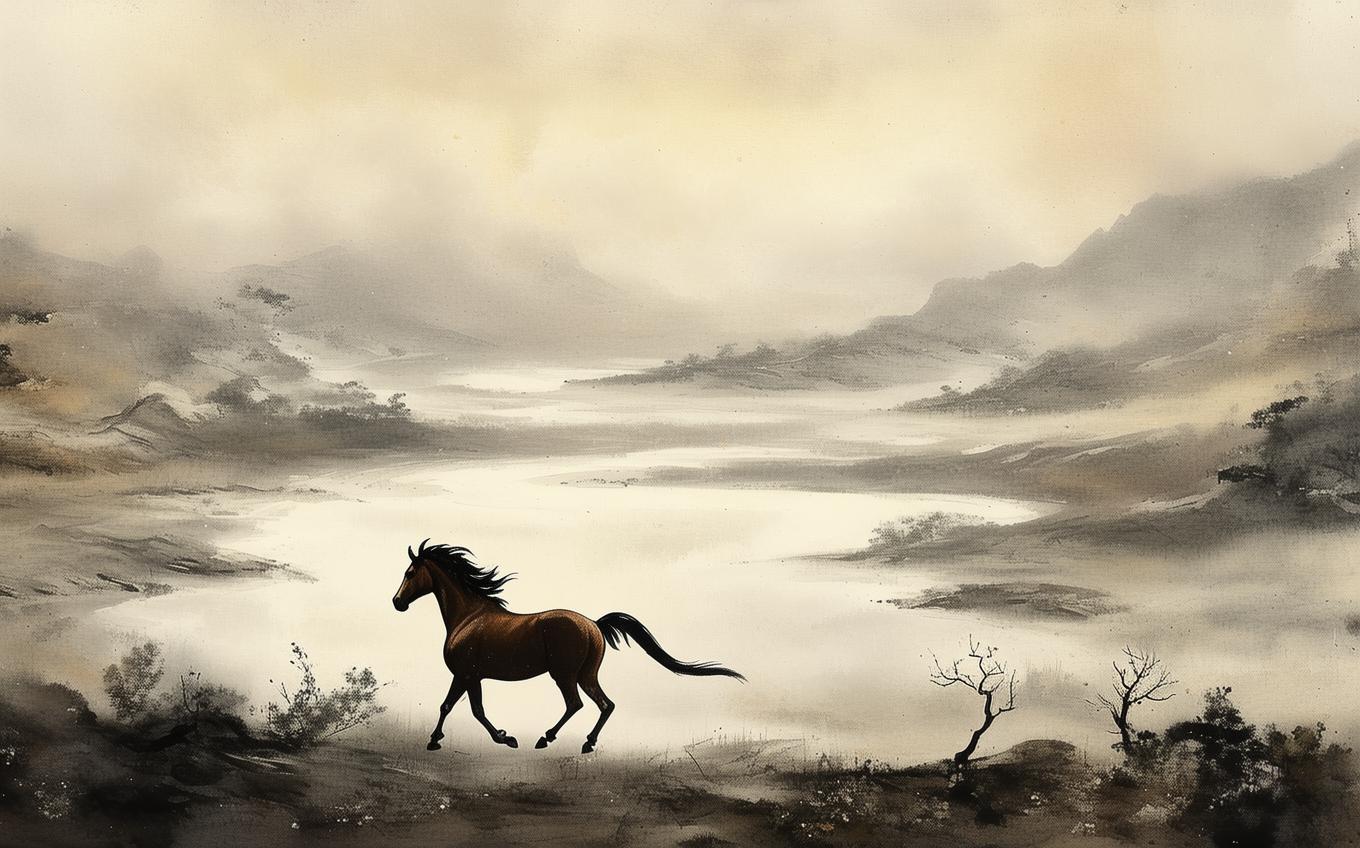
The title “鼓吹曲辞君马黄” combines a genre name and a poem title from the treasure house of early Chinese poetry. Guchui quci (鼓吹曲辞), literally “drum and wind songs,” was a category of music bureau (yuefu) poetry flourishing during the Han dynasty (206 BCE – 220 CE). These pieces were originally performed with drums and wind instruments at court ceremonies, military parades, and banquets. The poem Jun Ma Huang (君马黄, “My Lord’s Horse Is Yellow”) belongs to the famous Han Nao Ge (汉铙歌), a cycle of eighteen songs that accompanied bell-and-drum music. It is an anonymous work, cryptic and fragmentary, yet its imagery still captivates readers after two millennia. This article offers a faithful translation, a detailed line-by-line analysis, and an exploration of the poem’s cultural resonance, inviting English speakers into the mysterious world of Han dynasty yuefu.
The Poem: Full Text and Translation
君马黄,臣马苍,
Jūn mǎ huáng, chén mǎ cāng,
My lord’s horse is yellow, my horse is gray;
二马同逐臣马良。
Èr mǎ tóng zhú chén mǎ liáng.
When two horses race together, my horse proves fine.
易之有騩蔡有赭,
Yì zhī yǒu guī, Cài zhī yǒu zhě,
The Yi domain boasts black-maned steeds, Cai has fine chestnut bays,
美人归以南,驾车驰马,美人伤我心;
Měi rén guī yǐ nán, jià chē chí mǎ, měi rén shāng wǒ xīn;
The beauty returns southward, drives a chariot, whips the horses — the beauty wounds my heart;
佳人归以北,驾车驰马,佳人安终极。
Jiā rén guī yǐ běi, jià chē chí mǎ, jiā rén ān zhōng jí.
The fair one departs northward, drives a chariot, whips the horses — where will the fair one finally halt?
Line-by-Line Analysis
The poem opens with a striking chromatic contrast between two horses — the lord’s yellow and the speaker’s gray — that immediately sets up a social hierarchy. In Han China, yellow was an imperial and noble color, while gray or mixed hues were associated with lower status. Yet the second line subtly overturns this hierarchy: in a direct race, the speaker’s gray horse proves “fine” (liáng, 良), a word that connotes both speed and moral worth. This early reversal suggests a world where merit can outshine birth, or where the speaker quietly insists on his own capabilities despite his subservient position.
The third line leaps from the racetrack to two semi-mythical regions — Yi (modern Hebei area) and Cai (Henan region) — renowned in antiquity for breeding exceptional horses. The specific color terms guī (騩, a black horse with yellow markings) and zhě (赭, a reddish-brown horse) enrich the palette. By naming these distant places, the poet evokes a broader landscape of desire and competition; fine horses are everywhere, yet the speaker’s horse still excels. The line may also function as a narrative interlude, reminding the audience that excellence is never confined to a single stable.
The fourth line introduces the emotionally charged figure of the měi rén (美人, beautiful person), a term that in early poetry can signify a beloved woman, a patron, or even a virtuous ruler in allegorical reading. Her movement southward — a direction traditionally associated with warmth, the sun, and vitality — should be auspicious. Yet her carriage ride, described with the vigorous verb chí (驰, gallop), inflicts pain. The phrase “shāng wǒ xīn” (伤我心) is a direct, almost naïve cry of heartbreak. The beauty’s departure, whether literal or symbolic, disrupts the speaker’s emotional world; the chariot’s speed only magnifies the sense of helplessness.
The fifth line mirrors the fourth but replaces “beauty” (měi rén) with “fair one” (jiā rén, 佳人), a near synonym that often underscores elegance and grace. Her direction reverses — now north, a direction associated with cold, darkness, and solitude. The final rhetorical question “ān zhōng jí” (安终极, “where will she finally stop?”) closes the poem on a note of existential open-endedness. The speaker is left suspended between two vanishing figures, north and south, never certain if reunion is possible. The repetition of “jià chē chí mǎ” reinforces the relentless motion that separates the speaker from his desire.
Read as a whole, the poem moves from a tangible scene (a horse race) through a panoply of legendary steeds to a double portrait of unattainable beauty. The structure itself mirrors the psychological experience of competition and loss: initial confidence gives way to disorientation and longing.
Themes and Symbolism
The primary theme is the tension between merit and status, boldly staged in the horse imagery. The gray horse’s triumph over the yellow horse — or at least the assertion of its fineness — symbolizes the possibility of upward mobility and the recognition of hidden worth. In a society stratified by birth, such a poetic claim holds a quiet revolutionary charge.
A second major theme is the pain of separation and unrequited longing. The two female figures, one moving south, one north, embody the impossible pursuit of an ideal. Whether they represent real lovers, lost friends, or political allegories (the loyal minister abandoned by a fickle ruler), their chariots leave the speaker emotionally bereft. The poem captures a moment of suspended grief, refusing to offer closure.
Key symbols include:
- Horses: status, martial prowess, speed, and the vehicle of desire. The color spectrum (yellow, gray, black-maned, chestnut) paints a world of vivid distinctions.
- South and North: directional symbols of emotional states. South conventionally suggests life and favor; north suggests exile and loss. The two beauties going opposite directions also suggest the speaker torn between diverging loyalties or affections.
- The Chariot: a vehicle of power and distance, intensifying the lover’s separation from the speaker.
Cultural Context
The Nao Ge cycle, where Jun Ma Huang survives, was closely linked to Han court entertainment and possibly military ceremonies. The original music is lost, but the lyrics carry the rhythmic intensity of percussion and wind. Many Nao Ge poems are notoriously obscure, perhaps because they spliced together oral formulas or because lines were lost over centuries of transmission. This fragmentary quality invites multiple readings, making the poem a site of scholarly debate.
In the Han dynasty, yuefu poetry often carried political undercurrents. A courtier might lament a ruler’s neglect through the voice of a forsaken lover — the so-called “beautiful one” (měi rén) tradition. Thus, the departing beauties could symbolize a sovereign who no longer heeds loyal counsel. Read this way, the speaker’s fine gray horse becomes a metaphor for unrecognized talent in the bureaucracy, and the final question (“where will she halt?”) becomes a veiled warning: a ruler who continually flees wise advice may find no safe resting place.
The poem also reflects the early Chinese fascination with horses as agents of empire, trade, and cultural exchange. The mention of Yi and Cai points to the broad geography of the Han realm, where regional horse breeds were prized. The race between lord and retainer mirrors the competitive spirit of Han court life, where scholars and warriors vied for imperial favor.
Conclusion
Jun Ma Huang may be brief and textually challenging, but its power lies in its vivid contrasts — yellow and gray, north and south, presence and absence, confidence and sorrow. It compresses a complex emotional drama into a few swift strokes, much like a Chinese ink painting that uses empty space to evoke infinite depth. For the English-speaking lover of Chinese culture, this small gem reveals the early roots of a lyrical tradition that sees personal feeling and political fate as inseparable. Its unresolved ending reminds us that some poems, like some longings, are meant to linger in the mind, never quite reaching a terminal stop. In a world still full of departures and races, the heart‑cry of the musician from two thousand years ago continues to gallop alongside us.
Comments (0)
No comments yet. Be the first to comment!