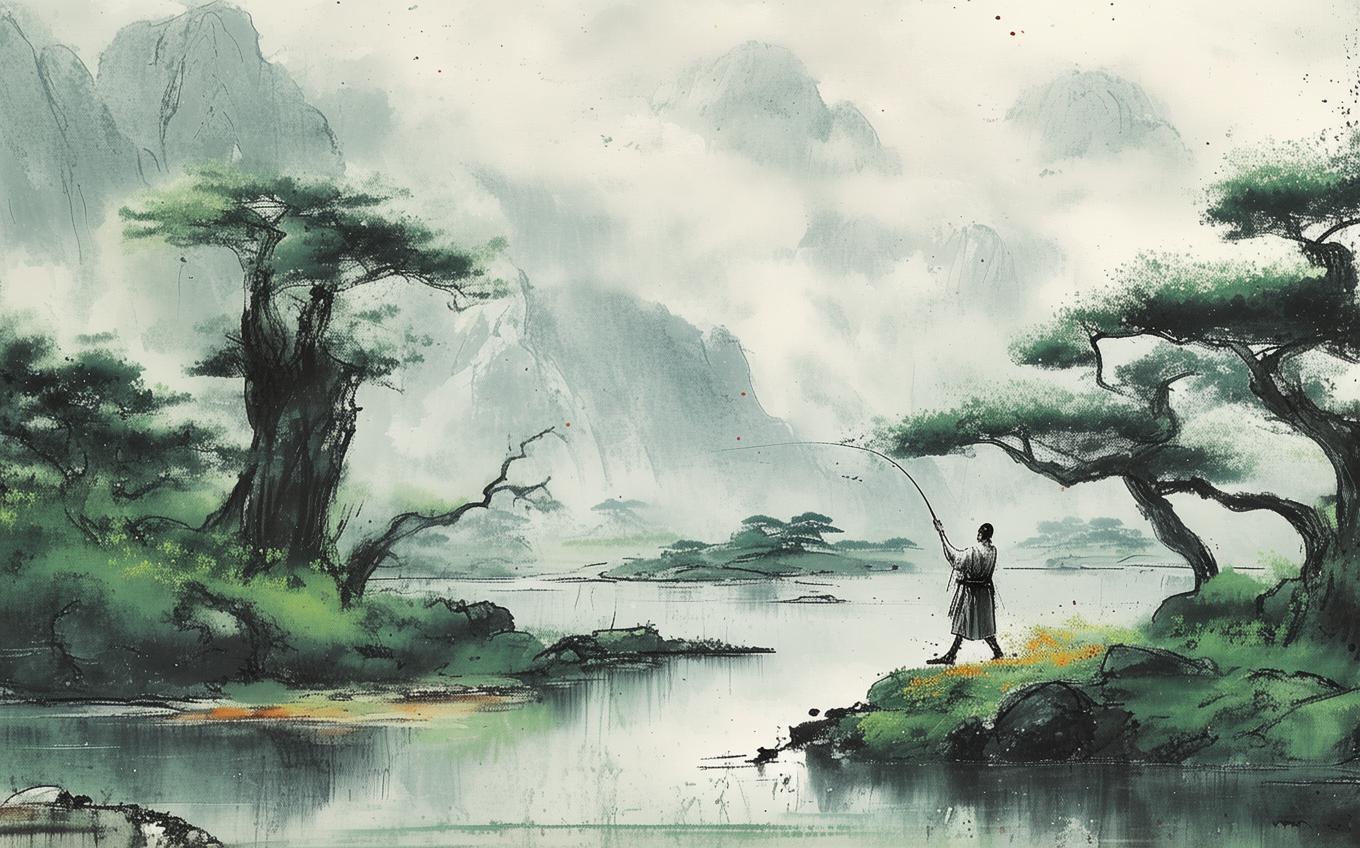
Analysis of "钓竿篇" (Song of the Fishing Pole) from "鼓吹曲辞"
Introduction
The poem “钓竿篇” (Diào Gān Piān, “Song of the Fishing Pole”) belongs to the “鼓吹曲辞” (Gǔ Chuī Qǔ Cí), a section of the Yuefu Shiji (Collection of Music Bureau Poems) that preserves ceremonial and processional songs from the Han to the Six Dynasties. This particular piece, however, is far from martial grandeur: it is a tranquil nature lyric attributed to Shen Yue (441–513), a leading poet of the Southern Liang dynasty. Shen Yue was a statesman, historian, and a pivotal figure in the development of the “Yongming style,” which emphasized tonal euphony and graceful imagery. In this short poem, he transforms the yuefu title into a meditation on leisurely fishing, embodying the Chinese literati’s timeless dream of retreating from officialdom into a peaceful natural world. For English readers, the poem offers a delicate glimpse into the aesthetics of simplicity and the Daoist-inspired ideal of living in harmony with nature.
The Poem: Full Text and Translation
桂舟既容与,
Guì zhōu jì róng yǔ,
The cinnamon-wood boat floats leisurely,绿浦复回纡。
Lǜ pǔ fù huí yū.
Along the green bank it winds and meanders again.轻丝动弱芰,
Qīng sī dòng ruò jì,
The light silk fishing line stirs the tender water caltrop,微楫起单凫。
Wēi jí qǐ dān fú.
The gentle oar startles a solitary wild duck.扣舷忘日暮,
Kòu xián wàng rì mù,
Tapping the gunwale, I forget that dusk is falling,卒岁以为娱。
Zú suì yǐ wéi yú.
I could pass the whole year in such delight.
Line-by-Line Analysis
桂舟既容与,绿浦复回纡。
The opening couplet sets the scene with a drifting boat made of aromatic cinnamon wood, a detail that immediately signals elegance and refined taste. “容与” (róng yǔ) means unhurried, drifting at ease, a term often used in early Chinese poetry to describe a carefree state of motion. The boat does not rush; it meanders along a lush green riverbank (“绿浦”) that “回纡” (huí yū) — twists and turns. This gentle movement is not just a physical path but a metaphor for a mind that flows without resistance, at one with the landscape.
轻丝动弱芰,微楫起单凫。
The focus shifts to minute, almost imperceptible actions. The “light silk line” is so delicate that it barely disturbs the “弱芰” (ruò jì), the tender leaves of the water caltrop floating on the surface. The “slight oar” stirs only enough to startle a single duck into flight. There is no violent catch, no strenuous rowing — just the soft interplay between human presence and the water’s fragile ecosystem. The line captures a moment of pure sensory awareness: visual delicacy and the sudden motion of the bird, contrasting with the surrounding stillness.
扣舷忘日暮,卒岁以为娱。
The final couplet turns inward. The speaker idly taps the side of the boat with his hand or a small stick — a gesture of contentment so absorbing that he loses all track of time (“忘日暮”). Dusk arrives unnoticed because the mind is fully present in the act. The last line crystallizes this feeling: “I could spend the entire year in such pleasure.” The poem does not celebrate a grand catch or any achievement; the highest joy is simply to be there, absorbed in the act of fishing that has become a form of meditation.
Themes and Symbolism
Leisurely Reclusion
The central theme is the ideal of “a life removed from worldly cares.” Fishing, in the Chinese literary tradition, rarely signifies a practical hunt for food. Instead, it represents the literatus’s desire to step away from political ambition and embrace a simple, self-sufficient existence. Shen Yue, a high-ranking court official, uses the poem to give voice to that longing for escape.
Harmony with Nature
The imagery emphasizes a world in balance: human activity is so minimal it barely registers. The silk line touches a plant, an oar disturbs a duck — these are interactions, not invasions. The boat follows the river’s curves rather than cutting through them, embodying the Daoist principle of wu wei (effortless action).
The Fishing Pole as Metaphor
The pole and line are symbols of patience, stillness, and receptivity. In Chinese cultural memory, the fisherman is a sage-like figure — think of Jiang Ziya, who famously fished with a straight hook to show he waited only for a worthy ruler, or the hermit fishermen in the poetry of Tao Yuanming. Here, the pole connotes a deliberate withdrawal from the frantic rhythms of public life.
Cultural Context
The “鼓吹曲辞” originally comprised martial and processional music performed with drums and wind instruments. By the Six Dynasties, however, many yuefu titles were adopted by literati poets for purely lyrical expression. Shen Yue’s choice to set a peaceful fishing scene to a title that once rang with military overtones subtly subverts the noisy world of official duty. The Southern Liang court was a center of refined literary culture, where poets prized natural description and cultivated an aesthetic of elegant restraint. This poem reflects that taste, as well as the broader influence of Neo-Daoism and the reclusive ideal that flourished after the collapse of the Han empire. The act of drifting alone in a boat becomes a quiet rebellion against the burdens of rank and the transience of fame.
Conclusion
“钓竿篇” is a jewel of brevity: with just thirty Chinese syllables, Shen Yue paints a scene that feels at once intimate and infinite. The poem’s enduring appeal lies in its ability to transport the reader into a state of unhurried grace. For a modern audience — whether in the East or West — this ancient voice still whispers a gentle invitation: slow down, forget the clock, and discover that true delight can be found in the simplest of moments, even in the tapping of a hand against a wooden boat as dusk steals across the water. In a world of haste, the fisherman’s equanimity remains a quiet, profound gift.


Comments (0)
No comments yet. Be the first to comment!