Introduction
- “诉衷情近” (Sù Zhōng Qíng Jìn) is a cí 词 tune pattern, a lyric form that flourished during the Song dynasty. The poem most closely associated with this tune is “诉衷情近·雨晴气爽” by 柳永 (Liǔ Yǒng, c. 987–1053), one of the most influential poets of the Northern Song period.
- Liu Yong was famous for writing emotionally rich lyrics about travel, separation, longing, urban life, and romantic sorrow. Unlike many earlier poets who wrote mainly for elite circles, Liu Yong’s works were widely sung in entertainment quarters and became beloved among common people.
- This poem is significant because it shows the beauty of Song cí: a brief but deeply atmospheric lyric in which landscape and emotion are inseparable. The poet stands by a riverside building after rain, gazing into the distance, and the outer scenery gradually becomes a mirror of inner loneliness.
The Poem: Full Text and Translation
雨晴气爽,伫立江楼望处。
Yǔ qíng qì shuǎng, zhù lì jiāng lóu wàng chù.
After the rain clears, the air is fresh; I stand long in a riverside tower, gazing afar.
澄明远水生光,重叠暮山耸翠。
Chéng míng yuǎn shuǐ shēng guāng, chóng dié mù shān sǒng cuì.
The clear distant waters shimmer with light; layered evening mountains rise in green.
遥认断桥幽径,隐隐渔村,向晚孤烟起。
Yáo rèn duàn qiáo yōu jìng, yǐn yǐn yú cūn, xiàng wǎn gū yān qǐ.
Far away I make out a broken bridge and a quiet path; a faint fishing village appears, where at dusk a lonely wisp of smoke rises.
残阳里。
Cán yáng lǐ.
In the fading sunlight.
脉脉朱阑静倚。
Mò mò zhū lán jìng yǐ.
Silently, with lingering feeling, I lean against the red railing.
黯然情绪,未饮先如醉。
Àn rán qíng xù, wèi yǐn xiān rú zuì.
My mood darkens with sorrow; before drinking, I already feel as if drunk.
愁无际。
Chóu wú jì.
Grief has no boundary.
暮云过了,秋光老尽,故人千里。
Mù yún guò le, qiū guāng lǎo jìn, gù rén qiān lǐ.
Evening clouds have passed; autumn’s light has grown old; my old friend is a thousand miles away.
竟日空凝睇。
Jìng rì kōng níng dì.
All day long, I gaze in vain.
Line-by-Line Analysis
雨晴气爽,伫立江楼望处。
The poem opens after rain. In classical Chinese poetry, rain often suggests sorrow, separation, or cleansing. Here, the rain has stopped, and the air is described as 气爽—fresh, clear, and invigorating. Yet this clarity does not bring emotional relief.
The speaker stands in a 江楼, a tower or building overlooking a river. Such elevated places are common in Chinese poetry. They allow the poet to see far away, but they also intensify longing. The act of 望—gazing into the distance—is rarely neutral. It often implies yearning for someone absent or searching for something unreachable.
澄明远水生光,重叠暮山耸翠。
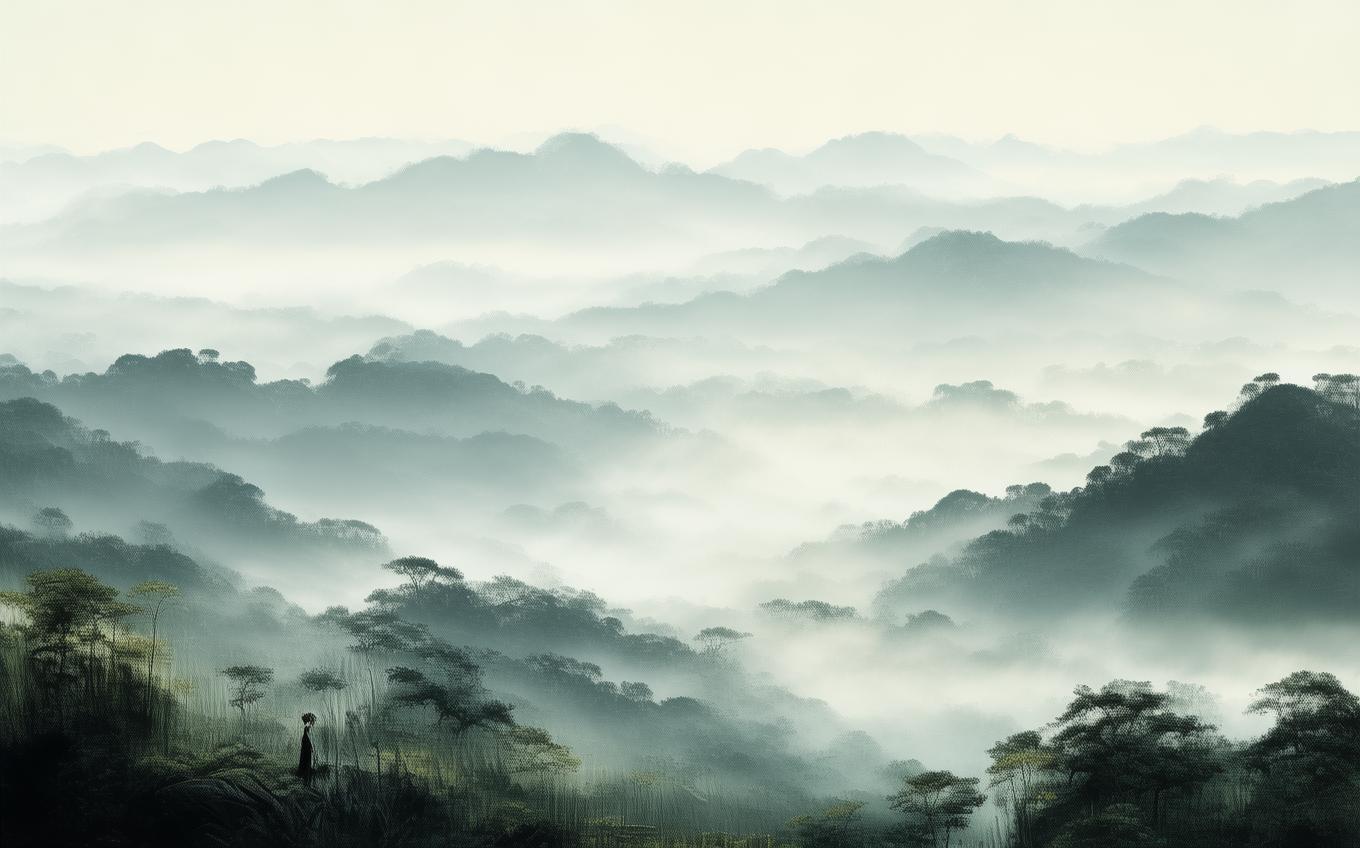
The landscape expands: distant water shines, and evening mountains rise in layers of green. The visual world is beautiful and calm. The phrase 澄明 suggests purity and brightness, while 重叠暮山 gives depth to the scene: mountain behind mountain, fading into dusk.
This is not only natural description. The distant waters and layered mountains create a sense of separation. The speaker sees far, but distance remains distance. Beauty becomes painful because it emphasizes how far away the beloved or old friend is.
遥认断桥幽径,隐隐渔村,向晚孤烟起。
The gaze moves from grand scenery to smaller details: a broken bridge, a quiet path, a faint fishing village. These images are delicate and human, but they are also lonely.
The 断桥—broken bridge—may symbolize interrupted connection. A bridge usually joins two sides, but a broken bridge suggests separation and failure to meet. The 幽径, or secluded path, deepens the sense of isolation.
The 孤烟, a solitary column of smoke rising at dusk, is especially evocative. Smoke from a village suggests ordinary domestic life: cooking, family, warmth, return. But because it is described as “lonely,” it reflects the speaker’s own solitude. The village has life, yet the poet remains outside it, watching from afar.
残阳里。
This short phrase is powerful because of its brevity. 残阳 means the remaining or fading sun. It marks the emotional turning point of the poem. Day is ending, light is weakening, and the scenery becomes more melancholy.
In Chinese poetry, sunset often symbolizes decline, parting, age, and the passing of time. Here it prepares us for the deeper sadness of the second half.
脉脉朱阑静倚。
The speaker is now physically present again: leaning quietly against a red railing. 朱阑 refers to a red-painted railing, often associated with elegant towers, pavilions, or refined spaces.
The word 脉脉 is difficult to translate fully. It suggests silent, tender, lingering emotion—feeling that is deeply present but unspoken. The poet does not cry out. Instead, the sorrow is restrained. This emotional restraint is a key feature of classical Chinese lyricism: the deepest feeling is often expressed through silence, posture, and landscape.
黯然情绪,未饮先如醉。
The mood becomes 黯然, darkened and sorrowful. The poet says he feels drunk before drinking. This is a familiar poetic idea: intense emotion itself can intoxicate. In Chinese literature, wine often appears as a companion to sorrow, but here even wine is unnecessary. Longing has already blurred the mind.
This line suggests emotional helplessness. The speaker is overwhelmed not by alcohol, but by memory and absence.
愁无际。
This line is strikingly direct: “Grief has no boundary.” After so much scenic description, the poet finally names the emotion clearly.
The phrase 无际 means limitless, without edge or horizon. It connects inner feeling with the wide landscape. Just as rivers, mountains, clouds, and sky stretch outward, the poet’s sorrow also extends endlessly. The world outside and the world inside become one.
暮云过了,秋光老尽,故人千里。
The evening clouds have passed, autumn light is nearly gone, and the old friend is far away. This line gathers time, season, and human separation into one emotional moment.
秋光老尽 is especially poignant. Autumn is already associated with decline and melancholy, but here even autumn’s light has “grown old” and is almost exhausted. Time is not simply passing; it is aging.
The phrase 故人千里 tells us the likely source of sorrow: someone dear is far away. 故人 can mean an old friend, a former companion, or someone once close. The distance of 千里, “a thousand miles,” is both literal and emotional. In traditional China, travel was slow and communication uncertain. Separation could feel almost absolute.
竟日空凝睇。
The poem ends with a quiet, devastating image: the speaker has spent the whole day gazing, but in vain.
凝睇 means to stare fixedly, to gaze with concentration and feeling. The word 空 means empty, futile, without result. This final line captures the essence of longing: the eyes look outward, but the desired person never appears.
The poem does not end with reunion or resolution. It ends in suspended waiting.
Themes and Symbolism
Longing and Separation
The central theme is emotional separation. The speaker looks into the distance because someone important is far away. The landscape is beautiful, but that beauty only sharpens the pain of absence.
Nature as Emotional Mirror
In classical Chinese poetry, nature is rarely just background. Here, water, mountains, dusk, smoke, clouds, and autumn light all reflect the speaker’s inner state. The world appears clear after rain, yet the heart remains clouded.
The Passage of Time
The poem moves from after-rain freshness to sunset, then to aging autumn light. This progression suggests not only the passing of a single day but also the larger passage of life. Time moves forward, but longing remains unresolved.
The Broken Bridge
The 断桥 is a key symbol. A bridge normally represents connection, communication, and crossing. A broken bridge suggests that the path to reunion has been damaged or interrupted. It quietly embodies the poem’s emotional situation.
The Lonely Smoke
The 孤烟 rising from the fishing village suggests domestic warmth seen from a distance. It may represent the life and companionship the speaker lacks. The smoke rises, but it also disappears—like memory, hope, or a message that cannot be delivered.
Cultural Context
- This poem belongs to the Song dynasty tradition of cí poetry. Unlike the regulated verse of the Tang dynasty, cí lyrics were originally written to fit musical tunes. Each tune pattern had its own rhythm, line lengths, and emotional associations.
- Liu Yong was especially important in developing longer and more emotionally detailed cí. He often wrote about travelers, lovers, courtesans, and people separated by distance. His language could be elegant but also accessible, which helped his works become widely popular.
- The poem reflects a major value in Chinese literary culture: the belief that human emotion and the natural world are deeply connected. Rather than directly explaining every feeling, the poet allows scenery to carry emotional meaning.
- It also reflects the traditional Chinese experience of travel and separation. Officials, scholars, merchants, and poets often lived far from home or from loved ones. In such a world, gazing from towers, watching rivers, and lamenting distance became powerful poetic motifs.
- Philosophically, the poem suggests the impermanence of all things: weather clears, sunlight fades, clouds pass, seasons age, and people remain apart. This sensitivity to transience is central to much of Chinese poetry.
Conclusion
“诉衷情近·雨晴气爽” is a beautiful example of how Song dynasty cí poetry transforms landscape into emotion. Liu Yong begins with a clear, fresh scene after rain, but gradually reveals a heart filled with loneliness and longing.
The poem’s enduring appeal lies in its restraint. It does not dramatize sorrow loudly. Instead, it shows a person standing quietly by a railing, watching distant water, fading sunlight, and a lonely wisp of smoke. Through these images, we feel the ache of absence.
For readers today, the poem remains deeply relatable. We may no longer stand in riverside towers waiting for news from a thousand miles away, but we still know what it means to look into the distance, to miss someone, and to feel that beauty itself can become painful when it cannot be shared.
Comments (0)
No comments yet. Be the first to comment!