Introduction
Du Zhenglun (杜正伦) was a notable poet and official of the early Tang Dynasty, a period often celebrated as a golden age of Chinese poetry. Born in the late sixth century, Du served in the court of Emperor Taizong and was known for his literary talent and political acumen. His career, however, was marked by both distinction and eventual downfall—a common fate for many scholar-officials navigating the treacherous waters of imperial politics.
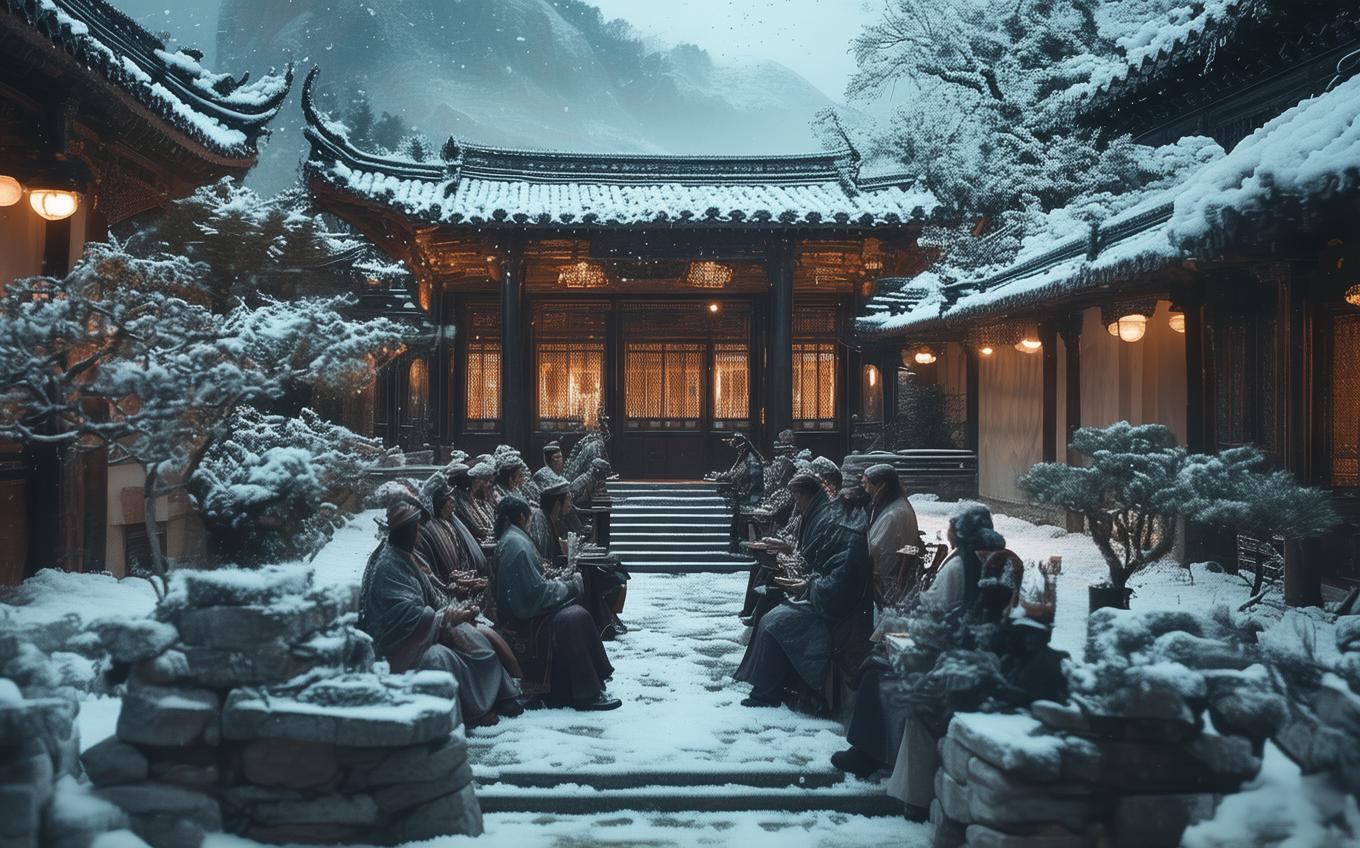
The poem presented here, 冬日宴于庶子宅各赋一字得节 ("Winter Day Banquet at the Residence of the Junior Mentor, Each Composing a Poem on an Assigned Character, I Received 'Jie'"), belongs to a distinctive genre of Chinese literary culture: the group composition at social gatherings. During such banquets, literati would be assigned a specific character as a rhyme or thematic anchor, and each guest would compose a poem incorporating that character. Du Zhenglun received the character 节 (jié), which carries rich connotations—season, integrity, restraint, and moral principle—all of which he weaves masterfully into this brief but profound work.
This poem is significant not only for its aesthetic beauty but also for what it reveals about Tang Dynasty literati culture: the deep bonds of friendship, the reverence for philosophical discourse, the appreciation of music, and the bittersweet awareness of time's passage.
The Poem: Full Text and Translation
李门余妄进,徐榻君恒设。
Lǐ mén yú wàng jìn, Xú tà jūn héng shè.
At the Li family gate I presumptuously enter; the Xu-style couch you always prepare.
清论畅玄言,雅琴飞白雪。
Qīng lùn chàng xuán yán, yǎ qín fēi bái xuě.
Pure discourse flows freely with profound words; the elegant qin sends forth "White Snow."
寒云暧落景,朔风凄暮节。
Hán yún ài luò jǐng, shuò fēng qī mù jié.
Cold clouds dim the setting scene; the north wind chills this evening season.
方欣投辖情,且驻当归别。
Fāng xīn tóu xiá qíng, qiě zhù dāng guī bié.
Just now I rejoice in the affection that removes the carriage linchpin; let us pause before we must part and return.
Line-by-Line Analysis
Line One: 李门余妄进,徐榻君恒设
The opening couplet establishes the social setting through two allusions to famous historical friendships. "李门" (Li family gate) references Li Ying (李膺), a renowned official of the Eastern Han Dynasty whose gate was so prestigious that being received there was considered an honor akin to "ascending the dragon's gate." By calling his own entry "妄进" (presumptuous), Du Zhenglun employs the language of self-deprecation—a hallmark of Chinese literati etiquette—while simultaneously elevating his host's status.
The second half of the line introduces "徐榻" (Xu's couch), an allusion to Xu Zhi (徐稚), a reclusive scholar of the Eastern Han. The story goes that the official Chen Fan (陈蕃) kept a special couch reserved exclusively for Xu Zhi; when Xu visited, the couch would be set out, and when he left, it would be hung up again. By saying "君恒设" (you always set it out), Du Zhenglun expresses profound gratitude: his host treats him with the same exceptional regard that Chen Fan showed Xu Zhi. This is not merely hospitality—it is a declaration of special friendship and mutual recognition.
Line Two: 清论畅玄言,雅琴飞白雪
This couplet transports us from the social frame into the intellectual and aesthetic heart of the gathering. "清论" (pure discourse) refers to the tradition of qingtan (清谈), "pure conversation"—a philosophical practice that flourished during the Wei-Jin period, involving elegant, abstract discussions of metaphysics, philosophy, and literature. The word "畅" (flowing freely) suggests that the conversation is not stilted or formal but moves naturally and joyfully among the participants.
"玄言" (profound words) deepens this image, evoking the xuanxue (玄学) tradition of Neo-Daoist philosophy that explored the mysterious depths of the Dao. The host and guests are not engaging in idle chatter; they are participating in the highest form of intellectual exchange known to Chinese culture.
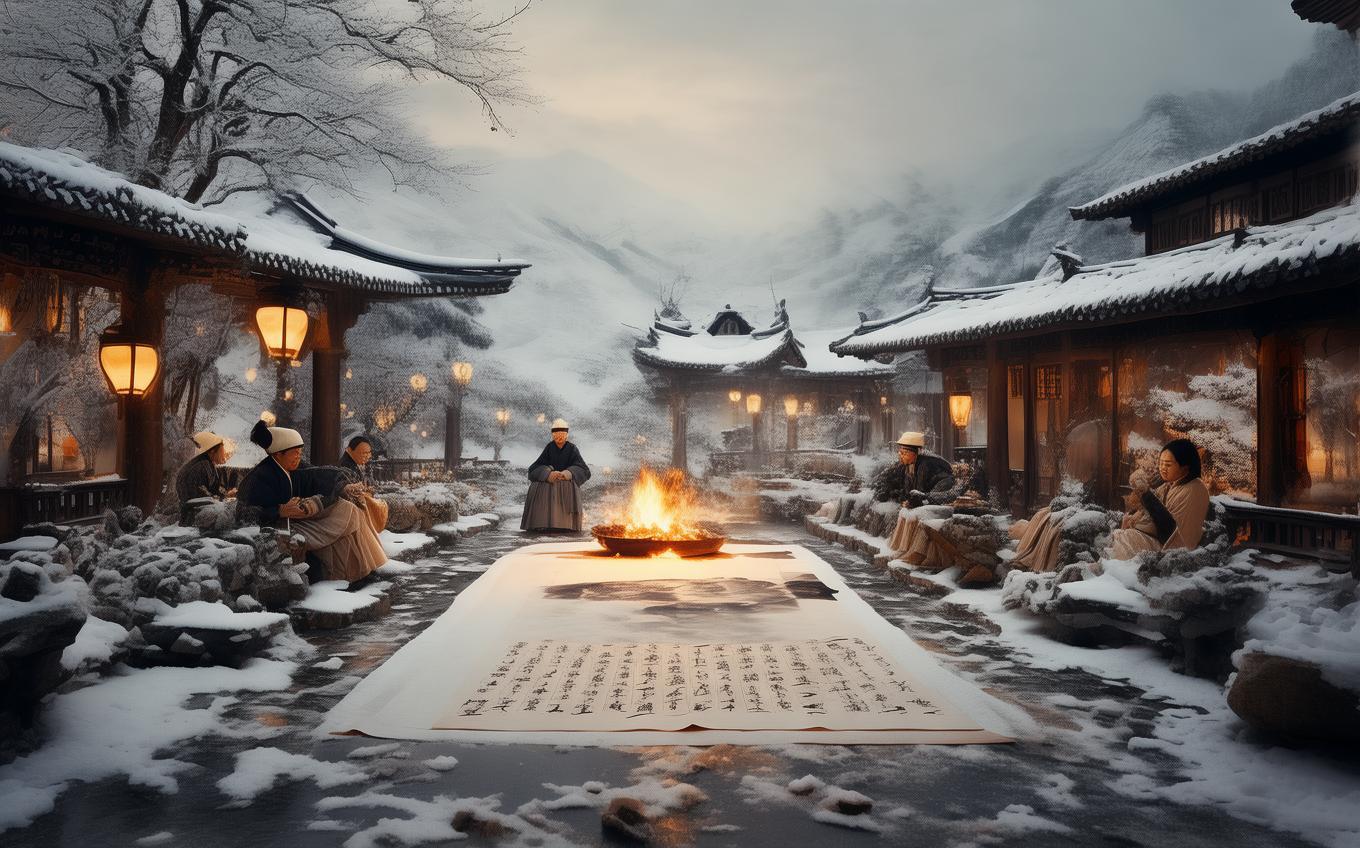
The second half introduces music: "雅琴" (elegant qin) refers to the guqin (古琴), the seven-stringed zither that was the instrument of choice for Chinese scholars. The phrase "飞白雪" (sends forth "White Snow") is a double reference. "White Snow" (Yangchun Baixue, 阳春白雪) was a legendary musical composition of such refinement that only the most discerning listeners could appreciate it—a metaphor for high art. The image of snow "flying" from the strings also evokes the famous story of the musician Shi Kuang, whose playing could summon snow from the heavens. The music is so pure, so beautiful, that it seems to materialize as snowflakes in the winter air.
Line Three: 寒云暧落景,朔风凄暮节
The poem now shifts from the warmth of the interior to the cold of the exterior world. "寒云" (cold clouds) gather, and "暧" (dim, obscured) modifies "落景" (the setting scene or sunset). The word 暧 is particularly evocative—it suggests not complete darkness but a softening, a veiling of the light. The sun is setting behind winter clouds, casting the world in a muted, melancholic glow.
"朔风" (north wind) is the wind of winter in Chinese poetry, always associated with cold, hardship, and the harshness of the season. "凄" (chilling, desolate) intensifies this feeling, and "暮节" (evening season) carries a double meaning. On one level, it refers literally to the winter season (jié as season), and on another, it evokes the evening of the year—the dying of the natural world. This is the character 节 that Du Zhenglun was assigned, and he uses it with remarkable skill, allowing it to resonate with both seasonal and moral significance.
The contrast is striking: inside, there is warmth, music, and intellectual brilliance; outside, the world is cold, darkening, and windswept. This juxtaposition heightens the preciousness of the moment.
Line Four: 方欣投辖情,且驻当归别
The final couplet introduces one more allusion, and it is perhaps the most poignant. "投辖" (throwing down the carriage linchpin) refers to a story about Chen Zun (陈遵), a Han Dynasty official famous for his hospitality. When guests tried to leave his banquets, Chen Zun would order their carriage linchpins removed and thrown into a well, making it impossible for them to depart. The "投辖情" is therefore the affection that refuses to let friends go—a love so strong it would sabotage your transportation to keep you near.
Du Zhenglun rejoices in this feeling: "方欣" (just now I rejoice). But the poem's final line acknowledges the inevitable: "且驻当归别" (let us pause, for we must return and part). The word "当归" (dāng guī) is particularly resonant. It means "must return," but it is also the name of a Chinese medicinal herb (Angelica sinensis), traditionally associated with the longing for home and the necessity of departure. The poet asks for a brief extension—"且驻" (let us stay a while longer)—even as he recognizes that all gatherings must end.
This tension between the desire to remain and the knowledge of parting is the emotional heart of the poem. It is a feeling as universal as it is ancient: the bittersweet awareness that joy is fleeting, that the warmth of friendship exists against the cold backdrop of time's passage.
Themes and Symbolism
The Theme of Friendship and Hospitality
The poem is fundamentally a celebration of friendship, expressed through a series of historical allusions. Each reference—Li Ying's gate, Xu Zhi's couch, Chen Zun's linchpin—represents a different facet of ideal friendship: honor, exclusivity, and the refusal to let go. Du Zhenglun positions himself as the grateful recipient of such friendship, and the poem becomes an act of gratitude, a gift offered in return for hospitality.
The Theme of Time and Seasons
The assigned character 节 (jié) anchors the poem's meditation on time. Jié can mean "season," "festival," "moral integrity," or "restraint"—all of which resonate throughout the poem. The winter season (冬节) is a time of endings, of cold and darkness, yet it is also a time when people gather indoors, drawing closer together against the harshness of the world. The poem captures this paradox: winter is both the harshest season and the season of the warmest human connection.
The Symbolism of Music
The guqin (古琴) is more than an instrument in Chinese culture; it is a symbol of the scholar's soul. Its music is said to express the inexpressible, to communicate the deepest feelings of the heart. The image of "White Snow" flying from the strings suggests a purity and transcendence that words alone cannot achieve. The music, like the friendship, is a bridge between the mundane and the sublime.
The Symbolism of the Setting Sun and North Wind
The "寒云" (cold clouds) and "朔风" (north wind) are traditional symbols of adversity, of the forces that threaten human warmth and connection. They represent not only the physical cold of winter but also the metaphorical cold of political danger, personal loss, and mortality. The setting sun (落景) is a universal symbol of decline and ending, reminding us that all bright things must eventually fade.
Cultural Context
The Tradition of Literary Gatherings
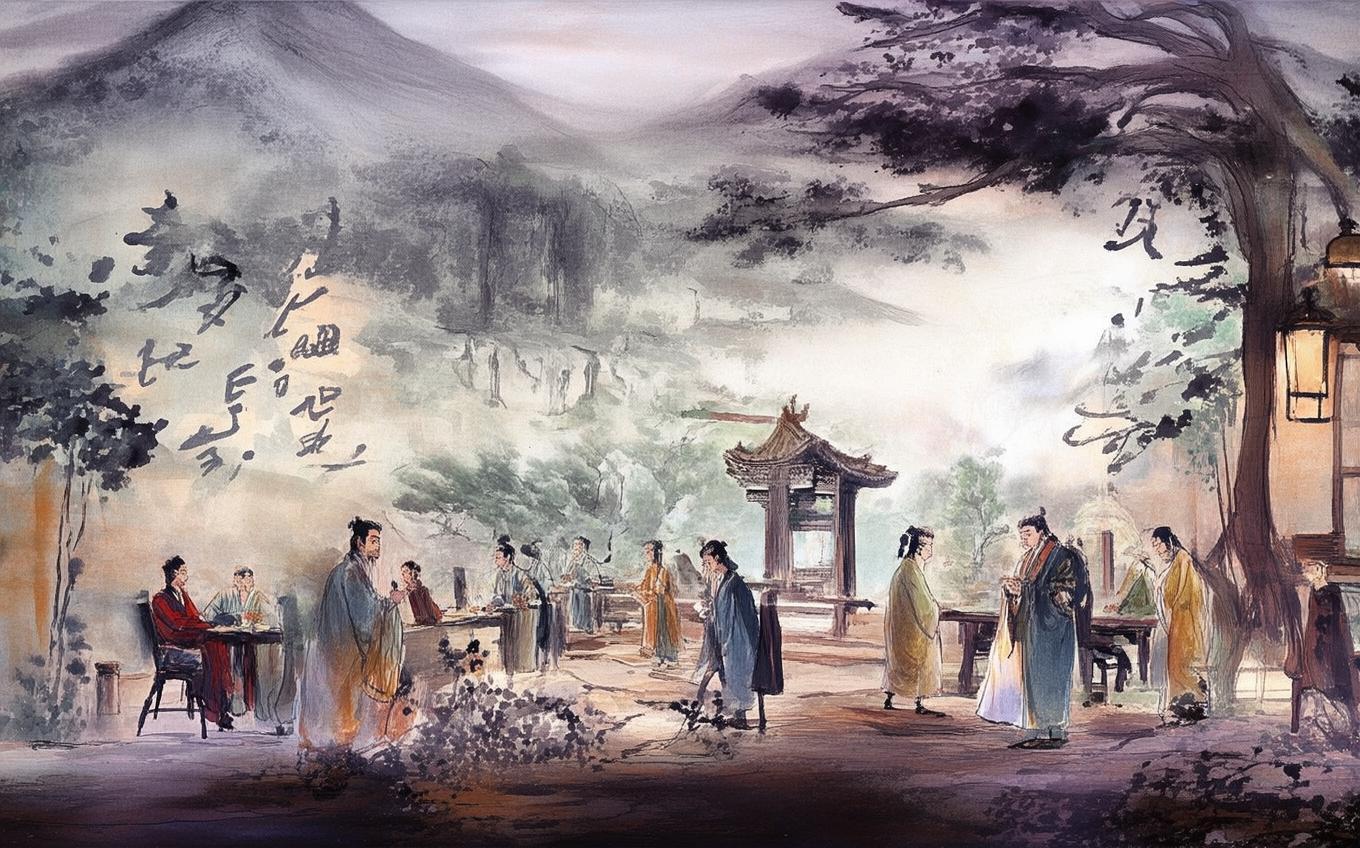
The practice of composing poetry at banquets dates back to the Han Dynasty and reached its zenith during the Tang. Such gatherings were not merely social events; they were arenas for intellectual display, where poets demonstrated their erudition, wit, and mastery of allusion. The assignment of characters (分韵 or 赋字) added an element of competition and constraint that paradoxically stimulated creativity. Du Zhenglun's poem is a product of this tradition—a work that is simultaneously a social performance and a deeply personal expression.
The Allusive Tradition
Chinese poetry of this period is densely allusive, drawing on a shared cultural vocabulary of historical references, literary quotations, and philosophical concepts. For the Tang literati, these allusions were not obscure or pedantic; they were a living language through which complex emotions could be expressed with remarkable economy. When Du Zhenglun mentions "徐榻," his audience would immediately understand: he is saying that his host treats him as a special friend, worthy of the highest honor. This shared cultural literacy created a bond between poet and audience that modern readers can only partially recover.
Confucian and Daoist Values
The poem reflects the synthesis of Confucian and Daoist values that characterized Tang literati culture. The emphasis on friendship, loyalty, and social ritual is Confucian; the appreciation of "玄言" (profound words) and the transcendental power of music is Daoist. The ideal scholar-official was expected to embody both traditions—to be a man of principle and duty who could also appreciate the deeper mysteries of existence. Du Zhenglun's poem demonstrates this synthesis, moving effortlessly from social etiquette to philosophical discourse to aesthetic appreciation.
The Winter Banquet as Cultural Ritual
In traditional Chinese culture, winter was a time for gathering, for storytelling, for the strengthening of social bonds. The agricultural cycle had come to an end; the fields lay fallow; and people turned inward, both physically and spiritually. The winter banquet was therefore more than a party—it was a ritual affirmation of community and friendship in the face of nature's harshest season. Du Zhenglun's poem captures this ritual significance, transforming a social occasion into a meditation on the enduring value of human connection.
Conclusion
Du Zhenglun's 冬日宴于庶子宅各赋一字得节 is a masterpiece of compression, packing layers of meaning into just forty Chinese characters. Through its carefully chosen allusions, it evokes a world of literary sophistication, philosophical depth, and emotional warmth. The poem moves from the social to the intellectual to the natural to the emotional, creating a complete arc that mirrors the experience of the banquet itself—from arrival to conversation to music to the bittersweet moment of parting.
What makes this poem endure is its universality. Though written over thirteen hundred years ago for a specific occasion at a specific residence, it speaks to experiences that transcend time and culture: the joy of good conversation, the beauty of music, the comfort of friendship against the cold of the world, and the melancholy knowledge that all gatherings must end. The poem's final line—"且驻当归别" (let us pause before we must part)—is a plea that resonates with anyone who has ever wished to extend a precious moment just a little longer.
In our modern world of constant connection and instant communication, the poem offers a reminder of what true friendship requires: presence, attention, and the willingness to be fully with others in a shared moment. The winter banquet of Du Zhenglun's poem may be long past, but the human longing it expresses—for connection, for meaning, for beauty in the face of time's passage—remains as urgent as ever.
This analysis is part of an ongoing series exploring classical Chinese poetry for English-speaking readers. Each poem offers a window into a world of profound beauty and enduring wisdom.
Sources and Verification
- Verified text and attribution: 杜正伦, “冬日宴于庶子宅各赋一字得节” (Tang dynasty).
- Primary dataset: Chinese Poetry open corpus.
- Source record:
25f2e98f-1527-4a5d-aece-4474b716209a.
The Chinese source text and attribution are supplied from the verified record above. The English translation and commentary are educational explanations.

Comments (0)
No comments yet. Be the first to comment!