Introduction
Lu Jing (陆敬) was a Tang Dynasty poet whose works, though not as widely celebrated as those of Li Bai or Du Fu, offer a valuable window into the rich tradition of landscape poetry in medieval China. The Tang Dynasty (618–907 CE) is often regarded as the golden age of Chinese poetry, a period when verse became the primary medium for expressing both personal emotion and philosophical reflection on the natural world.
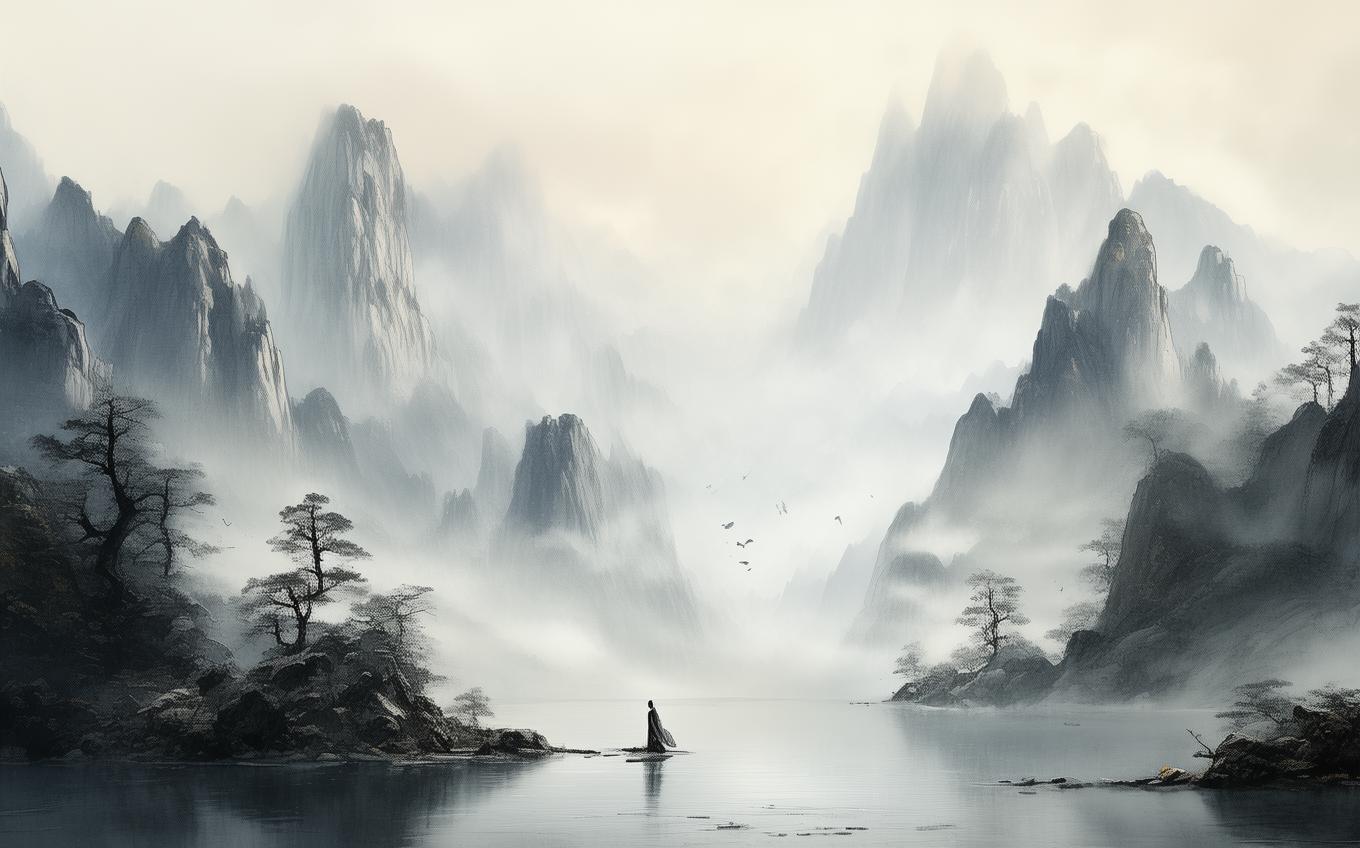
"巫山高" (Wū Shān Gāo), or "Mount Wu Is High," belongs to a category of poetry known as yuefu (乐府), originally folk songs collected by the Han Dynasty Music Bureau. Over centuries, the title became a fixed poetic theme, and many poets composed their own variations. Mount Wu, located in present-day Chongqing along the Yangtze River, holds deep mythological and cultural significance in Chinese tradition, most famously as the site where the legendary Goddess of Mount Wu (巫山神女) appeared to King Huai of Chu in a dream. Lu Jing's poem participates in this long literary lineage, using the mountain's awe-inspiring landscape to evoke both natural grandeur and romantic longing.
The Poem: Full Text and Translation
巫岫郁岧嶤,高高入紫霄。
Wū xiù yù tiáo yáo, gāo gāo rù zǐ xiāo.
The peaks of Mount Wu rise lush and towering, soaring high into the purple empyrean.
白云抱危石,玄猨挂迥条。
Bái yún bào wēi shí, xuán yuán guà jiǒng tiáo.
White clouds embrace the perilous crags; black gibbons hang from distant branches.
悬崖激巨浪,脆叶陨惊飙。
Xuán yá jī jù làng, cuì yè yǔn jīng biāo.
From the sheer cliffs, mighty waves are lashed into being; fragile leaves fall in the startling whirlwind.
别有阳台处,风雨共飘飖。
Bié yǒu yáng tái chù, fēng yǔ gòng piāo yáo.
Yet there is another place—the Sunlit Terrace—where wind and rain drift together in shared motion.
Line-by-Line Analysis
Line 1: 巫岫郁岧嶤,高高入紫霄。
The poem opens with a powerful vertical thrust. The phrase "郁岧嶤" (yù tiáo yáo) combines three evocative elements: yù (郁) suggests lush, dense vegetation and a sense of brooding intensity; tiáo yáo (岧嶤) is a reduplicative compound meaning "towering" or "lofty," often used to describe impossibly high peaks. The repetition of gāo gāo (高高, "high, high") intensifies the sense of elevation, as if the mountain refuses to stop climbing. The "purple empyrean" (紫霄, zǐ xiāo) is a Daoist-inflected term for the highest reaches of heaven, the realm of celestial beings. By placing Mount Wu in the purple firmament, Lu Jing immediately elevates the landscape from the merely physical to the mythic.
Line 2: 白云抱危石,玄猨挂迥条。
This couplet introduces the first of several striking visual images. White clouds (白云, bái yún) "embrace" (抱, bào) the dangerous rocks (危石, wēi shí). The verb bào is deeply intimate—it is the same word used for holding a loved one—and it transforms an otherwise impersonal meteorological phenomenon into a gesture of tenderness. The "perilous crags" suggest instability and risk, yet the clouds wrap around them protectively. In parallel, black gibbons (玄猨, xuán yuán) hang from far-reaching branches (迥条, jiǒng tiáo). The color contrast between white clouds and black gibbons is deliberate and striking, while the word xuán (玄) carries Daoist connotations of mystery and profundity. The gibbons, suspended in mid-air, embody a precarious balance between earth and sky.
Line 3: 悬崖激巨浪,脆叶陨惊飙。
Here the poem shifts from stillness to violent motion. The sheer cliffs (悬崖, xuán yá) "strike" or "agitate" (激, jī) enormous waves (巨浪, jù làng)—an image that suggests the mountain's power extends even to the waters below, as if the cliffs themselves generate the turbulence of the Yangtze River. The second half of the couplet introduces a counterpoint: fragile leaves (脆叶, cuì yè) fall (陨, yǔn) in the startling whirlwind (惊飙, jīng biāo). The word yǔn (陨) is particularly poignant; it is the same character used for "to perish" or "to fall from the sky," as in the case of a meteor. The juxtaposition of massive, cliff-generated waves with delicate, wind-torn leaves creates a sense of nature's dual character—both sublime and destructive, mighty and tender.
Line 4: 别有阳台处,风雨共飘飖。
The final couplet pivots from pure landscape description to mythological allusion. The "Sunlit Terrace" (阳台, yáng tái) is a direct reference to the famous story of the Goddess of Mount Wu. According to the Gaotang Fu (高唐赋), attributed to Song Yu of the Warring States period, King Huai of Chu dreamed of a beautiful goddess who told him: "In the morning I am the morning clouds; in the evening I am the passing rain. Morning and evening, I am always here by the Sunlit Terrace." The phrase "风雨共飘飖" (wind and rain drifting together) echoes this myth, where the goddess transforms herself into wind and rain. The word piāo yáo (飘飖) suggests a floating, swaying motion—graceful, ethereal, and slightly melancholic. By ending with this allusion, Lu Jing transforms the poem from a purely descriptive landscape piece into a meditation on longing, impermanence, and the boundary between the human and divine realms.
Themes and Symbolism
The Sublime Power of Nature
The dominant theme of the first three couplets is the overwhelming grandeur of the natural world. Mount Wu is not merely tall; it pierces the heavens. Its cliffs generate waves, its winds tear leaves from branches. This reflects a central tenet of Chinese landscape aesthetics: nature is not a passive backdrop but an active, living force that dwarfs human concerns. The Tang Dynasty inherited and refined this sensibility from earlier traditions, particularly Daoism, which taught that the dao (道), or "Way," manifests itself most purely in the spontaneous processes of the natural world.
The Myth of the Goddess and Romantic Longing
The poem's final couplet introduces the theme of romantic longing through the allusion to the Goddess of Mount Wu. In Chinese literary tradition, "云雨" (clouds and rain) became a standard euphemism for sexual union, and "阳台" (Sunlit Terrace) a symbol of romantic rendezvous. However, the myth is fundamentally about absence and unfulfillment—the goddess appears only in a dream, and the king wakes to find her gone. The poem's closing image of wind and rain "drifting together" carries a bittersweet quality: the union exists only in the ephemeral realm of weather and dream, never in stable, waking reality.
The Fragility of Existence
The image of "fragile leaves falling in the whirlwind" (脆叶陨惊飙) introduces a meditation on mortality. In Chinese poetry, falling leaves are a conventional symbol of aging, decline, and the passage of time. By placing this image within a landscape of immense power and permanence—the mountain, the cliffs, the waves—Lu Jing creates a poignant contrast between the enduring and the ephemeral. Human life, like the leaf, is fragile and fleeting; the mountain, like the cosmos, remains.
Cultural Context
The Yuefu Tradition
"巫山高" is one of the seventeen titles of the Han Raofu (汉铙歌), a collection of military and ceremonial songs from the Han Dynasty. Over time, poets of later dynasties—including the Tang—continued to compose poems under these fixed titles, even when the subject matter had evolved far from the original military context. This practice reflects a deep respect for literary tradition and a belief that poetry is a conversation across centuries. Lu Jing's "巫山高" participates in this dialogue, adding his own Tang-era sensibility to a theme that was already ancient in his time.
Mount Wu in Chinese Culture
Mount Wu (巫山) is not a single peak but a mountain range along the Yangtze River, famous for its dramatic gorges and cloud-shrouded summits. It is one of the most celebrated landscapes in Chinese poetry and painting. The association with the Goddess of Mount Wu dates back to the Chuci (楚辞, "Songs of Chu"), specifically the "Gaotang Fu" and "Shennü Fu" (神女赋), which describe the goddess's ethereal beauty and her fateful encounter with King Huai. By the Tang Dynasty, Mount Wu had become a shorthand for romantic longing, unattainable beauty, and the bittersweet nature of dreams.
Daoist Cosmology
The poem's vertical imagery—from the river waves at the base to the "purple empyrean" at the summit—mirrors the Daoist conception of the cosmos as a layered hierarchy of realms, from the earthly to the celestial. The "purple empyrean" (紫霄) is associated with the highest heavens, the abode of immortals. By describing Mount Wu as reaching this realm, Lu Jing suggests that the mountain is not merely a physical feature but a bridge between the human and divine worlds—a place where transformation is possible.
Conclusion
Lu Jing's "巫山高" is a masterful example of Tang Dynasty landscape poetry that operates on multiple levels simultaneously. On the surface, it offers a vivid, almost cinematic depiction of Mount Wu's towering peaks, embracing clouds, hanging gibbons, and wind-torn leaves. Yet beneath this descriptive surface lies a rich tapestry of cultural allusion and philosophical reflection. The poem draws on ancient myths, Daoist cosmology, and the conventions of the yuefu tradition to create a work that is at once a celebration of nature's sublime power and a meditation on human fragility and longing.
For modern readers, the poem's enduring appeal lies in its ability to evoke a sense of awe before the natural world while also touching on universal human emotions—the desire for connection, the pain of absence, the awareness of mortality. In an age of environmental crisis and digital distraction, Lu Jing's vision of a mountain that "embraces" clouds and "generates" waves reminds us of a world that is alive, powerful, and worthy of reverence. The goddess may be gone, but the wind and rain still drift together over the Sunlit Terrace, and the mountain still rises into the purple sky.
Sources and Verification
- Verified text and attribution: 陆敬, “巫山高” (Tang dynasty).
- Primary dataset: Chinese Poetry open corpus.
- Source record:
1ea9c7f4-fb9a-4f4d-89a8-6baa6e7639ee.
The Chinese source text and attribution are supplied from the verified record above. The English translation and commentary are educational explanations.
Comments (0)
No comments yet. Be the first to comment!