Introduction
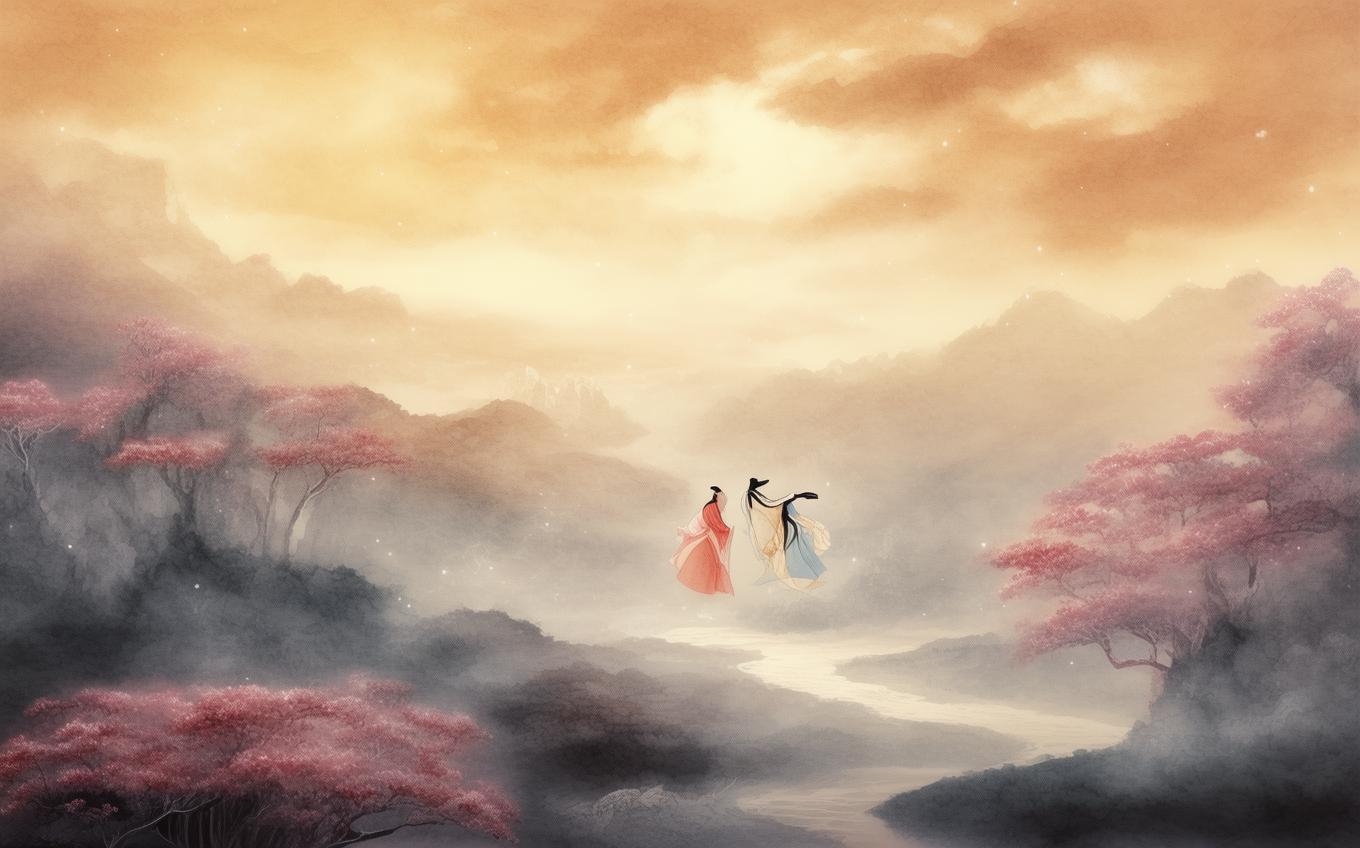
The poem "七夕赋咏成篇" (Qīxī Fù Yǒng Chéng Piān), or "Composed on the Theme of the Seventh Night," is a Tang Dynasty work by the poet 陆敬 (Lù Jìng). The Seventh Night—commonly known in English as the Qixi Festival or Chinese Valentine's Day—falls on the seventh day of the seventh lunar month and commemorates the legendary annual reunion of the Cowherd (牛郎, Niúláng) and the Weaver Girl (织女, Zhīnǚ), two star-crossed lovers separated by the Silver River (the Milky Way) and permitted to meet only once each year across a bridge of magpies.
陆敬 is not among the most famous Tang poets, and relatively little biographical information survives about him. What we do know places him firmly within the Tang poetic tradition, where the Qixi theme was a beloved subject, inspiring countless verses on love, longing, and the bittersweet nature of reunion. This particular poem stands out for its vivid celestial imagery, its sumptuous sensory details, and its poignant meditation on the fleeting nature of joy. It captures both the grandeur of the heavenly court and the deeply human ache of separation, making it a valuable window into how Tang poets transformed myth into lyrical art.
The Poem: Full Text and Translation
夙驾鸣鸾启阊阖,霓裳遥裔俨天津。
sù jià míng luán qǐ chāng hé, ní cháng yáo yì yǎn tiān jīn
At dawn she drives her chariot, phoenix bells ringing, opening the Gates of Heaven; her rainbow robes trail far behind, majestic at the Celestial Ford.
五明霜纨开羽扇,百和香车动画轮。
wǔ míng shuāng wán kāi yǔ shàn, bǎi hé xiāng chē dòng huà lún
With five-brightness frost-white silk, she opens her feathered fan; her hundred-blend perfumed carriage sets its painted wheels in motion.
婉娈夜分能几许,靓妆冶服为谁新。
wǎn luán yè fēn néng jǐ xǔ, jìng zhuāng yě fú wèi shéi xīn
This tender, beautiful night—how long can it last? Her exquisite makeup and alluring attire—for whom are they made new?
片时欢娱自有极,已复长望隔年人。
piàn shí huān yú zì yǒu jí, yǐ fù cháng wàng gé nián rén
This brief moment of joy has its limit; already she returns to longingly gazing toward the one separated by a year.
Line-by-Line Analysis
Line 1: 夙驾鸣鸾启阊阖,霓裳遥裔俨天津
The poem opens with a grand, processional scene. The subject—implicitly the Weaver Girl (织女)—sets out at dawn (夙, sù, meaning early morning) in a chariot adorned with luán bells (鸾铃), small bells shaped like the mythical phoenix-like luán bird. The phrase 阊阖 (chāng hé) refers specifically to the Gates of Heaven, a term with deep roots in Chinese mythology, appearing in texts like the Chuci (楚辞, "Songs of Chu") to describe the entrance to the celestial realm. By invoking this term, the poet immediately transports us to a divine setting.
The second half of the line describes her nícháng (霓裳), or rainbow-colored robes, trailing far behind her (遥裔, yáo yì), creating an image of ethereal majesty as she approaches 天津 (tiān jīn), the Celestial Ford—a poetic name for the Milky Way, the very river that separates her from her beloved. The word 俨 (yǎn), meaning "solemn" or "majestic," lends the scene a sense of ritual gravity. This is not merely a romantic rendezvous; it is a cosmic event, a meeting ordained by heaven itself.
Line 2: 五明霜纨开羽扇,百和香车动画轮
Here the poet lavishes attention on sensory details. 五明 (wǔ míng) refers to the "five brightnesses," a term associated with the radiance of the sun and moon, while 霜纨 (shuāng wán) describes silk so white and fine it resembles frost. Together they evoke a fan of extraordinary luminosity and purity, made of white silk and adorned with feathers (羽扇, yǔ shàn). The opening of this fan is a gesture of elegance and ceremony, perhaps also a symbol of revelation—the Weaver Girl revealing herself in her full beauty.
The second half introduces her carriage: 百和香车 (bǎi hé xiāng chē), a "hundred-blend fragrance carriage," perfumed with a mixture of many aromatic substances. The painted wheels (画轮, huà lún) begin to turn (动, dòng), and the verb here carries a sense of both physical movement and emotional stirring. The cumulative effect of these two lines is one of overwhelming sensory richness—sound (the bells), sight (the rainbow robes, the white fan, the painted wheels), and smell (the perfumed carriage)—all working together to create a scene of almost overwhelming beauty.
Line 3: 婉娈夜分能几许,靓妆冶服为谁新
The tone shifts dramatically in the third line. After the grand procession, the poet poses a rhetorical question: 婉娈夜分能几许 (wǎn luán yè fēn néng jǐ xǔ)—"This tender, beautiful night—how long can it last?" The word 婉娈 (wǎn luán) carries connotations of beauty, tenderness, and youthful charm, while 夜分 (yè fēn) refers to the division of night, the midnight hour. The question is not merely about the length of a single evening but about the nature of time itself when joy is fleeting. The word 能几许 (néng jǐ xǔ), "how much can it be," carries a note of lament, a recognition that even the most beautiful moments are bounded by time.
The second half of the line deepens this melancholy: 靓妆冶服为谁新 (jìng zhuāng yě fú wèi shéi xīn)—"Her exquisite makeup and alluring attire—for whom are they made new?" This is the emotional heart of the poem. The Weaver Girl has adorned herself with the utmost care, yet the question implies a sense of futility. If the meeting is so brief, if the separation so long, what is the purpose of such elaborate preparation? The question is left unanswered, hanging in the air like a sigh. It speaks not only to the myth but to a universal human experience: the effort we put into moments that pass all too quickly.
Line 4: 片时欢娱自有极,已复长望隔年人
The final line brings the poem to its emotional conclusion. 片时欢娱自有极 (piàn shí huān yú zì yǒu jí)—"This brief moment of joy has its limit." The word 片时 (piàn shí) emphasizes the extreme brevity of the reunion, a mere fragment of time. 欢娱 (huān yú) denotes joy and pleasure, but the phrase 自有极 (zì yǒu jí), "naturally has its limit," suggests an inevitability, a law of existence that cannot be overcome. The joy is real, but so is its boundary.
The poem ends with 已复长望隔年人 (yǐ fù cháng wàng gé nián rén)—"already she returns to longingly gazing toward the one separated by a year." The word 已 (yǐ), "already," is devastating in its immediacy. No sooner has the joy begun than it is over, and the long waiting begins anew. 长望 (cháng wàng) suggests a gaze that stretches out across vast distances and vast stretches of time. 隔年人 (gé nián rén), "the person separated by a year," is a poignant way to describe the Cowherd—not merely distant in space but separated by the very structure of time itself. The poem thus ends not with reunion but with the anticipation of the next separation, the next long year of waiting.
Themes and Symbolism
The Fleeting Nature of Joy
The central theme of the poem is encapsulated in the phrase 片时欢娱自有极—"this brief moment of joy has its limit." The Weaver Girl and Cowherd's annual meeting is the ultimate symbol of transient happiness. Their joy is real and intense, but it is bounded by the inexorable passage of time. This theme resonates deeply with Chinese philosophical traditions, particularly Daoist and Buddhist notions of impermanence. The poem suggests that the very brevity of joy is what gives it its poignancy—and its pain.
Love and Separation
At its core, this is a poem about love across distance and time. The Weaver Girl's elaborate preparation—her rainbow robes, her perfumed carriage, her exquisite makeup—all speak to the depth of her love and her longing. Yet the poem also acknowledges the cruelty of a love that can only be fulfilled once a year. The phrase 隔年人, "the person separated by a year," captures the unique tragedy of this myth: the lovers are not merely far apart but separated by the very fabric of time.
The Heavenly and the Human
The poem moves between celestial grandeur and human emotion. The opening lines are filled with divine imagery—the Gates of Heaven, the Celestial Ford, rainbow robes—yet the emotions expressed are deeply human: longing, anticipation, the bittersweet awareness of time's passage. This blending of the cosmic and the personal is characteristic of Tang poetry, which often used mythological subjects to explore universal human experiences.
Key Symbols
- The Celestial Ford (天津): The Milky Way, the cosmic river that separates the lovers. It symbolizes both the vastness of their separation and the cosmic order that enforces it.
- The Rainbow Robes (霓裳): Symbol of divine beauty and the Weaver Girl's celestial nature. The trailing robes suggest both majesty and the passage of time, as they stretch out behind her.
- The Feathered Fan (羽扇): An object of elegance and ceremony, possibly symbolizing the Weaver Girl's role as a celestial being. Its opening might represent the moment of revelation or reunion.
- The Perfumed Carriage (香车): Represents the journey toward love, the effort and preparation involved in bridging the gap between two beings.
- The Painted Wheels (画轮): The turning wheels symbolize the passage of time, the inexorable movement toward both reunion and separation.
Cultural Context
The Qixi Festival and the Weaver Girl Myth
The Qixi Festival (七夕节) has been celebrated in China for over two thousand years, with roots tracing back to the Han Dynasty. The legend tells of 织女 (Zhīnǚ), the Weaver Girl, a celestial being who descended to earth and fell in love with 牛郎 (Niúláng), a mortal cowherd. Their love was so consuming that the Weaver Girl neglected her heavenly duties of weaving the clouds, and the Cowherd neglected his earthly work. The Queen Mother of the West (西王母, Xīwángmǔ) punished them by separating them across the Silver River (the Milky Way), allowing them to meet only once a year, on the seventh day of the seventh month, when magpies form a bridge across the river.
Tang Dynasty Poetic Culture
The Tang Dynasty (618–907 CE) is widely regarded as the golden age of Chinese poetry, and the Qixi theme was particularly popular among Tang poets. The theme allowed poets to explore complex emotions—love, longing, joy, sorrow—within a rich mythological framework. Poems on Qixi were often written for court occasions or social gatherings, where poets would compose verses on set themes (赋咏, fù yǒng, meaning "to compose on a theme"). This poem's title, "七夕赋咏成篇," explicitly marks it as such a composition.
Women and Adornment in Tang Culture
The poem's detailed description of the Weaver Girl's attire and makeup reflects Tang Dynasty aesthetics, which valued elaborate adornment and beauty. The emphasis on her 靓妆冶服 (exquisite makeup and alluring attire) speaks to the cultural importance of feminine beauty and the art of self-presentation. Yet the poem also subverts this emphasis by asking "for whom" such beauty is prepared, suggesting a deeper meditation on the purpose of beauty when the beloved is absent.
Chinese Values and Philosophy
The poem reflects several key Chinese philosophical concepts:
- The acceptance of cosmic order: The lovers' separation is not portrayed as unjust but as a natural part of the cosmic order. The poem does not rage against fate but accepts it with melancholy grace.
- The value of perseverance in love: Despite the brevity of their reunion, the lovers continue to prepare, to hope, to wait. This reflects the Chinese cultural value of constancy and loyalty in love.
- The beauty of restraint: The poem expresses deep emotion through understatement and implication rather than overt passion, reflecting the Chinese aesthetic preference for含蓄 (hánxù), or restrained expression.
Conclusion
陆敬's "七夕赋咏成篇" is a masterful exploration of love, time, and longing, wrapped in the glittering imagery of Tang Dynasty poetry. Through its vivid depiction of the Weaver Girl's celestial procession and its poignant meditation on the brevity of joy, the poem captures the essence of the Qixi myth and transforms it into a universal meditation on the human condition.
What makes this poem endure is its honesty about the nature of happiness. It does not pretend that the annual reunion solves the problem of separation; instead, it acknowledges that joy and sorrow are inextricably intertwined, that every moment of happiness contains within it the seed of its own ending. The Weaver Girl's beautiful robes and exquisite makeup are not merely adornments but acts of hope—a hope that persists even in the face of inevitable separation.
For modern readers, the poem's message remains deeply relevant. We all experience moments of joy that pass too quickly, loved ones separated by distance or circumstance, the bittersweet awareness that time moves inexorably forward. 陆敬's poem reminds us that these experiences are not failures but fundamental aspects of the human condition—and that the very brevity of joy is what makes it precious. The Weaver Girl's long gaze across the Silver River, waiting for a reunion that is always both imminent and impossibly far away, is an image that speaks to anyone who has ever loved someone across a distance.
In its fusion of mythological grandeur and human vulnerability, "七夕赋咏成篇" stands as a testament to the enduring power of Chinese poetry to illuminate the deepest truths of the human heart.
Sources and Verification
- Verified text and attribution: 陆敬, “七夕赋咏成篇” (Tang dynasty).
- Primary dataset: Chinese Poetry open corpus.
- Source record:
3f100fea-4315-4080-8697-036e1daef99b.
The Chinese source text and attribution are supplied from the verified record above. The English translation and commentary are educational explanations.
Comments (0)
No comments yet. Be the first to comment!