Introduction
Yang Shidao (杨师道, ?–647 CE) was a distinguished poet and statesman of the early Tang Dynasty, a period often celebrated as a golden age of Chinese poetry. Born into the imperial Yang family of the preceding Sui Dynasty, he navigated the turbulent transition to Tang rule with remarkable grace, eventually serving as a chancellor under Emperor Taizong. His poetry is characterized by its refined elegance, courtly sensibility, and masterful command of landscape imagery.
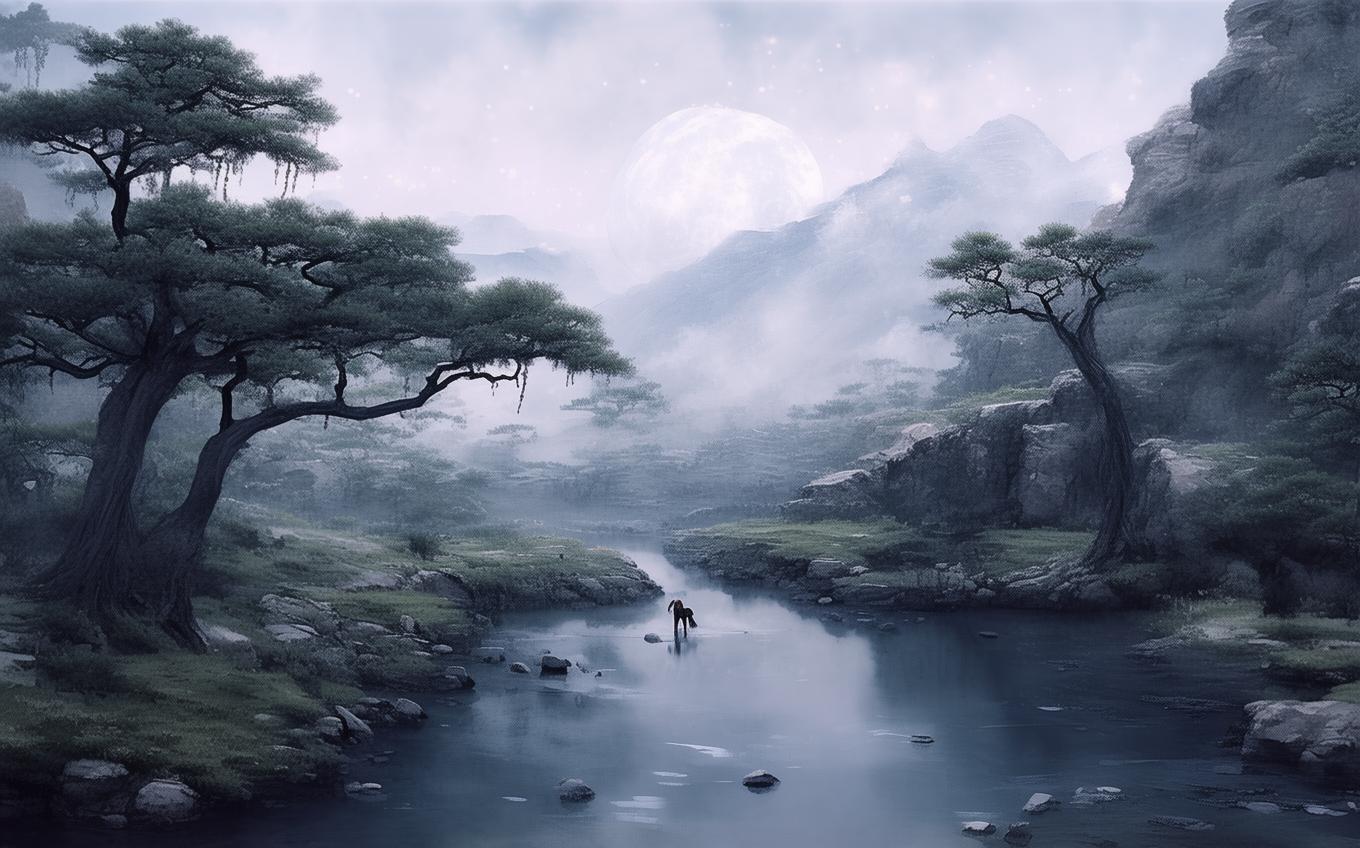
The poem presented here, 咏饮马应诏 (Yǒng Yìn Mǎ Yìng Zhào), translates roughly to "On Watering Horses, Composed by Imperial Command." The phrase "应诏" (yìng zhào) indicates that this poem was written in response to an imperial decree—a common practice among court poets who were expected to compose verses on designated themes during royal gatherings or outings. This particular poem takes as its subject the elegant scene of horses drinking from a clear mountain stream, transforming what could be a mundane moment into a meditation on freedom, beauty, and the contrast between the cultivated life of the court and the harsh realities of frontier existence.
The poem holds significance in Chinese literature as an exemplary piece of "应制诗" (yìng zhì shī)—poetry written at imperial command—demonstrating how skilled poets could elevate occasional verse into genuine art through vivid imagery and subtle philosophical undertones.
The Poem: Full Text and Translation
清晨控龙马,弄影出花林。
Qīngchén kòng lóngmǎ, nòng yǐng chū huā lín.
In the clear morning, guiding the dragon-horse, it plays with shadows emerging from the flowering grove.
躞蹀依春涧,联翩度碧浔。
Xièdié yī chūn jiàn, liánpiān dù bì xún.
With mincing steps it follows the spring torrent; in swift succession it crosses the emerald shallows.
苔流染丝络,水洁写雕簪。
Tái liú rǎn sī luò, shuǐ jié xiě diāo zān.
Flowing moss stains the silken bridle; the pure water reflects the carved hairpin.
一御瑶池驾,讵忆长城阴。
Yī yù Yáochí jià, jù yì Chángchéng yīn.
Once driving the carriage at the Jade Pool, how could one recall the shadow of the Great Wall?
Line-by-Line Analysis
Line 1: 清晨控龙马,弄影出花林
The poem opens with a scene of exquisite refinement. The phrase "龙马" (lóngmǎ, "dragon-horse") is particularly significant—in Chinese tradition, the dragon-horse is a mythical creature that emerged from the Yellow River bearing the patterns that inspired the ancient sages to create the Eight Trigrams. By referring to the horse as a "dragon-horse," Yang Shidao elevates an ordinary steed to something almost supernatural, a creature of legend and imperial majesty. The verb "控" (kòng) means to control or guide with reins, suggesting mastery and command.
The phrase "弄影" (nòng yǐng, "playing with shadows") is deeply evocative. The horse does not merely walk—it plays with its own shadow as it moves through the flowering grove. This personification imbues the scene with a sense of joyful spontaneity. The "花林" (huā lín, "flowering grove") establishes the setting as a cultivated, beautiful space—likely an imperial garden or park where nature has been shaped to human aesthetic preferences.
Line 2: 躞蹀依春涧,联翩度碧浔
Here the poet introduces the central action of the poem: the horse approaching water. "躞蹀" (xièdié) is a wonderfully specific term describing the delicate, mincing gait of a horse—small, precise steps that convey elegance and control. The horse "依" (yī, "leans toward" or "follows alongside") the spring mountain stream, suggesting intimacy with the natural landscape.
"联翩" (liánpiān) describes continuous, unbroken movement—the horse crosses the "碧浔" (bì xún, "emerald shallows") with fluid grace. The color word "碧" (bì) is crucial here; it denotes a blue-green hue that in Chinese poetry often represents clarity, purity, and the ideal of pristine nature. The image is one of perfect harmony between the noble animal and the crystalline water.
Line 3: 苔流染丝络,水洁写雕簪
This couplet introduces a subtle shift from pure description to more complex imagery. "苔流" (tái liú, "flowing moss") suggests the movement of water plants in the current—the green moss sways and flows with the stream. The verb "染" (rǎn, "to dye" or "to stain") is particularly striking: the moss colors the "丝络" (sī luò, "silken bridle") as the horse drinks. There is a sense of nature imprinting itself upon the trappings of civilization, however temporarily.
The second half of the couplet presents a beautiful mirror image: "水洁写雕簪" (shuǐ jié xiě diāo zān). The character "写" (xiě) here means "to depict" or "to reflect"—the clear water "writes" or "paints" the image of the carved hairpin. The "雕簪" (diāo zān, "carved hairpin") refers to an ornamental hairpin worn by the rider, likely a member of the imperial court. This line creates a reciprocal relationship: the moss stains the bridle from below, while the water reflects the rider's ornament from above. The natural world and human artistry interpenetrate one another.
Line 4: 一御瑶池驾,讵忆长城阴
The final couplet introduces a dramatic shift in perspective and tone. "瑶池" (Yáochí, "Jade Pool") is a powerful cultural reference—it is the legendary dwelling place of Xi Wangmu (西王母), the Queen Mother of the West, a Daoist immortal goddess. The Jade Pool represents paradise, immortality, and transcendent beauty. To "drive the carriage at the Jade Pool" (御瑶池驾) is to experience the highest form of joy and freedom imaginable.
The rhetorical question "讵忆" (jù yì, "how could one recall") introduces the contrasting image: "长城阴" (Chángchéng yīn, "the shadow of the Great Wall"). The Great Wall, in Tang Dynasty poetry, often symbolizes the harsh frontier—the cold, dangerous borderlands where soldiers were stationed far from home, facing the threat of nomadic invasions. The "shadow" (阴, yīn) carries connotations of darkness, cold, and melancholy.
The question is profound: once one has experienced the transcendent beauty of the Jade Pool, how could the memory of the Great Wall's shadow even enter the mind? This line can be read on multiple levels—as a celebration of the present moment's beauty, as a subtle political statement about the peace and prosperity of the Tang Dynasty making frontier concerns seem distant, or even as a gentle reminder that such bliss might cause one to forget important duties.
Themes and Symbolism
The Harmony of Nature and Civilization
The poem's central theme is the harmonious coexistence of the natural world and human refinement. The dragon-horse, a symbol of imperial power and mythical grandeur, moves gracefully through a natural landscape. The moss stains the silken bridle; the water reflects the carved hairpin. There is no conflict between nature and civilization here—instead, they enhance one another in a vision of perfect aesthetic unity.
Transcendence and Forgetfulness
The final couplet introduces the theme of transcendence—the ability of beauty and joy to transport one beyond ordinary concerns. The reference to the Jade Pool invokes Daoist immortality and paradise, suggesting that the scene described is not merely pleasant but approaching the divine. The forgetting of the Great Wall's shadow represents a liberation from anxiety, duty, and the darker aspects of existence.
The Dragon-Horse Symbol
The "龙马" (dragon-horse) is a rich symbol in Chinese culture. Beyond its mythical origins, it represents the ideal union of strength and grace, the earthly and the celestial. In the context of an imperial poem, it also serves as a flattering symbol of the emperor's power and the vitality of his reign. The dragon-horse is no ordinary animal—it is a creature worthy of the Jade Pool itself.
Water as Mirror and Medium
Water plays a dual role in this poem. It is both a physical substance that sustains the horse and a reflective surface that captures and transforms images. The "emerald shallows" suggest purity and clarity, while the water's ability to "write" the hairpin's reflection suggests that nature itself engages in artistic creation. Water becomes a medium of exchange between the human and natural worlds.
Cultural Context
The Tradition of Imperial Command Poetry
"应诏" (yìng zhào) poetry was a significant genre in the Chinese court tradition. Emperors would often compose poems and command their ministers to write matching verses, or assign topics for poetic composition during banquets, outings, and ceremonies. These poems served multiple functions: they demonstrated the literary cultivation of the court, reinforced social bonds between ruler and subject, and celebrated the peace and prosperity of the reign.
Writing such poetry required considerable skill. The poet had to produce something beautiful and appropriate while avoiding excessive flattery that might seem insincere. Yang Shidao's poem succeeds by focusing on the aesthetic experience of the moment rather than direct praise of the emperor, allowing the beauty of the scene itself to serve as implicit tribute to the ruler who made such refined pleasures possible.
The Jade Pool and Daoist Immortality
The reference to 瑶池 (Yáochí) connects this poem to a rich tradition of Daoist mythology. Xi Wangmu, the Queen Mother of the West, was said to dwell in the Kunlun Mountains, where the Jade Pool was located. The legendary King Mu of Zhou was said to have visited her there, and the meeting became a powerful symbol of the encounter between mortal rulers and immortal beings. By invoking this image, Yang Shidao elevates the imperial outing to mythic proportions, suggesting that the Tang emperor's court rivals the paradise of the immortals.
The Great Wall in Tang Poetry
The Great Wall (长城) appears frequently in Tang Dynasty poetry as a symbol of the frontier and its hardships. While we often think of the Great Wall as a symbol of Chinese strength and unity today, in Tang poetry it more often evoked the loneliness of soldiers stationed far from home, the cold of northern winters, and the constant threat of conflict. The "shadow" of the Great Wall suggests the dark underside of imperial power—the human cost of maintaining borders and security.
Conclusion
Yang Shidao's "咏饮马应诏" is a masterful example of how court poetry could transcend its occasional origins to achieve genuine artistic beauty. Through vivid imagery and carefully chosen cultural references, the poet transforms a simple scene of horses drinking from a stream into a meditation on beauty, transcendence, and the relationship between civilization and nature.
The poem's enduring appeal lies in its ability to capture a moment of perfect aesthetic harmony—the clear morning light, the flowering grove, the graceful horse, the crystalline water. In our own age of constant connectivity and anxiety, the poem offers a vision of what it means to be fully present in a moment of beauty, to allow oneself to be transported beyond ordinary concerns. The final question—"how could one recall the shadow of the Great Wall?"—resonates across the centuries, reminding us that moments of transcendent beauty can, however briefly, liberate us from the shadows that haunt our lives.
For English-speaking readers, this poem offers a window into the refined aesthetic sensibility of Tang Dynasty court culture, where poetry served as both entertainment and spiritual practice, and where the boundary between the natural world and human artistry was seen not as a division but as a meeting place of mutual enhancement.
Sources and Verification
- Verified text and attribution: 杨师道, “咏饮马应诏” (Tang dynasty).
- Primary dataset: Chinese Poetry open corpus.
- Source record:
a017cffc-4dbe-49b6-a6c4-bfaf65b91195.
The Chinese source text and attribution are supplied from the verified record above. The English translation and commentary are educational explanations.
Comments (0)
No comments yet. Be the first to comment!