Introduction
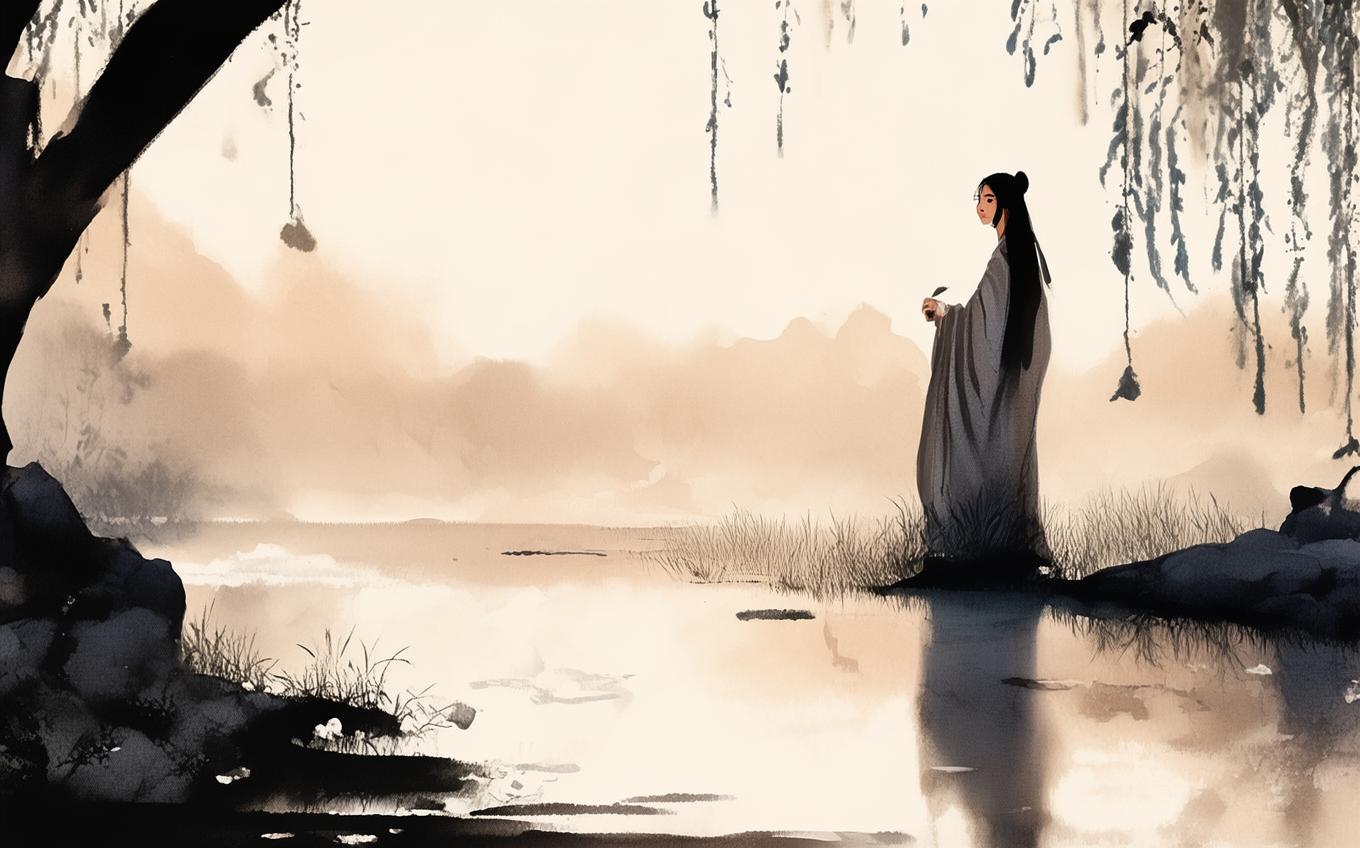
Among the many gems of Tang Dynasty poetry, Zhu Qingyu’s “近试上张籍水部” (On the Eve of the Examination, Presented to Vice Minister Zhang Ji) stands out for its delicate indirection and psychological insight. On the surface, it paints an intimate scene of a nervous bride preparing to meet her in‑laws for the first time. Beneath that surface, however, hides a candidate’s anxious plea for a senior official’s judgment of his literary talent on the eve of the imperial examinations. This single quatrain, often also titled “闺意献张水部” (A Bride’s Thoughts, Offered to Secretary Zhang), encapsulates the subtle art of Tang poetic communication and remains one of the most beloved examples of metaphor in classical Chinese literature.
Zhu Qingyu (朱庆馀) was active during the early ninth century, a period when success in the civil service examinations was the key to social standing and an official career. The poem was sent to Zhang Ji (张籍), a poet of considerable influence who, as Vice Minister of the Ministry of Water Control (水部), could lend crucial support to an aspiring candidate. By couching his request in the language of a newlywed’s private trepidation, Zhu transformed a potentially awkward supplication into a masterpiece of tact and emotional resonance.
The Poem: Full Text and Translation
洞房昨夜停红烛,
Dòng fáng zuó yè tíng hóng zhú,
Last night in the bridal chamber the red candles rested, glowing bright;
待晓堂前拜舅姑。
Dài xiǎo táng qián bài jiù gū.
Waiting for dawn to pay respects before the hall to my new parents‑in‑law.
妆罢低声问夫婿,
Zhuāng bà dī shēng wèn fū xù,
After finishing my makeup I softly ask my husband,
画眉深浅入时无。
Huà méi shēn qiǎn rù shí wú?
“Are the shade and depth of my painted eyebrows in fashion — or not?”
Line‑by‑Line Analysis
Line 1: 洞房昨夜停红烛
The opening transports us into the nuptial chamber after the wedding night. “洞房” (bridal chamber) immediately establishes a private, heightened atmosphere. “昨夜” (last night) anchors the scene in recent memory, while “停红烛” — literally “the red candles were stopped / rested” — suggests that they have been burning through the night and are now still, their flame perhaps extinguished or gently flickering. Red candles are a symbol of joy, festivity, and the consummation of marriage. The verb “停” implies a pause in the celebrations, a hushed, expectant waiting. The line thus captures both the intimacy of the marital space and the suspended tension before a public, ceremonial test: the morning audience with the husband’s parents.
Line 2: 待晓堂前拜舅姑
With the coming of dawn (“待晓”), the bride must perform the ritual act of “拜舅姑” — paying respects to her husband’s parents (“舅” the father‑in‑law, “姑” the mother‑in‑law). In traditional Chinese society, this morning greeting was the crucial moment when a new daughter‑in‑law was formally accepted into the family. Her conduct, appearance, and poise would be scrutinized, cementing her status or inviting disapproval. The line is filled with quiet apprehension: the word “待” (waiting) stretches the moment, intensifying the bride’s anxiety. On the allegorical level, the “dawn” is the examination day, and the “parents‑in‑law” are the examiners whose approval the candidate desperately needs.
Line 3: 妆罢低声问夫婿
After carefully completing her makeup (“妆罢”), the bride turns to her husband with a whispered question. “低声” (in a low voice) is marvellously expressive: it conveys both modesty and the intimacy of a confidence shared only between the newlyweds. The husband, unlike the severe in‑laws, is an ally, yet his opinion matters enormously as a gauge of the world outside. For Zhu Qingyu, the “husband” is Zhang Ji — the trusted, established figure who can judge whether his poetic style (“makeup”) is “fashionable” enough for the taste of the examination authorities.
Line 4: 画眉深浅入时无
The question itself is a small tour de force of nuance. “画眉” (painted eyebrows) were a central feature of a woman’s courtly appearance in Tang times, with fashions in eyebrow shape and shading changing often. Asking “深浅入时无?” — “Are the shade and depth in fashion or not?” — is to inquire about the tiniest particulars of taste, the very thing that could mean the difference between refinement and awkwardness. In the poetic conceit, the “eyebrows” stand for Zhu Qingyu’s writing: its style, its degree of elegance, its conformity to the expectations of the current literary establishment. The final “无” (a question particle, equivalent to “or not?”) leaves the answer hanging, full of hopeful uncertainty.
Themes and Symbolism
Anxiety Before a Crucial Test
At its heart, the poem is about the universal human experience of seeking approval and fearing rejection. Whether it is a bride before her in‑laws or a scholar before the examination board, the emotional core is the same: meticulous preparation combined with an acute dread that one’s best effort may not be “in fashion.” By framing this anxiety through a domestic, feminine persona, Zhu makes the feeling both delicate and deeply relatable.
The Metaphor of Marriage and Feminine Adornment
The poem belongs to a long tradition of using the neglected or anxious woman to voice a political or social concern, but here the gender reversal works with remarkable precision. The bride’s makeup becomes the poet’s artfully crafted verses; her whispered question to her husband is the poet’s humble request for feedback. Everything is indirect, yet everything is clear to the intended reader. The feminine persona allows the poet to express vulnerability without losing dignity — an important consideration in the hierarchical world of Tang literati.
Fashion and Conformity
“入时” (entering the current fashion) is the key symbolic phrase. Fashion is arbitrary, transient, dictated by powerful taste‑makers — not unlike the changing criteria of examiners or literary patrons. The poem gently critiques, or at least acknowledges, the importance of external perception in determining inner worth. The bride’s (and candidate’s) fate hangs on a judgment that is partly subjective, partly cultural, and wholly outside their control.
Cultural Context
Zhu Qingyu’s poem cannot be fully appreciated without understanding the practice of “行卷” (juǎn), the pre‑examination submission of one’s writings to influential figures. In Tang China, even a brilliant candidate might go unnoticed without the endorsement of a respected scholar‑official. Aspiring poets would therefore send samples of their work to such patrons, often accompanied by a poem requesting guidance. This was not seen as crass lobbying but as part of a cultivated literary exchange.
Zhang Ji was an ideal recipient: a poet of high standing and a man known for nurturing young talent. His own works often celebrated the quiet virtues of ordinary life, and he responded to Zhu Qingyu with a poem that played along with the extended metaphor, praising Zhu’s “菱歌” (lotus‑picker’s song) as worth ten thousand pieces of gold — a clear signal of approval. The exchange encapsulates the Tang ideal of wen (文, literary refinement) as the medium of social intercourse, where even self‑promotion had to be conducted with elegance and mutual respect.
The poem also reflects deeper Confucian values: respect for hierarchy (the in‑laws, the examiners), the importance of li (ritual propriety), and the conviction that inner virtue must be matched by appropriate outer form. The bride’s anxiety is not vanity but a sincere desire to fulfill her role correctly — a sentiment that aligned perfectly with the scholar’s desire to serve the state through the correct channels.
Conclusion
More than twelve centuries after it was written, “近试上张籍水部” continues to charm readers with its vivid little scene and its deft double meaning. Zhu Qingyu turned a moment of personal vulnerability into a timeless exploration of ambition, performance, and the human longing for a nod of acceptance. The whispered question, “画眉深浅入时无?”, still hangs in the air, reminding us that every act of public self‑presentation — whether a painted eyebrow or a polished poem — contains a secret hope that someone will answer, “Yes, just right.”
For English‑speaking lovers of Chinese culture, the poem offers a window into the elegant indirection of Tang society, where even a job application could become a work of art. It is a testament to the power of metaphor to bridge the distance between poet and reader, past and present, one soft‑voiced question at a time.

Comments (0)
No comments yet. Be the first to comment!