Introduction
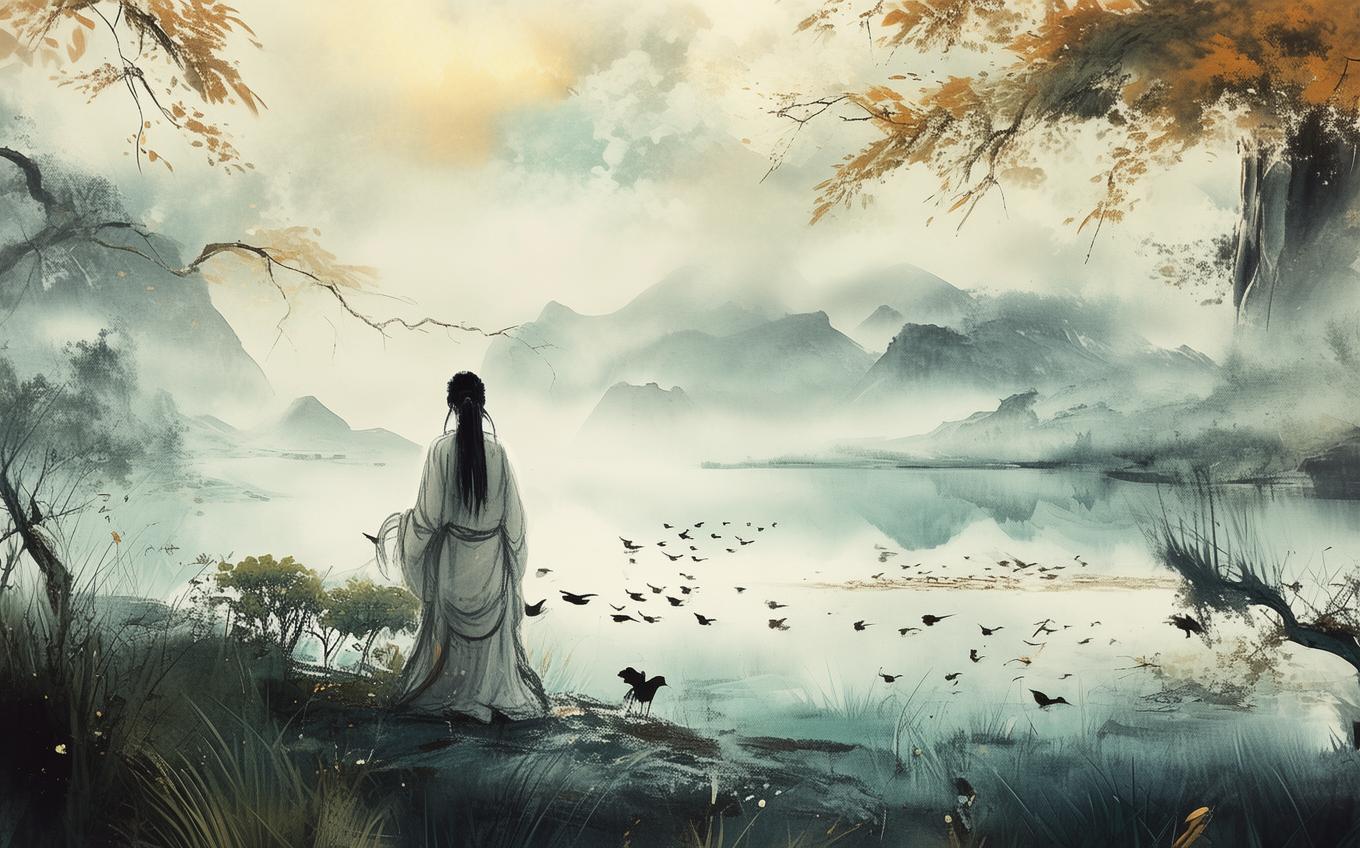
Composed by Yuan Haowen (元好问, 1190–1257), a towering literary figure of the Jin dynasty, "摸鱼儿·雁丘词" (Touching Fish · Wild Goose Mound Poem) is one of the most celebrated love lyrics in classical Chinese literature. Inspired by a true encounter with a devoted wild goose, Yuan Haowen transforms a hunter’s tale into a profound meditation on the nature of love, life, and the eternal union of souls. The poem belongs to the ci genre—a lyrical form set to a specific tune—and uses the melody name "摸鱼儿" (Touching Fish). Originally written in his youth and later revised with proper musical prosody, this work remains a timeless testament to the belief that true love transcends even death.
The Poem: Full Text and Translation
乙丑岁赴试并州,道逢捕雁者云:
Yǐ chǒu suì fù shì Bīngzhōu, dào féng bǔ yàn zhě yún:
In the yichou year, on my way to take the exam in Bingzhou, I met a goose catcher who said:
“今旦获一雁,杀之矣。其脱网者悲鸣不能去,竟自投于地而死。”
“Jīn dàn huò yī yàn, shā zhī yǐ. Qí tuō wǎng zhě bēi míng bù néng qù, jìng zì tóu yú dì ér sǐ.”
“This morning I caught one goose and killed it. The goose that broke free from the net cried out in grief and would not leave; in the end, it threw itself to the ground and died.”
予因买得之,葬之汾水之上,垒石为识,号曰“雁丘”。
Yǔ yīn mǎi dé zhī, zàng zhī Fén shuǐ zhī shàng, lěi shí wéi zhì, hào yuē “Yàn Qiū”.
I therefore bought the pair of geese and buried them together on the bank of the Fen River, piling up stones as a marker, and named it “Wild Goose Mound.”
同行者多为赋诗,予亦有《雁丘词》。旧所作无宫商,今改定之。
Tóng xíng zhě duō wèi fù shī, yǔ yì yǒu “Yàn Qiū cí”. Jiù suǒ zuò wú gōng shāng, jīn gǎi dìng zhī.
Many of my fellow travelers composed poems about this; I also wrote a “Wild Goose Mound Lyric.” The earlier draft lacked proper musical tones; now I have revised and finalized it.
问世间、情是何物,直教生死相许?
Wèn shì jiān, qíng shì hé wù, zhí jiào shēng sǐ xiāng xǔ?
I ask the world: what is love, that it compels life and death to pledge themselves to each other?
天南地北双飞客,老翅几回寒暑。
Tiān nán dì běi shuāng fēi kè, lǎo chì jǐ huí hán shǔ.
Travelers flying together from south sky to northern earth, their aging wings have weathered so many cold seasons and summer heats.
欢乐趣,离别苦,就中更有痴儿女。
Huān lè qù, lí bié kǔ, jiù zhōng gèng yǒu chī ér nǚ.
The joy of union, the pain of parting—among all these, there are the most infatuated lovers.
君应有语:
Jūn yīng yǒu yǔ:
You must have words to speak:
渺万里层云,千山暮雪,只影向谁去?
Miǎo wàn lǐ céng yún, qiān shān mù xuě, zhǐ yǐng xiàng shéi qù?
Far away, through ten thousand miles of layered clouds, over a thousand mountains in evening snow, a solitary shadow – to whom can it fly?
横汾路,寂寞当年箫鼓,荒烟依旧平楚。
Héng Fén lù, jì mò dāng nián xiāo gǔ, huāng yān yī jiù píng chǔ.
The road across the Fen River: lonely now are the flutes and drums of bygone days; the desolate mist still blankets the distant low trees.
招魂楚些何嗟及,山鬼暗啼风雨。
Zhāo hún Chǔ suò hé jiē jí, shān guǐ àn tí fēng yǔ.
To summon their souls with Chu-sighs – what good would it do? Mountain spirits weep unseen in the wind and rain.
天也妒,未信与,莺儿燕子俱黄土。
Tiān yě dù, wèi xìn yǔ, yīng ér yàn zi jù huáng tǔ.
Heaven itself must be jealous; I can scarcely believe they should share the yellow earth with orioles and swallows.
千秋万古,为留待骚人,狂歌痛饮,来访雁丘处。
Qiān qiū wàn gǔ, wèi liú dài sāo rén, kuáng gē tòng yǐn, lái fǎng Yàn Qiū chù.
For a thousand autumns and ten thousand ages, it is preserved for poets who, with wild songs and deep drinking, will come to visit the place of the Wild Goose Mound.
Line-by-Line Analysis
The poem opens with a prose preface that acts as both a documentary note and an emotional trigger. Yuan Haowen recounts the exact year and place—the yichou year (likely 1205) on his way to the civil service examination—and the hunter’s matter-of-fact report: one goose was killed, and the freed mate, unable to bear the separation, committed a self-destroying plunge. The poet immediately sees beyond the incident; he buys the two bodies, buries them together, and marks the spot with stones, naming it Yan Qiu (“Wild Goose Mound”). The final line of the preface reveals that this is a revised version, now set to proper musical tones, signaling the poet’s lifelong care for the poem’s form.
The lyric proper begins with the speaker’s cosmic question:
“Wèn shì jiān, qíng shì hé wù, zhí jiào shēng sǐ xiāng xǔ?”
This single line has become one of the most quoted expressions about love in Chinese culture. The question is directed at the entire world: “What is love?” The answer is not defined but demonstrated—it is something so powerful that it makes one commit to another even beyond life and death. The phrase “生死相许” (pledge life and death to each other) elevates the geese’s bond from instinct to a conscious, almost religious devotion.
The second line enters the perspective of the geese’s shared life. “天南地北双飞客” paints them as wanderers traversing vast distances; they are travelers (kè, “guests”) in the world, always migrating. The “老翅” (aging wings) suggest years of togetherness, enduring the cycle of cold and heat—a subtle metaphor for the trials of a long-term relationship. The juxtaposition of “欢乐趣” (joy of togetherness) and “离别苦” (pain of parting) summarizes the entire emotional spectrum of love, and “就中更有痴儿女” singles out the “infatuated ones” (chī ér nǚ)—those who love so deeply they appear foolish to the world.
The poet then imagines the surviving goose speaking before its suicide: “君应有语”—“you must have had something to say.” The following words are the poet’s empathic reconstruction. “渺万里层云,千山暮雪,只影向谁去?” These lines are a breathtaking expansion of loneliness. The vastness of layered clouds over ten thousand miles and the chill of evening snow over a thousand mountains form an utterly indifferent universe. The “solitary shadow” (只影) has lost its companion, and no destination remains meaningful. This is the emotional climax of the first stanza.
The second stanza shifts from the personal tragedy to a historical and cosmic plane. “横汾路” refers to the Road across the Fen River, a site associated with Emperor Wu of Han, who once held spectacular banquets here. Now, all that remains is “寂寞当年箫鼓”—the silence of those glorious flutes and drums, replaced by desolate mist over the lowlands. The poet intones that summoning the geese’s souls with ancient Chu elegies is futile (“招魂楚些何嗟及”), and even mountain spirits weep unheard in the storm (“山鬼暗啼风雨”)—alluding to Qu Yuan’s Nine Songs, where the Mountain Spirit waits in vain. This layering of cultural memory elevates the geese’s love to mythic proportions.
The next line, “天也妒” (Heaven itself is jealous), is audacious: the intensity of this love provokes cosmic envy. The poet refuses to accept that these devoted geese should share the same fate as ordinary birds—“莺儿燕子俱黄土” (orioles and swallows all turn to yellow earth). The final couplet, “千秋万古,为留待骚人,狂歌痛饮,来访雁丘处,” transforms the mound into an eternal monument. The Wild Goose Mound will last through the ages, preserved not for kings but for sao ren (poets driven by passion), who will come, sing wildly, drink heartily, and commemorate love’s ultimate sacrifice.
Themes and Symbolism
The central theme is the transcendent nature of love. The poem poses the question “What is love?” and answers through narrative and imagery: love is a force that binds two beings so completely that one cannot live without the other. This is not merely romantic love; it is a life-commitment that defies rationality and even death.
Symbolism:
- Wild Geese: In Chinese tradition, geese are emblems of fidelity and lifelong partnership because they are believed to mate for life. Here they represent the ideal of unwavering devotion.
- Aging wings / Cold and heat: The hardships of time and migration symbolize the endurance required in love, the shared passage through life’s seasons.
- Layered clouds, thousand mountains, evening snow: The immense, indifferent landscape against the lone shadow underscores the desolation of the survivor and the absoluteness of loss.
- Chu-sighs, Mountain Spirit, soul-summoning: References to the ancient Chu Ci (Songs of Chu) imbue the poem with shamanistic sorrow, connecting personal grief to a long poetic tradition of longing and unrequited yearning.
- Yellow earth: A common metonym for death and mortality, but here it is contrasted with the eternal monument—the geese’s love exempts them from ordinary oblivion.
- Wild Goose Mound: A physical and poetic marker that transforms transient tragedy into a pilgrimage site for sentimental poets, symbolizing art’s power to immortalize love.
Cultural Context
Yuan Haowen lived during the decline of the Jurchen Jin dynasty and later under Mongol rule. He is often regarded as the foremost literary figure of his age, a multifaceted scholar who compiled the Zhongzhou Ji (Anthology of the Central Plains) and wrote powerful poems reflecting historical turmoil. "摸鱼儿·雁丘词" stands apart from his political works, showcasing his sensitivity to the micro-dramas of the natural world and human emotion.
The poem draws heavily on the ci tradition’s capacity for intimate lyricism and on the broader Chinese aesthetic of ganwu (感物, “being moved by things”). The poet encounters an external event and allows it to stir profound inner reflection. The reference to Emperor Wu’s vanished glory (the flutes and drums at Fen River) also echoes a classic theme: the impermanence of worldly power versus the endurance of true feeling. In this way, the poem bridges the personal and the historical, suggesting that a pair of wild geese can inspire more lasting reverence than an emperor’s banquet.
Confucian values would have emphasized the human realm, but Daoist and Buddhist influences allow for a more fluid boundary between beings. The geese’s act of self-sacrifice resonates with the idea that all sentient creatures are capable of deep, binding emotion (qing), a concept much debated in later Chinese philosophy. Yuan Haowen’s poem thus contributes to the long conversation about whether qing is a virtue that elevates or a passion that blinds—and ultimately celebrates it as the very thing that makes existence meaningful.
Conclusion
"摸鱼儿·雁丘词" endures because it reveals a truth as old as poetry itself: love, when absolute, refuses the finality of death. Yuan Haowen turned a casual roadside story into a lyrical monument that has been chanted, quoted, and loved for centuries. The Wild Goose Mound remains a symbol—less a physical place than a poetic promise that true feeling will always find its witnesses, its “wild singers,” generation after generation. In a world that often urges us to be practical and detached, this poem invites us to be among the chī ér nǚ, those foolish children of love who understand that some bonds are worth more than life itself.
Comments (0)
No comments yet. Be the first to comment!