Introduction
Emperor Taizong of Tang (唐太宗, personal name Li Shimin 李世民, r. 626–649 CE) is revered as one of the greatest rulers in Chinese history. A brilliant military strategist and a wise administrator, he transformed the Tang dynasty into a cosmopolitan empire of unprecedented wealth and cultural splendor. Yet beyond his political achievements, Taizong was also a poet and calligrapher who left behind a modest body of literary works. His poem “正日臨朝” (Zhèngrì Líncháo – “Holding Court on New Year’s Day”) captures the grandeur of an imperial audience on the first day of the lunar year, blending spectacle with introspection. For English readers interested in Chinese culture, this poem offers a rare glimpse into the mind of an emperor who, even at the height of his power, mused on virtue, unity, and the weight of his office.
The Poem: Full Text and Translation
條風開獻節,
Tiáo fēng kāi xiàn jié,
The gentle east wind opens the season of offerings,
灰律動初陽。
Huī lǜ dòng chū yáng.
The ash-measured pitch‑pipes stir with the newborn sun.
百蠻奉遐贐,
Bǎi mán fèng xiá jìn,
The hundred barbarians present tributes from afar,
萬國朝未央。
Wàn guó cháo wèiyāng.
Ten thousand states pay homage at the Weiyang Palace.
雖無舜禹迹,
Suī wú Shùn Yǔ jì,
Though I lack the achievements of Shun and Yu,
幸欣天地康。
Xìng xīn tiāndì kāng.
I am fortunate and rejoicing that heaven and earth are at peace.
車軌同八表,
Chē guǐ tóng bā biǎo,
Carriage tracks are standardized to the eight extremities,
書文混四方。
Shū wén hùn sìfāng.
Writing and script are unified across the four quarters.
赫奕儼冠蓋,
Hè yì yǎn guān gài,
Majestic and solemn rise the hats and canopies,
紛綸盛服章。
Fēn lún shèng fú zhāng.
Dazzling and multicolored are the ceremonial robes and insignia.
羽旄飛馳道,
Yǔ máo fēi chí dào,
Feathered banners fly over the imperial avenue,
鐘鼓震巖廊。
Zhōng gǔ zhèn yán láng.
Bells and drums shake the palace corridors.
組練輝霞色,
Zǔ liàn huī xiá sè,
Silk ribbons and fine cloth gleam like rosy clouds,
霜戟耀朝光。
Shuāng jǐ yào cháo guāng.
Frosty halberds sparkle in the morning light.
晨宵懷至理,
Chén xiāo huái zhì lǐ,
At dawn and dusk I cherish the highest principles,
終愧撫遐荒。
Zhōng kuì fǔ xiá huāng.
In the end I am ashamed to govern the distant wilds.
Line‑by‑Line Analysis
Opening couplet: “條風開獻節,灰律動初陽。”
The poem begins with a subtle seasonal marker. The “條風” (tiáo fēng, literally “shoot‑wind”) is the east wind that arrives in early spring, signaling the start of the sacrificial cycle. The second line weaves in an ancient scientific practice: to keep the calendar in tune with nature, court astronomers burned fine ash inside bamboo pipes of varying lengths. When the qi of a particular period arrived, the ash would fly out of the corresponding pipe. Here the “灰律” (ash‑pipes) stir exactly as the first solar warmth returns, anchoring the magnificent ceremony in cosmic order. Right from the start, the emperor presents the New Year audience not as a political convenience but as an event synchronized with the rhythm of Heaven and Earth.
Diplomatic panorama: “百蠻奉遐贐,萬國朝未央。”
The gaze widens to embrace the entire known world. “百蠻” (“hundred barbarians”) is a classic Chinese term for non‑Han peoples, devoid here of contempt—it simply lists the many envoys arriving with treasures from distant lands. “未央” refers to the Weiyang Palace of the Han dynasty, a name that had become a poetic metonym for the imperial court of any age. The image of ten thousand states gathering at that symbolic palace emphasizes the Tang empire’s unparalleled reach. The couplet celebrates a moment of cultural and political centrality: the throne is the pivot around which the world turns.
The ruler’s modesty: “雖無舜禹迹,幸欣天地康。”
Suddenly the tone shifts inward. Emperor Taizong alludes to the legendary sage‑kings Shun (舜) and Yu (禹), paragons of virtue whose reigns were said to have been so perfect that the natural world responded with harmony. With a sense of genuine humility, the emperor confesses he cannot match their mythical deeds. Instead, he finds his joy in a tangible blessing: the peace of heaven and earth. This is a classic Confucian gesture—the ideal ruler deflects praise to cosmic forces and acknowledges his own shortcomings, thereby modeling the virtue of self‑restraint.
The imperial order: “車軌同八表,書文混四方。”
Two of the most concrete symbols of a unified empire are standardized cart axles and a uniform script. Echoing the great Qin dynasty’s unification policies centuries earlier, Taizong now boasts that even the “eight extremities” (the farthest horizons) run on the same axle width, and that characters are written the same way “across the four quarters.” The couplet moves from ritual display to administrative reality: the spectacle outside the hall is backed by a state that can truly connect and integrate its vast territories.
Ceremonial splendor: “赫奕儼冠蓋,紛綸盛服章。羽旄飛馳道,鐘鼓震巖廊。”
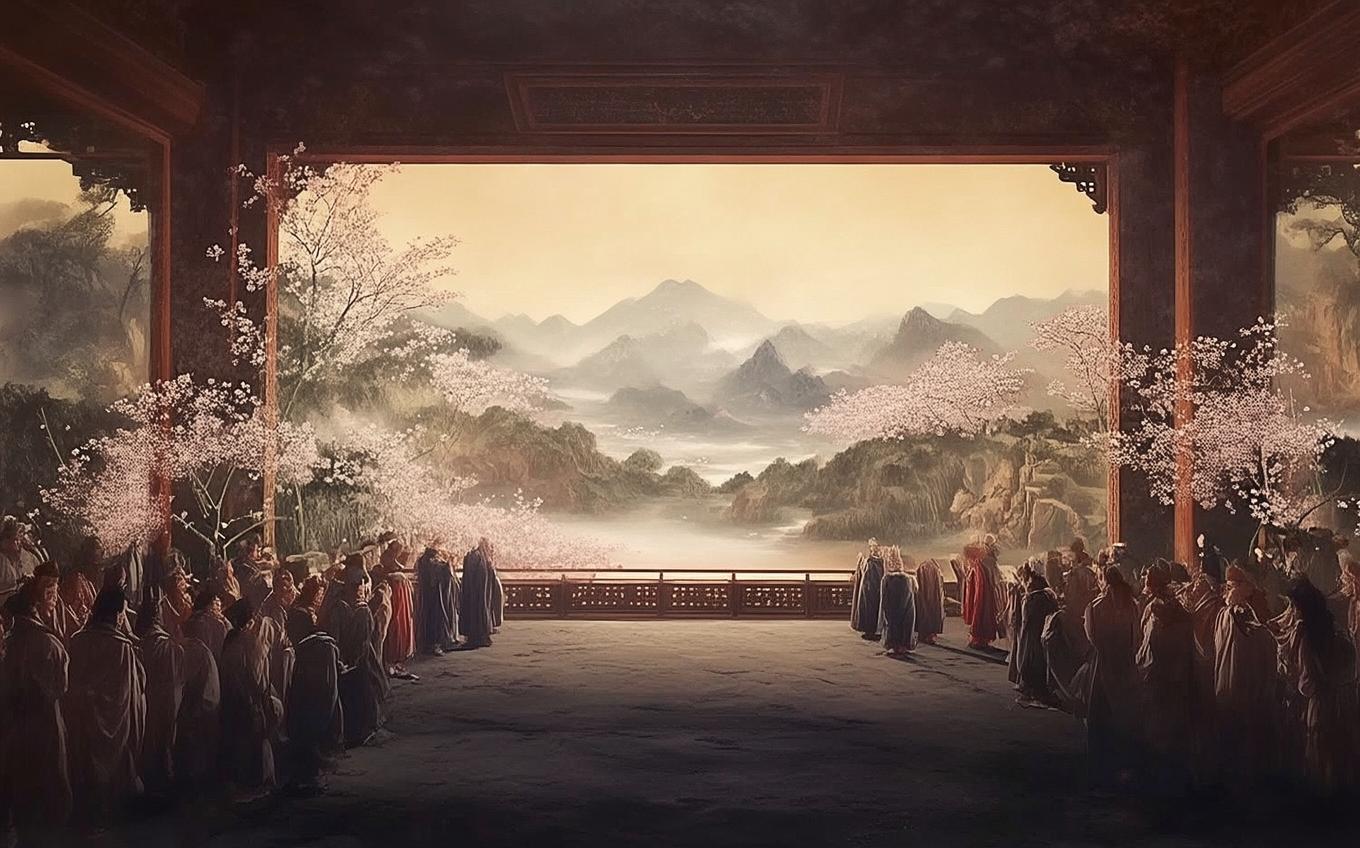
Four lines flood the scene with sensory details. “冠蓋” (headdresses and carriage canopies) conjure the forest of officials lined up in strict protocol; “盛服章” (splendid robes and rank‑badges) is a blaze of embroidered dragons, clouds, and symbols of office. Motion enters with fluttering feathered banners hung with yak‑tail tassels (“羽旄”) and the thunderous percussion of bronze bells and great drums echoing off the rock‑hewn galleries of the palace. Every sight and sound reinforces the majesty of the Tang house.
Light and metal: “組練輝霞色,霜戟耀朝光。”
The focus tightens on fabric and weaponry. The silk worn by courtiers—woven into intricate patterns or worn as ceremonial sashes—gleams with a rosy luster that rivals dawn clouds. At the same time, rows of “frosty halberds” (halberds whose blades flash white like ice) catch the low morning sun. The interplay of soft textile radiance and hard metallic brilliance creates a visual paradox that mirrors the ideal of the emperor as both civil (文) and martial (武).
Final self‑reflection: “晨宵懷至理,終愧撫遐荒。”
The poem closes on a note of personal meditation far removed from the earlier pomp. Taizong claims that from morning to night he cherishes the “highest principles” (至理)—the deep Daoist and Confucian wisdom of how to rule in harmony with nature and human hearts. Yet the final line admits a lingering shame: governing the remote wildernesses is a burden he feels unworthy to carry. Here the “遐荒” (distant wilds) can be read literally—the frontier zones still not fully assimilated—and symbolically, as the inner wilderness of any human soul that resists order. The emperor’s humility, at least in the poem, is the crown’s truest ornament.
Themes and Symbolism
Cosmic harmony and the sage‑ruler.
The poem opens with nature’s signals (the east wind, the ash‑pipes), placing the imperial ceremony inside a universal calendar. The ruler acts as the mediator who aligns human institutions with the Dao (the Way). When the court gathers precisely as spring begins, it ritually ensures that the state, like the seasons, will renew itself.
Unity and civilization.
Standardized axle widths and a shared script are not neutral technical details; they signify the transformative power of a centralized state. For an eighth‑century reader, these images evoked the memory of China’s first unifier, Qin Shi Huang, while also testifying that the Tang had succeeded in creating a cultural sphere that stretched from the steppes to the sea.
Power and humility.
Taizong repeatedly undercuts his own glory. He invokes sage‑kings he cannot equal and admits shame before the task of governing. Far from false modesty, this reflects a deep‑seated Confucian belief that the ruler must constantly examine his own virtue. The poem’s emotional arc—from cosmic assurance to personal unease—suggests that true authority rests not on might but on ceaseless moral effort.
Visual and musical spectacle as metaphors.
The dazzling clothes, the metallic glint of weapons, the pulsing drums—all these are both literal and figurative. They paint the court as a microcosm of cosmic harmony: every color, sound, and gesture has its appointed place, just as stars keep their orbits.
Cultural Context
“正日臨朝” was composed in the early Tang dynasty, an era often called China’s golden age. The New Year’s Day audience was one of the most solemn occasions on the ritual calendar. All civil and military officials donned their grandest regalia, foreign envoys arrived with tribute gifts, and the Son of Heaven performed his cosmic role by receiving the world and bestowing blessings. This poem was likely recited or displayed at court, functioning not merely as personal expression but as a state performance in verse.
The references to Weiyang Palace anchor the Tang in the Han tradition, explicitly linking Li Shimin’s reign to the earlier great dynasty. The mention of Shun and Yu ties him to China’s mythological golden age, a time when rulers were chosen by virtue, not birth. For an emperor who had seized the throne through a bloody coup, such allusions were also political; they publicly framed his rule as the restoration of moral order.
The poem also reflects the Tang ideology of “all under heaven” (tianxia 天下). The “hundred barbarians” and “ten thousand states” coming to court were not mere flattery. In Taizong’s reign, the Tang capital Chang’an truly was the most cosmopolitan city on earth, home to Zoroastrian temples, Nestorian Christian monasteries, and merchants from Persia, India, and Japan. The poem’s confidence is rooted in that historical reality.
Conclusion
More than a simple camera‑pan over a lavish ceremony, Emperor Taizong’s “正日臨朝” is a profound meditation on what it means to rule. It fuses the grandeur of a world empire with a ruler’s private dread of moral failure. Readers today can still feel the cold morning light on the halberds and the weight of the emperor’s introspection. The poem remains compelling because it refuses to end in triumph; instead, it leaves us with an image of a man who, surrounded by all the splendours of the earth, whispers that he is not yet worthy of the distant wilds under his care. That tension between power and humility, visible glory and invisible duty, is what grants this ancient Chinese poem its enduring and universal appeal.
Comments (0)
No comments yet. Be the first to comment!