
Introduction
Emperor Xuanzong of Tang (唐玄宗, 685–762), personal name Li Longji, is one of the most celebrated and controversial figures in Chinese history. His reign saw the pinnacle of Tang cultural brilliance and the catastrophic An Lushan Rebellion. Amidst his political legacy, he was also an accomplished poet, and his poem “重幸武功” (Chóng Xìng Wǔgōng, Revisiting Wugong) offers a rare glimpse into the emperor’s private reflections. Written when Xuanzong returned to Wugong—his birthplace and the seat of his family’s early power—the poem intertwines personal nostalgia with a ruler’s meditation on duty, tradition, and the fragility of virtuous governance. It stands as a poignant example of how classical Chinese poetry could fuse the intimate and the imperial, making it an enduring piece for understanding Tang court culture.
The Poem: Full Text and Translation
代邸青门右,
Dài dǐ qīng mén yòu,
The old mansion lies east of the Blue Gate;
离宫紫陌陲。
Lí gōng zǐ mò chuí.
The traveling palace rests by purple pathways’ edge.
庭如过沛日,
Tíng rú guò Pèi rì,
The courtyard feels like when we crossed the Pei River long ago;
水若渡江时。
Shuǐ ruò dù jiāng shí.
The waters seem like those we forded in the south.
绮观连鸡岫,
Qǐ guàn lián jī xiù,
Ornate pavilions stretch to the Rooster Peaks;
朱楼接雁池。
Zhū lóu jiē yàn chí.
Vermilion towers meet the Wild Goose Pond.
从来敦棣萼,
Cóng lái dūn dì è,
Since olden times we’ve cherished brotherly love;
今此茂荆枝。
Jīn cǐ mào jīng zhī.
And now here, the thorny branches flourish anew.
万叶传余庆,
Wàn yè chuán yú qìng,
Through ten thousand leaves, our surplus blessings pass;
千年志不移。
Qiān nián zhì bù yí.
For a thousand years, my purpose will not waver.
凭轩聊属目,
Píng xuān liáo zhǔ mù,
I lean on the balustrade and let my gaze wander;
轻辇共追随。
Qīng niǎn gòng zhuī suí.
My light carriage joins the retinue that follows.
务本方崇训,
Wù běn fāng chóng xùn,
To honor the fundamentals is to uphold true teaching;
敦朴乃遗规。
Dūn pǔ nǎi yí guī.
To prize simplicity is a rule bequeathed by our ancestors.
时康俗易变,
Shí kāng sú yì biàn,
When the age is peaceful, customs easily change;
德薄政难施。
Dé bó zhèng nán shī.
When virtue is thin, governance is hard to carry out.
迎驾来无定,
Yíng jià lái wú dìng,
Welcoming the royal carriage — the date is never fixed;
登封事有期。
Dēng fēng shì yǒu qī.
But the Feng-sacrifice at Mount Tai has its appointed time.
愿将书轨一,
Yuàn jiāng shū guǐ yī,
I wish to unify writing and carriage axles across the land,
同奉圣明时。
Tóng fèng shèng míng shí.
And together serve this era of sagely brightness.
Line-by-Line Analysis
The poem opens with a precise geographical and architectural setting. “代邸青门右,离宫紫陌陲.” The “old mansion” refers to the residence of the Li family before they founded the Tang, and “Blue Gate” is an ancient Chang’an landmark. By placing his birthplace in the shadow of these imperial symbols, Xuanzong immediately links his personal roots to the legitimacy of his dynasty. “Purple pathways” evoke the imperial color, reminding readers that even a humble origin is now infused with royal destiny.
“庭如过沛日,水若渡江时.” These lines draw historical parallels. “Crossing the Pei” alludes to Liu Bang, founder of the Han Dynasty, who returned to his home in Pei after becoming emperor—a classic topos of a triumphant return. “Fording the river” might recall the difficult early campaigns of the Tang founding. Xuanzong sees his own return mirrored in that of the great Han founder, subtly claiming a similar glory, yet the “as if” hints that memory and present are not fully unified; the past is a shadow.
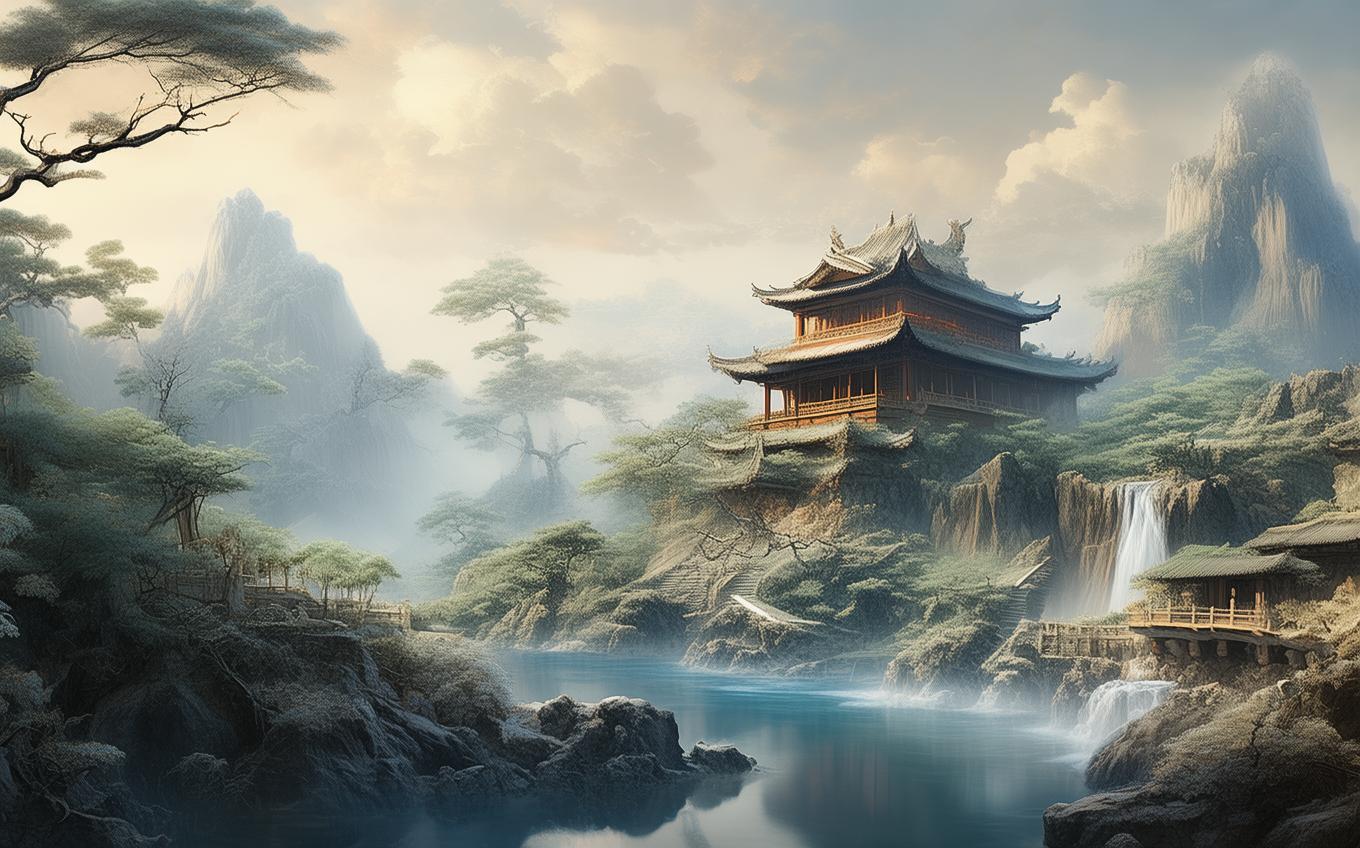
“绮观连鸡岫,朱楼接雁池.” A landscape description filled with elaborate architecture. “Rooster Peaks” and “Wild Goose Pond” are likely real places around Wugong, but the pairing of birds with ornamented buildings creates a sense of harmonious integration between human artistry and nature—a hallmark of Tang garden aesthetics. The opulence also reminds us that the imperial presence has transformed this once-ordinary place.
“从来敦棣萼,今此茂荆枝.” The “calyx of the cherry tree” (棣萼) is a traditional metaphor for brotherly love, drawn from the Book of Songs. Xuanzong emphasizes familial harmony, a crucial value for an imperial clan often torn by fratricidal strife. “Thorny branches” (荆枝) represent the hardy, persistent growth of his family line. The contrast is gentle: from soft blossoms of brotherhood to the sturdy, albeit prickly, continuity of the dynasty.
“万叶传余庆,千年志不移.” Here the poem ascends to a grand vision. “Ten thousand leaves” means future generations, and “surplus blessings” (余庆) is a Confucian concept: the accumulated goodness of ancestors extends to descendants. The emperor declares his unwavering resolve for a thousand years—a hyperbolic but sincere commitment to dynastic perpetuation. This couplet transforms personal nostalgia into a prayer for eternal stability.
“凭轩聊属目,轻辇共追随.” The scene shifts back to the immediate moment. Leaning on the railing, the emperor scans the horizon. The “light carriage” joining the retinue suggests an ease that contrasts with the political weight of the preceding lines. There’s a breath of relief here, a fleeting moment of simple observation in the midst of a heavy ceremonial journey.
“务本方崇训,敦朴乃遗规.” Didactic couplets now enter. “To honor the fundamentals” refers to agriculture and root virtues—classical Chinese governance ideals. “Simplicity” is a legacy from the ancestors. Xuanzong is reminding himself and his court that the glories of the Tang are built on frugality and moral earnestness, a theme he reiterated in early edicts during his reign. The language is self-consciously instructive, almost a self-admonition.
“时康俗易变,德薄政难施.” A candid political observation. In times of peace, customs drift toward luxury and laxity; when the ruler’s personal virtue is deficient, good government becomes impossible. For an emperor presiding over a soon-to-be tumultuous era, these lines are laced with irony. They read as a prophetic anxiety, even if composed before the An Lushan catastrophe. They express the classic Confucian fear that moral decay leads to political collapse.
“迎驾来无定,登封事有期.” The irregularity of welcome ceremonies underscores the unpredictability of an emperor’s travels, yet the great Feng-sacrifice on Mount Tai—the highest ritual to Heaven—remains on the calendar. This juxtaposition pits the mundane chaos of daily governance against the ordered, timeless rhythm of dynastic ritual, a tension every ruler must manage.
“愿将书轨一,同奉圣明时.” The final couplet echoes Qin Shi Huang’s standardization of writing and wheel gauges, a historical symbol of unification. Xuanzong wishes for a realm where all is aligned under a sagacious ruler. The phrase “圣明时” (era of sagely brightness) is both a hope and a boast; it reflects the early period of his Kaiyuan reign, often seen as a golden age. The poem ends not with a personal sigh, but with an emperor’s grand administrative dream.
Themes and Symbolism
The dominant theme is nostalgia fused with political philosophy. The return to a birthplace is not merely sentimental; it becomes a re-affirmation of the moral and familial foundations that sustain the empire. A second theme is the ideal of virtuous rule. Xuanzong constantly contrasts external splendor (“vermillion towers”) with inner qualities like simplicity and brotherly love, suggesting that true power rests on ethical foundations.
Key symbols include:
- The old mansion and Blue Gate: humility of origin and legitimacy of ascent.
- Pei River and ford-crossing: historical continuity with the Han Dynasty, every emperor a new Liu Bang.
- Calyx and thorny branches: brotherly affection and enduring clan vitality.
- Surplus blessings: the Confucian family as moral capital, passed down through ages.
- Writing and carriage axles: political unity, the emperor’s ultimate aspiration.
Cultural Context
Emperor Xuanzong’s reign was both a cultural climax and a turning point. The poem likely dates from the prosperous Kaiyuan period (713–741), although a return to Wugong might have occurred later. The tension in the lines about “virtue thin” suggests an awareness of creeping decadence—ironic, given that later historians blamed his infatuation with consort Yang Guifei for the empire’s decline.
Culturally, the poem embodies the Tang ideal of the scholar-emperor: a ruler who wields political power but also participates in literary and philosophical discourse. It reflects core Confucian values—filial piety, ritual propriety, the primacy of agriculture, and the moral responsibility of the sovereign. Daoist traces appear in the effortless observation (“lean on the balustrade”), while the unification wish nods toward Legalist statecraft. This blending of ideologies is quintessentially Tang.
Conclusion
“重幸武功” is a miniature portrait of an emperor at a threshold—between memory and duty, private feeling and public awe. Xuanzong’s controlled, elegantly balanced couplets carry the weight of China’s highest office while still quivering with personal emotion. For the modern reader, the poem offers more than historical curiosity; it is a meditation on how leaders negotiate their origins and ambitions, and a reminder that even golden ages are fragile, built on the shifting ground of virtue and remembrance. Its enduring appeal lies in this honest complexity, rendered in verse that still shines like the vermilion towers it describes.


Comments (0)
No comments yet. Be the first to comment!