Analysis of "遼城望月" - Classical Chinese Poetry
Introduction
Among the many voices in classical Chinese poetry, few are as unexpected as that of Emperor Taizong of Tang (唐太宗, 598–649). A brilliant military strategist and one of China’s greatest rulers, Li Shimin was also a cultivated poet. His poem “遼城望月” (Gazing at the Moon from Liao City) was composed in 645 AD during his ambitious campaign against the kingdom of Goguryeo in the Liaodong region. While camped near what is now Liaoyang, the emperor turned his gaze to the moonlit sky and wove a poem that blends natural description with imperial symbolism. The piece is valued not only for its literary craft but also for the rare insight it offers into the mind of a conqueror-poet at a pivotal historical moment.
The Poem: Full Text and Translation
玄兔月初明,
Xuán tù yuè chū míng,
The dusky rabbit moon begins to brighten,
澄輝照遼碣。
Chéng huī zhào Liáo jié.
Clear radiance shines on the stelae of Liao.
映雲光暫隱,
Yìng yún guāng zàn yǐn,
Reflected in clouds, its light is briefly hidden,
隔樹花如綴。
Gé shù huā rú zhuì.
Through the trees, blossoms seem threaded like hanging gems.
魄滿桂枝圓,
Pò mǎn guì zhī yuán,
The moon-soul full, the cassia branches round,
輪虧鏡彩缺。
Lún kuī jìng cǎi quē.
The wheel wanes, the mirror’s colored gleam is broken.
臨城卻影散,
Lín chéng què yǐng sàn,
Approaching the city walls, its shadows scatter,
帶暈重圍結。
Dài yùn chóng wéi jié.
A halo forms, layer upon layer like besieging rings.
駐蹕俯九都,
Zhù bì fǔ jiǔ dū,
I halt the imperial carriage, gazing down on the Nine Capitals,
停觀妖氛滅。
Tíng guān yāo fēn miè.
I stand and watch the baleful miasma extinguished.
Line-by-Line Analysis
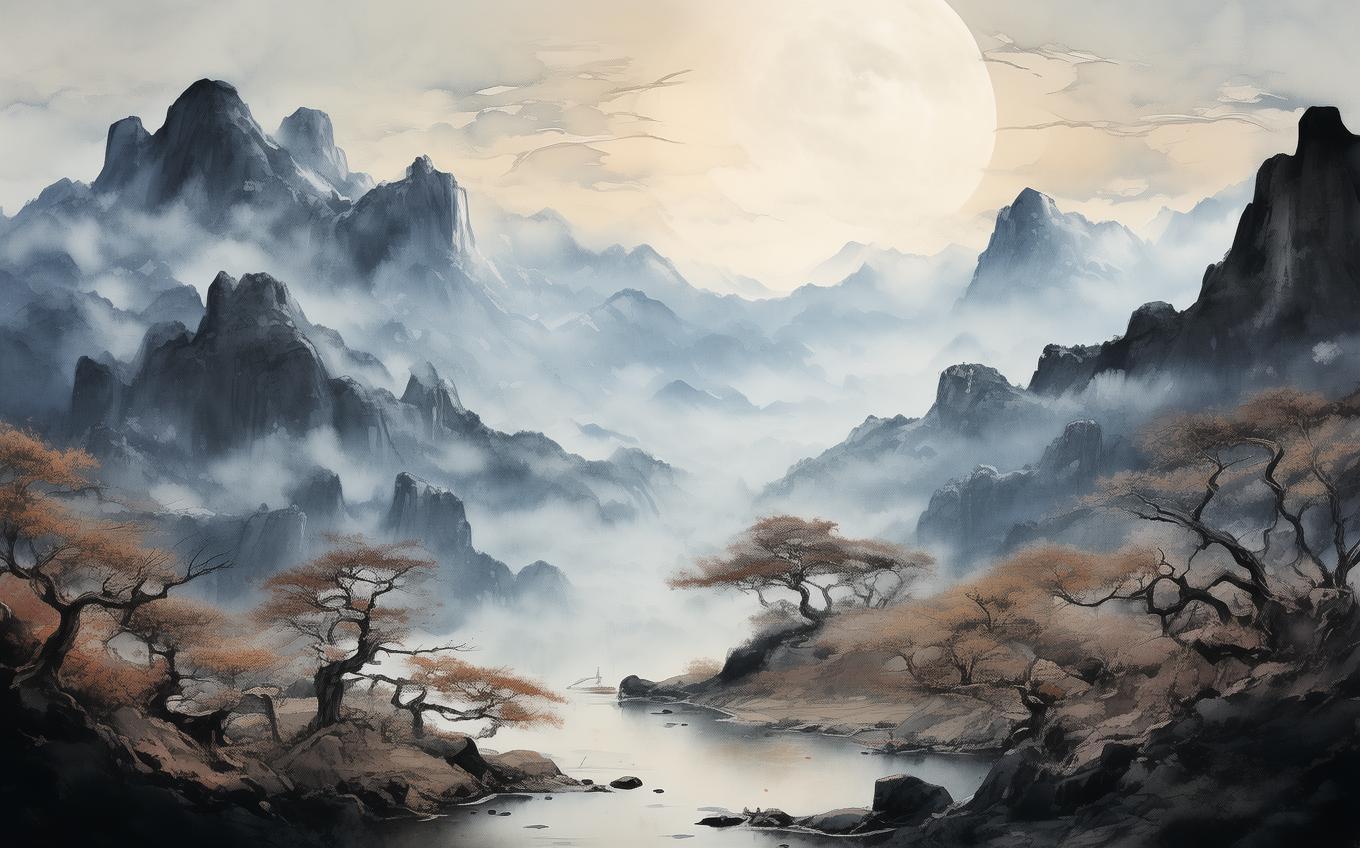
The opening couplet announces the moon with the elegant kenning “玄兔” (dusky rabbit), alluding to the mythological jade rabbit that dwells on the lunar surface. The word “初明” captures the moment the moon first sheds its clear brilliance over the landscape. “遼碣” – the ancient stone monuments of Liaodong – anchors the celestial in the geographic reality of the campaign. Through this juxtaposition, the emperor’s gaze transforms the frontier into a space touched by cosmic light.
The second couplet introduces movement. The moonlight “gets hidden for a moment” behind clouds and reappears, a gentle play of veiling and unveiling. The image of flowers seen through trees “like threaded ornaments” (如綴) presents nature as a delicately crafted tapestry. This intimate observation tempers the militaristic setting, suggesting that the emperor remains receptive to beauty even amid war.
The third couplet weaves lunar myth into the scene. In Chinese legend, a great cassia tree grows on the moon. When the moon is full, “魄滿桂枝圓” – the soul of the moon is complete, the cassia branches appear perfectly round. The very next line, however, speaks of the waning moon: “輪虧鏡彩缺” – the moon’s disc is incomplete, the mirror’s lustre broken. Together, the lines associate waxing with wholeness and power, and waning with fragmentation. For an emperor on a campaign, the full moon becomes a metaphor for a realm that must be made whole again, while the waning moon mirrors the current unrest on the frontier.
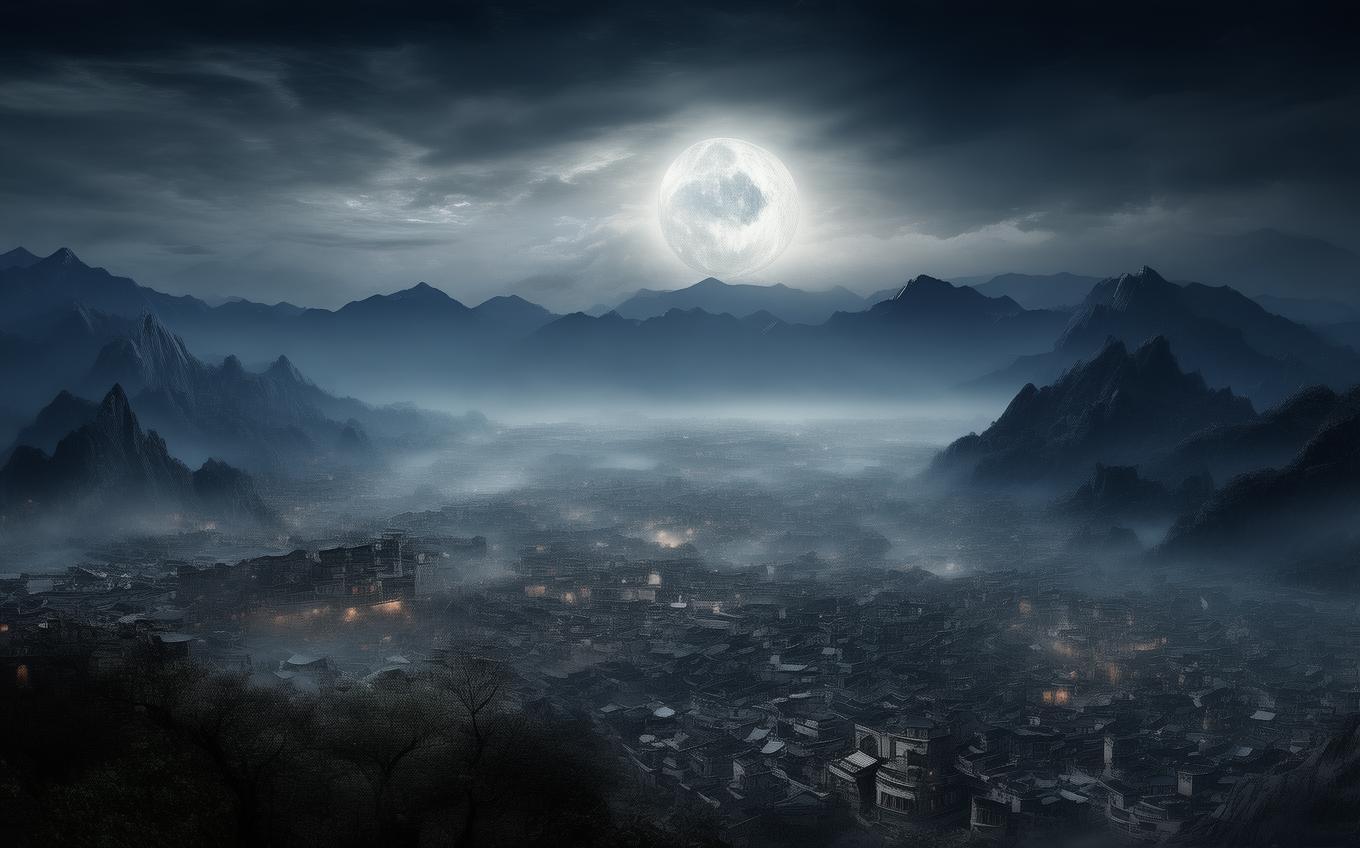
In the fourth couplet, the poem shifts from cosmic imagery back to the ground. “臨城卻影散” describes how shadows break apart as the moon nears the city ramparts – a subtle hint that imperial brightness disperses the darkness of the enemy. The “暈” (lunar halo) appears as “重圍結”, rings that encircle like layers of siege lines. This is perhaps the poem’s most audacious image: a natural phenomenon is recast as a celestial endorsement of the emperor’s military encirclement. The halo does not just happen; it actively mirrors the strategy of the Tang army.
The final couplet leaves no doubt about the political message. “駐蹕” refers to the halt of the imperial entourage, and from that height the emperor looks down upon “九都” – the Nine Capitals, a grand term for the Goguryeo strongholds. The “妖氛” (baleful miasma) is the rebel spirit that the emperor vows to extinguish. Under the clarity of the moon, the evil fog will be dissolved, and order restored. The poem thus concludes as a declaration of will, sealed by the testimony of the heavens.
Themes and Symbolism
At its core, “遼城望月” explores the intersection of natural beauty and imperial authority. The moon functions as a witness, a mirror of the state’s condition, and a symbol of the Son of Heaven’s mandate. Its phases – full and waning – embody the cycle of chaos and order. The lunar halo, ostensibly a meteorological curiosity, is infused with martial significance, becoming an omen of victory.
The poem also subtly meditates on perception. The emperor’s gaze moves from the expansive sky to the intricate details of flowers and shadows, then returns to a panoramic view of the enemy land. This shift mirrors the dual nature of leadership: the need to appreciate both the minute and the monumental. Nature does not simply provide a backdrop; it is recruited into the imperial project, its beauty co-opted to legitimize the campaign.
Cultural Context
The Tang dynasty (618–907) marked an apex of Chinese power and cultural confidence. Emperor Taizong’s 645 expedition against Goguryeo, though ultimately inconclusive, was part of a broader effort to stabilize the northeastern border and assert the centrality of the Tang in East Asia. Military campaigns were often accompanied by poetic composition, as verse served to express noble sentiment, record significant moments, and reinforce the ruler’s image as both a warrior and a sage.
In classical Chinese poetry, the moon is a perennial motif. Typically it is linked to homesickness, longing, or the passage of time. Taizong’s poem stands out exactly because it redirects this symbol toward statecraft. The “clear radiance” (澄輝) that illuminates Liao’s stelae is also the light of civilisation dispelling barbarian chaos – a powerful statement of the Confucian ideal that a virtuous ruler brings harmony to all under heaven.
Conclusion
“遼城望月” is far more than a moon-gazing vignette. It is a carefully orchestrated performance of imperial identity in verse. Taizong harnesses every detail – from the mythological rabbit to the halo around the moon – to project an image of destined triumph and cosmic order. The poem’s enduring appeal lies in its ability to merge delicate natural observation with unapologetic political ambition. Today, it remains a fascinating window into how a Tang emperor saw his world: a battlefield that was simultaneously a poem, where even the moon fought on his side.
Comments (0)
No comments yet. Be the first to comment!