Introduction
The poem “初晴落景” (Clear After Rain, Falling Scenery) was composed by Emperor Taizong of the Tang Dynasty (Tang Taizong, personal name Li Shimin, 598–649), one of the most revered rulers in Chinese history. More than a powerful statesman who consolidated the Tang Empire, Li Shimin was also an accomplished poet and calligrapher who helped usher in a golden age of Chinese arts and letters. This poem reflects the emperor’s refined sensibility, his delight in the natural world, and his aspiration for a mind that soars above worldly affairs. For lovers of Chinese culture and literature, “初晴落景” offers a rare glimpse into the inner life of a ruler who found solace and philosophical meaning in the tranquil beauty of a landscape after rain.
The Poem: Full Text and Translation
晚霞聊自怡,
Wǎn xiá liáo zì yí,
The evening glow idly brings me delight;
初晴弥可喜。
Chū qíng mí kě xǐ.
The clearing after rain is even more to be cherished.
日晃百花色,
Rì huǎng bǎi huā sè,
Sunlight brightens the hues of a hundred flowers;
风动千林翠。
Fēng dòng qiān lín cuì.
Wind stirs the emerald green of a thousand groves.
池鱼跃不同,
Chí yú yuè bù tóng,
Pond fish leap, each in its own way;
园鸟声还异。
Yuán niǎo shēng hái yì.
Garden birds sing, each with a different note.
寄言博通者,
Jì yán bó tōng zhě,
I send this message to those of broad learning and understanding;
知予物外志。
Zhī yǔ wù wài zhì.
They will recognize my aspiration beyond the world of things.
Line-by-Line Analysis
The poem opens with a relaxed, personal tone. “晚霞聊自怡” (The evening glow idly brings me delight) suggests a moment of leisurely contemplation. The word “聊” (liáo, idly, casually) indicates that the speaker is not forcing any profound feeling—he simply allows the beauty of the sunset clouds to please him. This spontaneous appreciation sets the scene for the transformative power of nature.
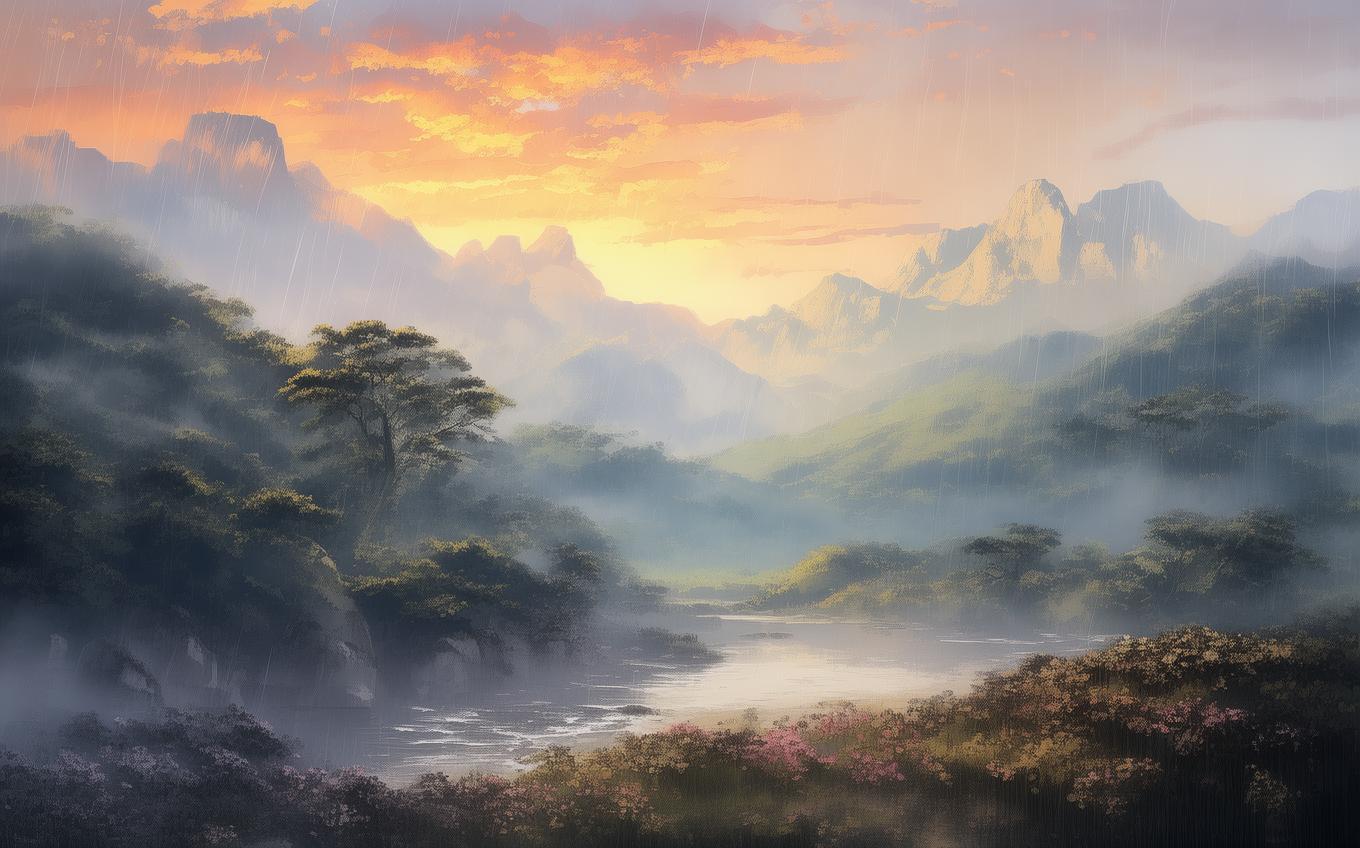
In the second line, “初晴弥可喜” (The clearing after rain is even more to be cherished), the poet compares two sources of pleasure: the evening glow is already a joy, but the fresh clarity that follows rain is even more delightful. The word “弥” (mí, even more) elevates this state. Rain-washed air, renewed brightness—this is a moment of pure sensory and spiritual refreshment. The pairing of “晚霞” and “初晴” also establishes a temporal frame: a single day moving from afternoon rain to evening clearing.
The next couplet shifts to a vivid visual tableau. “日晃百花色” (Sunlight brightens the hues of a hundred flowers) depicts sunlight playing on blossoms, intensifying their colors. The character “晃” (huǎng) suggests a shimmering, almost dazzling effect. “风动千林翠” (Wind stirs the emerald green of a thousand groves) complements the first line with motion and sound—wind rustling through lush foliage. The parallel construction “百花” (a hundred flowers) and “千林” (a thousand groves) is a classical hyperbole that conveys abundance and vastness. Together, these two lines capture a world teeming with vibrant life after the rain.
The third couplet turns to living creatures. “池鱼跃不同” (Pond fish leap, each in its own way) observes the varied, spontaneous movements of fish. “园鸟声还异” (Garden birds sing, each with a different note) hears the individuality in their calls. Here the emperor-poet reveals a keen eye and ear for the uniqueness of each creature. The repetition of “不同” (different) and “异” (different) underlines a Taoist-inflected appreciation of the natural world in its effortless diversity. There is no judgment—just delighted observation.
The final couplet is the philosophical heart of the poem. “寄言博通者” (I send this message to those of broad learning and understanding) directly addresses an imagined audience of cultivated minds. “博通者” are people who have studied widely and grasped the patterns of the world. “知予物外志” (They will recognize my aspiration beyond the world of things) uses the key phrase “物外” (beyond things, transcending the material). The poet claims a “志” (aspiration, will, ambition) that lies outside mundane concerns. For an emperor weighed down by affairs of state, this declaration is poignant: true fulfillment lies in contemplative harmony with nature, not in power or possessions.
Themes and Symbolism
The poem’s central themes are nature’s restorative power, spontaneity and individuality, and transcendence of the material world. The title “初晴落景” itself sets the tone—the interplay of clearing weather and settling evening evokes a liminal moment of beauty that will soon pass, urging the observer to cherish it fully.
Symbolically, the rain-clear skies represent a mind cleansed of worldly dust. The hundred flowers and thousand groves are not just botanical facts but emblems of natural profusion and the generative force of the Dao (the Way). The leaping fish and singing birds embody the ideal of living according to one’s own nature (ziran), a key concept in both Taoism and later Zen-influenced aesthetics. The “博通者” (broadly learned) is a stand-in for the ideal reader who shares the poet’s vision—one who sees that true wisdom lies in aligning with the cosmic pattern rather than in acquiring rank or riches. “物外志” (aspiration beyond things) echoes the ancient Chinese philosophical ideal of “游于物外” (roaming beyond the realm of things), a theme that appears in poets from Tao Qian to Wang Wei.
Cultural Context
Emperor Taizong ruled from 626 to 649 CE, a period known as the “Reign of Zhenguan,” often held up as a model of good governance and cultural efflorescence. Despite his demanding role as military strategist, law-giver, and administrator, Taizong was deeply immersed in literary pursuits. He gathered around him a court of distinguished scholars and poets, setting a standard for civil service examinations that valued literary skill. His own poetry blends Confucian self-cultivation with Taoist and Buddhist insights into emptiness and detachment.
In the Tang dynasty, poetry was the highest form of cultural expression, and even emperors were expected to master it. “初晴落景” is an example of “landscape poetry” (shanshui shi), which uses natural scenes to reflect inner states. The poem’s finale, with its address to kindred spirits, also reflects the Chinese tradition of “commiserating with those who understand” (zhiyin)—the belief that a true friend or reader will grasp what is left unsaid. For a ruler, such a poem was also a subtle form of self-presentation: the sovereign as a sage who values spiritual freedom over sensual pleasure or tyrannical control.
Conclusion
“初晴落景” endures because it distills a universal moment—a pause after rain when the world looks newly born—into a quiet manifesto for the examined life. Emperor Taizong’s concise, luminous lines remind us that beauty lies in the ordinary, that every creature has its own valid way, and that the most valuable ambition may be to rise above ambition itself. For the modern reader, this poem offers a gentle nudge to step outside the treadmill of daily concerns and rediscover the world with fresh eyes. It is a timeless invitation to roam beyond things, and to find, in a clearing sky, a mirror for the mind.
Comments (0)
No comments yet. Be the first to comment!